[ad_1]
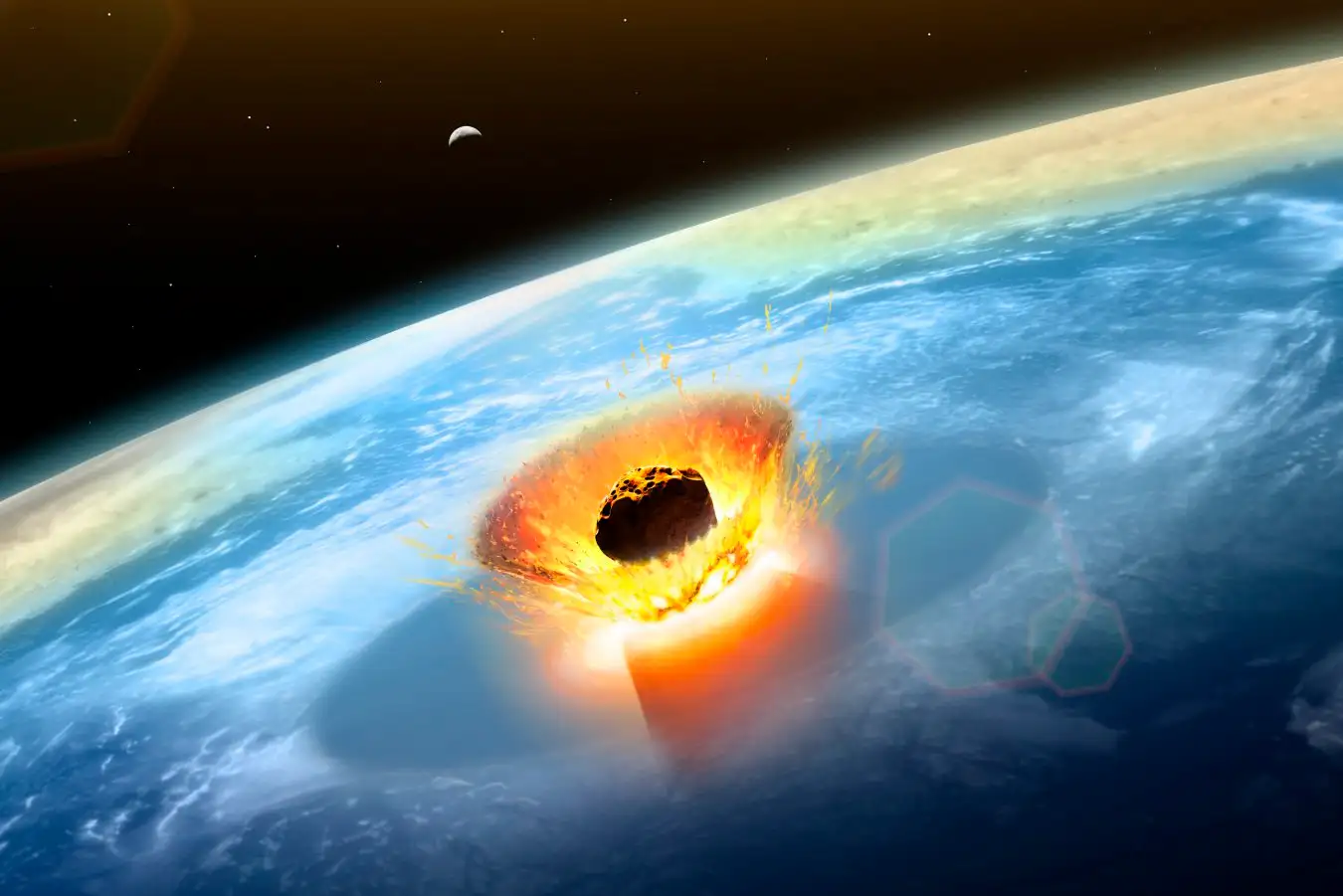
Illustration of the Chicxulub asteroid impact, which took place 66 million years ago
MARK GARLICK/Science Photo Library/Getty Images
The asteroid strike that wiped out the dinosaurs hit with such force that it took at least 8 million years for the impact site to cool down, creating a warm underground ecosystem where microscopic life thrived.
The Chicxulub asteroid, which collided with Earth 66 million years ago at what is now Mexico, is thought to have been as large as 15 kilometres in diameter. The strike caused so much climate chaos that it wiped out three-quarters of species on Earth. All the dinosaurs except the ancestors of birds became extinct and a nuclear winter gripped the planet for at least 15 years.
Its effects were also felt deep underground. “The Chicxulub impact was big enough to cause deformation at least 35 kilometres under the surface of the Earth, detectable using geophysical surveys,” says Annemarie Pickersgill at the University of Glasgow, UK.
The impact melted about 10,000 cubic kilometres of rock, she says. The combination of melted rock and seawater created porous material filled with tiny pockets of hot water, known as a hydrothermal system.
Because of the presence of minerals that only form where there is liquid water and heat, we know that the asteroid would have created hydrothermal environments to depths of several kilometres. But the scale and lifespan of the heating and resulting hydrothermal system has, it seems, been massively underestimated.
Previously, it was thought it took only 2 million years for the impact site to cool down. Now, Pickersgill and her colleagues say it may have taken at least four times longer, giving hydrothermal life much more time to thrive.
“One of the biggest unknowns about all impact-generated hydrothermal systems, and Chicxulub in particular, is how long the heat keeps water circulating through the structure,” says Pickersgill.
To figure this out, the team drilled 1 kilometre into the crater to obtain rock cores. Because potassium in the rocks has decayed into argon gas over time, the researchers could measure the amount of argon trapped in the samples to find out their age.
“We got a range of ages from the time of impact at 66 million years ago to about 58 million years ago,” says Pickersgill. “That told us that hydrothermal activity was ongoing in at least part of the Chicxulub structure for 8 million years after the impact.”
Sulphur isotopes in the cores provide evidence that microbial life existed in the hydrothermal system and recovered rapidly after the impact.
The results mean that the very earliest impact craters on the young Earth – and perhaps other worlds – may also have had habitable hydrothermal systems for longer than previously known.
“This provides more opportunity for life to develop, evolve and spread,” says Pickersgill. “It supports the concept that early life on Earth may have found a long-term home in impact craters, and possibly even life on other planets where these massive impact craters are dominant surface features.”
Chris Kirkland at Curtin University in Perth, Australia, says while there is “not an entirely unambiguous record of continuous hydrothermal activity” at Chicxulub, the evidence is strong that the impact site stayed hot for millions of years.
“Large impacts do not simply destroy environments,” he says. “They can also create long-lived underground systems where hot fluids circulate through shattered rock. These chemically rich settings may provide sheltered habitats for microbes and perhaps even favourable conditions for some of the early chemical steps towards life.”
Topics:
[ad_2]
Source link : https://www.newscientist.com/article/2529627-dinosaur-killing-asteroid-impact-site-stayed-hot-for-millions-of-years/?utm_campaign=RSS%7CNSNS&utm_source=NSNS&utm_medium=RSS&utm_content=home
Author :
Publish date : 2026-06-09 10:01:00
Copyright for syndicated content belongs to the linked Source.