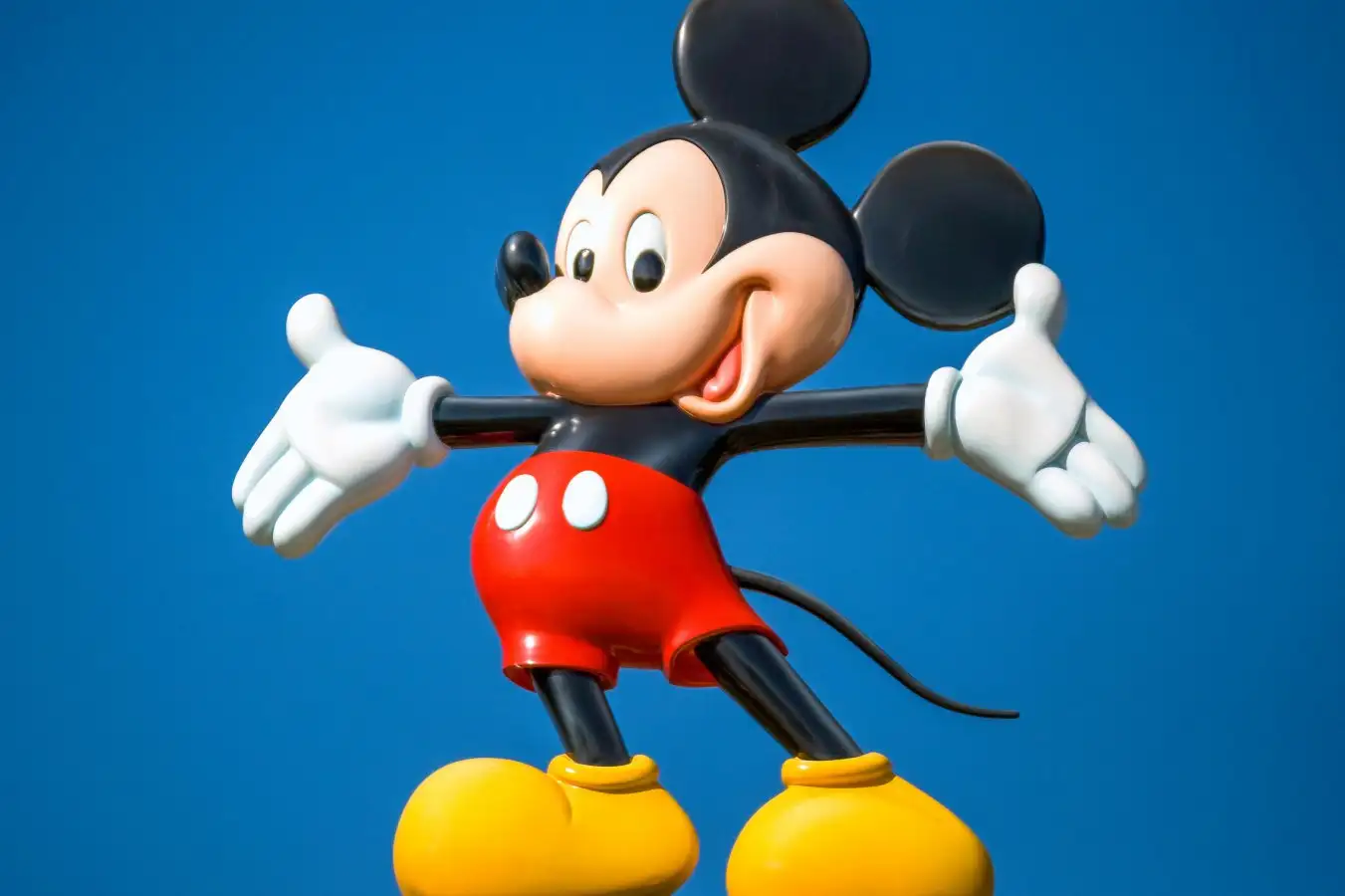
Disney’s famous Mickey Mouse character will soon be available for use in AI-generated videos
Greg Balfour Evans / Alamy
The world’s best-known AI company and the world’s best-known entertainment firm have come to a surprise agreement to allow AI versions of some of the most iconic characters in film, TV and cartoons to be used in generative AI videos and images. The deal may be a sign that major copyright holders see no way to hold back the flood of AI tools on the market.
The Walt Disney Company has signed a deal with OpenAI that will allow the AI firm’s Sora video generation tool and ChatGPT image creator to use more than 200 of Disney’s most iconic characters. Meanwhile, Disney remains in dispute with another AI firm, Midjourney, over alleged infringement of their intellectual property (IP), claiming Midjourney aims to “blatantly incorporate and copy Disney’s and Universal’s famous characters” into their image generating tool. The suit was seen as part of an indication that copyright holders were starting to more robustly defend their rights against AI firms’ unauthorised use – but some experts now believe the deal could be an indication Disney believes if you can’t beat AI companies, you should join them.
The characters now deemed fair game for OpenAI users include the likes of Mickey and Minnie Mouse, Simba and Mufasa from The Lion King and Moana, as well as Marvel and Lucasfilm characters, including some of Star Wars’s most well-known names. While it will be possible for users to create videos of those characters, the rights to their voices – many of which come from celebrities, such as Tom Hanks in the case of Woody from Toy Story – will not be permitted.
Users will be able to create those images and videos starting in early 2026. The licensing agreement lasts three years.
According to a statement released by both companies, the deal was agreed after OpenAI committed to implementing age-appropriate policies and “reasonable controls” to prevent underage users from accessing their products, as well as “robust controls to prevent the generation of illegal or harmful content, to respect the rights of content owners in relation to the outputs of models, and to respect the rights of individuals to appropriately control the use of their voice and likeness”.
For its part, Disney has agreed to take a $1 billion equity investment in OpenAI, and the option to purchase additional equity in the fast-growing AI firm. Some of the characters that can now be used by OpenAI tools are the same ones that Disney cited in its lawsuit against Midjourney.
“This is a great opportunity for the company to enable consumers to engage with our characters on what is probably the most modern of technology and media platforms today,” Disney CEO Bob Iger told CNBC. “OpenAI is both respecting and valuing our creativity.” Iger also said the growth of AI was “breathtaking”. In the same interview, OpenAI CEO Sam Altman said “people really want to connect with Disney characters and express creativity in new ways”.
Despite the warm words, the deal came as a shock to many. “I’m surprised, because Disney are famously protective of their brand,” says Catherine Flick at the University of Staffordshire, UK. The company has previously strongly defended its characters’ IP, including fighting to keep Mickey Mouse out of the public domain, says Rebecca Williams at the University of South Wales, UK.
However, others are less stunned by the deal. “It was clear that Disney didn’t want to attack the large tech companies like Google, OpenAI and Meta because they have always seen generative AI as something that can work in their favour,” says Andres Guadamuz at the University of Sussex, UK.
Guadamuz believes that the deal with OpenAI benefits Disney because of the potential it offers. “What I think will happen is that they will be using their extensive catalogue to train their own models,” he says, adding that it could be used within the animation process itself. Disney will reportedly become a “major customer” of OpenAI tools.
Williams worries the agreement is an indication of the general direction AI and copyright contests are heading. “It shows that companies like Disney appear to think that it’s impossible to stem the tide of AI,” she says. “Their strategy is to partner up with these types of companies in a bid to profit from use of their IP rather than having it stolen from them and used anyway.”
However, Ty Martin at licensing company Copyrightish believes other AI companies will start to meet licence holders halfway. “This is where 2026 is heading,” he says. “Licensing becomes the engine of quality. AI platforms with access to strong, recognisable IP will cut through the slop trough, while unlicensed or generic content is lost.”
Whether it’s a positive, proactive move or a defensive one born out of exasperation, the partnership depends on the agreement lasting the initial three-year term – and Flick believes it will only be a matter of time before the deal is abandoned. “There are going to be people that will use it in ways that Disney would not normally want their brand to be used,” she says.
Flick adds: “This will be a good test case to see what’s going to happen with the usage of this IP, and personally, I think it’s going to be an exercise in seeing how long [Disney] put up with people doing things that they’re not super comfortable with, with their IP.”
Topics:
- artificial intelligence/
- AI
Source link : https://www.newscientist.com/article/2508397-disney-and-openai-have-made-a-surprise-deal-what-happens-next/?utm_campaign=RSS%7CNSNS&utm_source=NSNS&utm_medium=RSS&utm_content=home
Author :
Publish date : 2025-12-11 17:25:00
Copyright for syndicated content belongs to the linked Source.