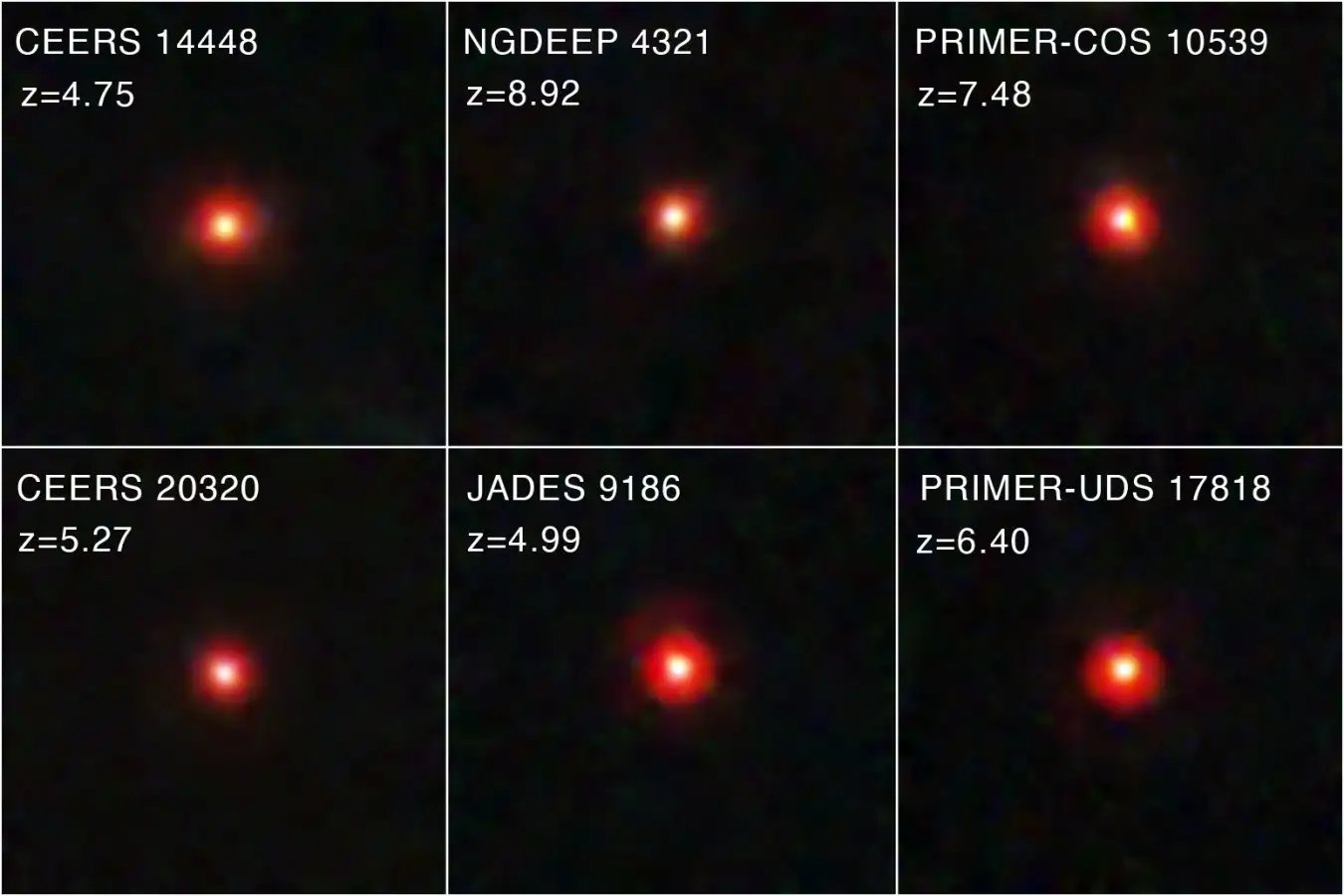
A collection of “little red dots” spotted by the James Webb Space Telescope
NASA, ESA, CSA, STScI, and D. Kocevski (Colby U.)/Space Telescope Science Institute Office of Public Outreach
Impossibly bright galaxies discovered by the James Webb Space Telescope (JWST) may not be so bright after all. These galaxies once threatened to upend our understanding of the cosmos by suggesting it contained monstrous black holes or far more stars than we had anticipated, but astronomers now think the galaxies might actually contain “baby” black holes instead.
In its first few years scanning the early universe, JWST unexpectedly discovered hundreds of very red and extremely bright galaxies, which astronomers called “little red dots” (LRDs).
The amount of light coming from these galaxies suggested that they contained either a density of stars that was far greater than any galaxy we know of, and which would be difficult to square with the mass of the universe that we expect, or black holes that were far more massive than astronomers thought possible given the size of their host galaxies.
Both of these scenarios would have required significant adjustments to our models of galaxy formation and black hole growth in the early universe.
But these conclusions also rested on the assumption that the LRDs’ red colour was due to an abundance of dust, either around the black hole itself or surrounding the stars, because that is what is typically found in the very red galaxies of our local universe. Recently, that idea has been questioned, after researchers found a lack of evidence that LRDs contain dust after all.
Jenny Greene at Princeton University and her colleagues think that this finding means we need to reconceive what LRDs are. “We were sure that we could detect the dust emission, if indeed they were red because of dust, and then we did not find that emission at all,” says Greene. “That was the big clue that our assumption that they’re dusty is just wrong, that’s not why they’re red.”
Previous observations had inferred the total brightness of LRDs by measuring a specific single frequency of light, associated with the element hydrogen, which can then be used to calculate the total brightness, based on typical models of how dust affects this light.
In a new analysis, Greene and her team directly measured the total light emissions from two LRD galaxies by looking at many different frequencies of light, including X-rays and infrared. They found that for most frequencies, apart from visible light, there was much less light being emitted than for typical galaxies, suggesting that the LRDs were at least ten times dimmer than initial estimates suggested. This finding has implications for the black holes inside the LRDs.
“If there’s actually not as much light there as we thought, the black hole masses are probably much more modest,” says Greene. “Then they don’t have to be that over-massive, and we don’t have to have too much mass in black holes at early times, so it really alleviates a lot of the tension that was perplexing us.”
Because the light emissions suggest the black holes contain relatively little mass compared to standard black holes, team member Rohan Naidu at the Massachusetts Institute of Technology says we can think of them as “baby black holes.” He adds that this also fits with an emerging picture that the black holes in the LRDs are actually black hole stars – a special class of black hole surrounded by gas.
“In ordinary black holes, what you actually see with your eyes is the tip of the iceberg of the total energy that is coming out of the system, but the little red dots we now understand should really be thought of as these puffed-up black hole stars,” says Naidu. “It seems that most of their energy is coming out at these wavelengths that we see with our eyes, so what you see is what you get.”
But Roberto Maiolino at the University of Cambridge says that we can’t be sure about the masses of black holes in the LRDs, because the light being emitted from a black hole tells us about its rate of growth, not about its total mass.
Greene argues that the baby black hole idea is valid. “If there’s far fewer photons [being emitted], it means that the whole mass scale shifts down,” says Greene. “On average, they are lower mass than we thought when we incorrectly assumed that it was a normal accreting black hole buried by dust.”
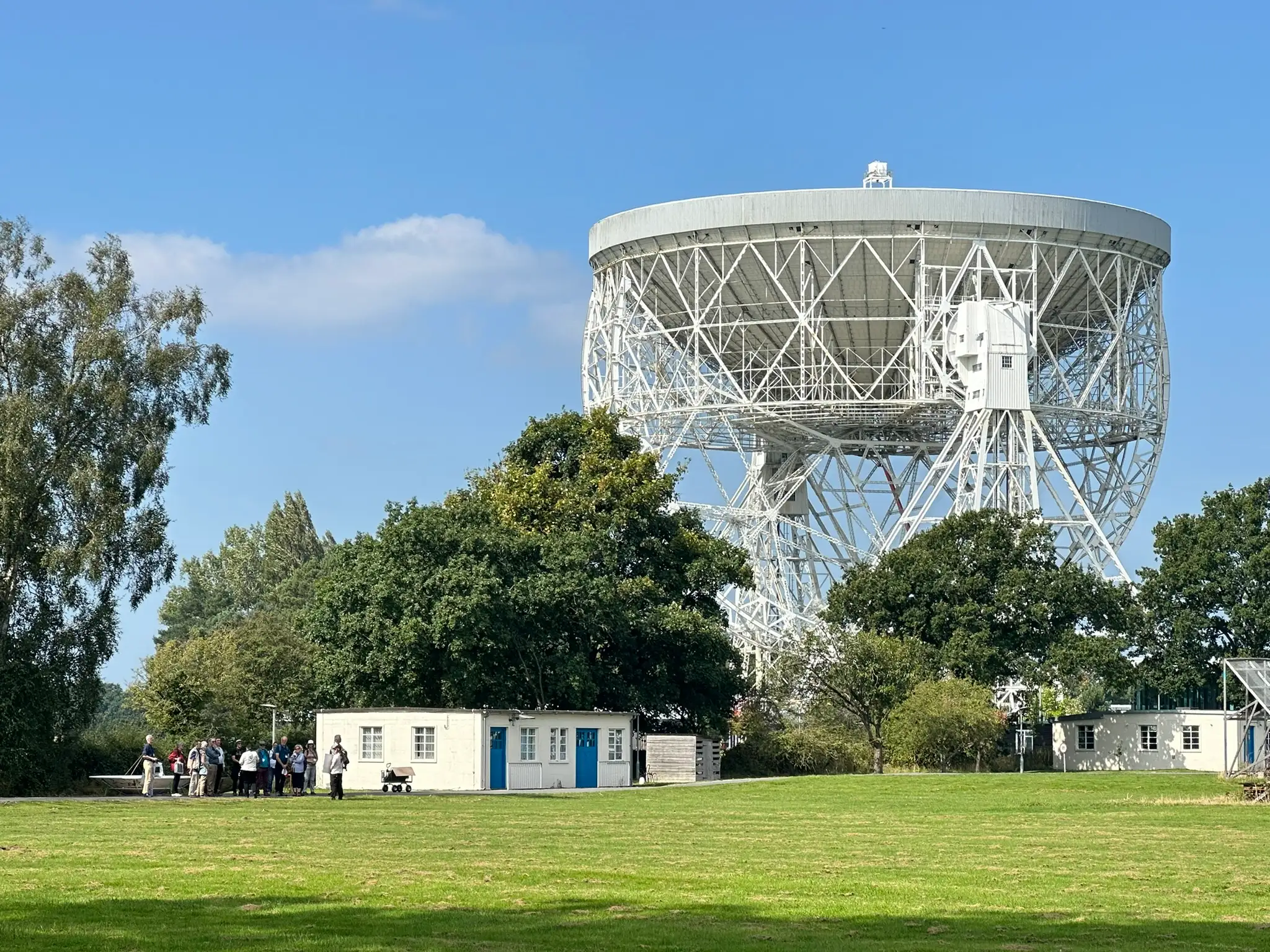
Mysteries of the universe: Cheshire, England
Spend a weekend with some of the brightest minds in science, as you explore the mysteries of the universe in an exciting programme that includes an excursion to see the iconic Lovell Telescope.
Topics:
Source link : https://www.newscientist.com/article/2511576-distant-little-red-dot-galaxies-may-contain-baby-black-holes/?utm_campaign=RSS%7CNSNS&utm_source=NSNS&utm_medium=RSS&utm_content=home
Author :
Publish date : 2026-01-15 18:00:00
Copyright for syndicated content belongs to the linked Source.