
[ad_1]
The DESTINY-Breast09 trial, presented at this year’s American Society of Clinical Oncology annual meeting, established trastuzumab deruxtecan (T-DXd; Enhertu) plus pertuzumab (Perjeta) as a new first-line treatment option for patients with HER2-positive metastatic breast cancer, while raising new questions about patient selection and treatment duration.
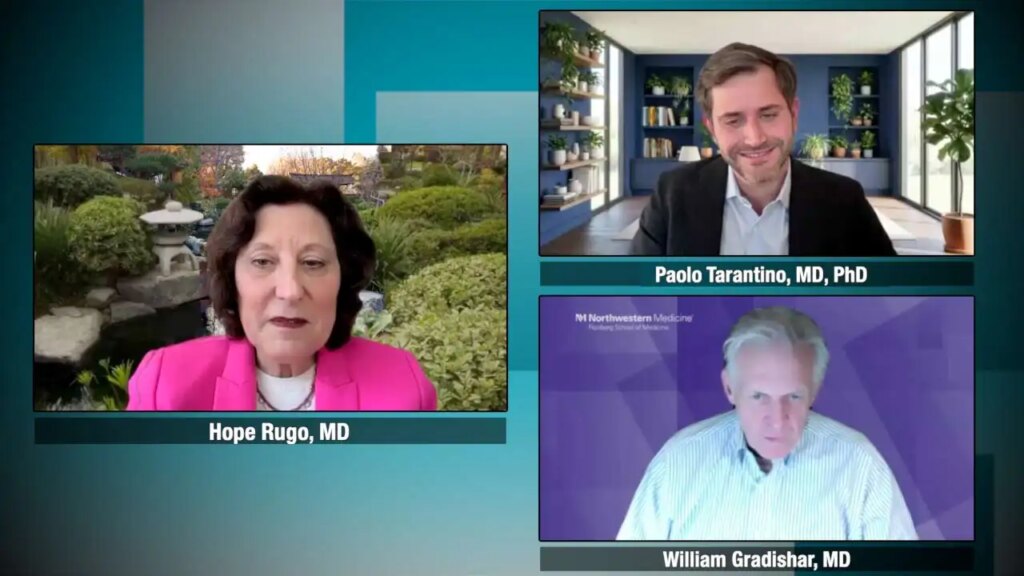
MedPage Today brought together three expert leaders in the field: Moderator Hope S. Rugo, MD, of the City of Hope Comprehensive Cancer Center in Duarte, California, is joined by William J. Gradishar, MD, of Northwestern University Feinberg School of Medicine in Chicago, and Paolo Tarantino, MD, PhD, of Dana-Farber Cancer Institute in Boston, for a virtual roundtable discussion. In this fourth and final exclusive episode, the panel discusses which patients are most likely to benefit from the DESTINY-Breast09 regimen, whether traditional first-line approaches still have a role, and how long T-DXd should be continued in clinical practice.
Click here to watch the other videos from this series.
Following is a transcript of their remarks:
Rugo: DB-09, do you think we should always start with T-DXd now with metastatic HER2-positive disease where you didn’t just give it?
Tarantino: I never liked the word “always.” I think in oncology, very rarely the word “always” applies and I think this is one of those cases. I don’t think that the CLEOPATRA approach is dead. I think that clearly DB-09 is the most effective approach. And so if you have a patient where you can afford to use the most effective approach, young, fit patients, where you’re really thinking about trying to maximize long-term outcomes, you do want to start with T-DXd/pertuzumab, particularly in high-risk scenarios, brain metastases, visceral metastases, recurrent disease, PIK3CA-mutant disease, or even patients with ER [estrogen receptor]-negative disease where we don’t have the option of endocrine therapy and palbo [palbociclib (Ibrance)].
But then there are selected patients instead that have more indolent disease, de novo, ER-positive, no visceral mets [metastases]. There, I think that giving just a few months of taxane and moving to PATINA totally makes sense. Albeit with the caveat that you want to tell the patient that there is another option that is more effective and we don’t know if we could cure more patients with the DB-09 approach. And so I think it’s something worth discussing with the patient, but remembering that we have options. And then the big, big question is for how long to give T-DXd/pertuzumab? And I leave this question to Bill.
Rugo: My question is, you use T-DXd as induction. How long are you treating for and then what?
Gradishar: Well, that’s a good question. So the argument might be that obviously if they were ER-positive at some point, maybe after you got maximal response, pivoting to a PATINA-like regimen and stopping the T-DXd, give them HP [trastuzumab (Herceptin) and pertuzumab] and optimal endocrine therapy with the CDK4/6 inhibitor. In some ways that’s kind of easy. That one’s easier. It’s the patients who aren’t ER-positive. How long do you keep flogging away?
Particularly if they reach a point where they have stable disease clinically, it’s not melted away completely, it’s not doing anything. Do you just keep flogging away or do you switch them at that point to something else? And your decision’s going to be obviously tempered a little bit by the patient’s tolerance to the treatment.
The data that was presented looking at depth of PRs [partial responses], it was interesting because if you push it, even if you didn’t get a CR [complete response], but you were getting closer and closer, patients seemed to do better. Their duration on therapy was longer. The time until they progress was longer. So there is an argument for pushing a little bit, not just having a finite number of cycles of therapy. So I would consider that looking at something like that in patients who don’t have ER-positive disease.
Rugo: Yeah. I mean, it seems like the tucatinib [Tukysa] data that was presented also I think is quite intriguing. So it seems to work in different settings. So it didn’t work as well in ER-positive as in ER-negative disease, but I think you may be able to prevent, you know, one of the really hard areas of progression in patients who are on maintenance therapies is in brain. So maybe we could see that delayed.
And I hope with this approach, T-DXd induction and maintenance for the right patients, as Paolo pointed out, that we might cure more women with metastatic disease because we already cure a small percentage with our current approaches. So I think it is really interesting. It’s just there’s not a one size fits all, and that’s a very important point that you made, Paolo, and I think it’s important for our listeners also.
Please enable JavaScript to view the comments powered by Disqus.
[ad_2]
Source link : https://www.medpagetoday.com/meetingcoverage/ascoexpertroundtablebreastca/121986
Author :
Publish date : 2026-06-30 16:10:00
Copyright for syndicated content belongs to the linked Source.