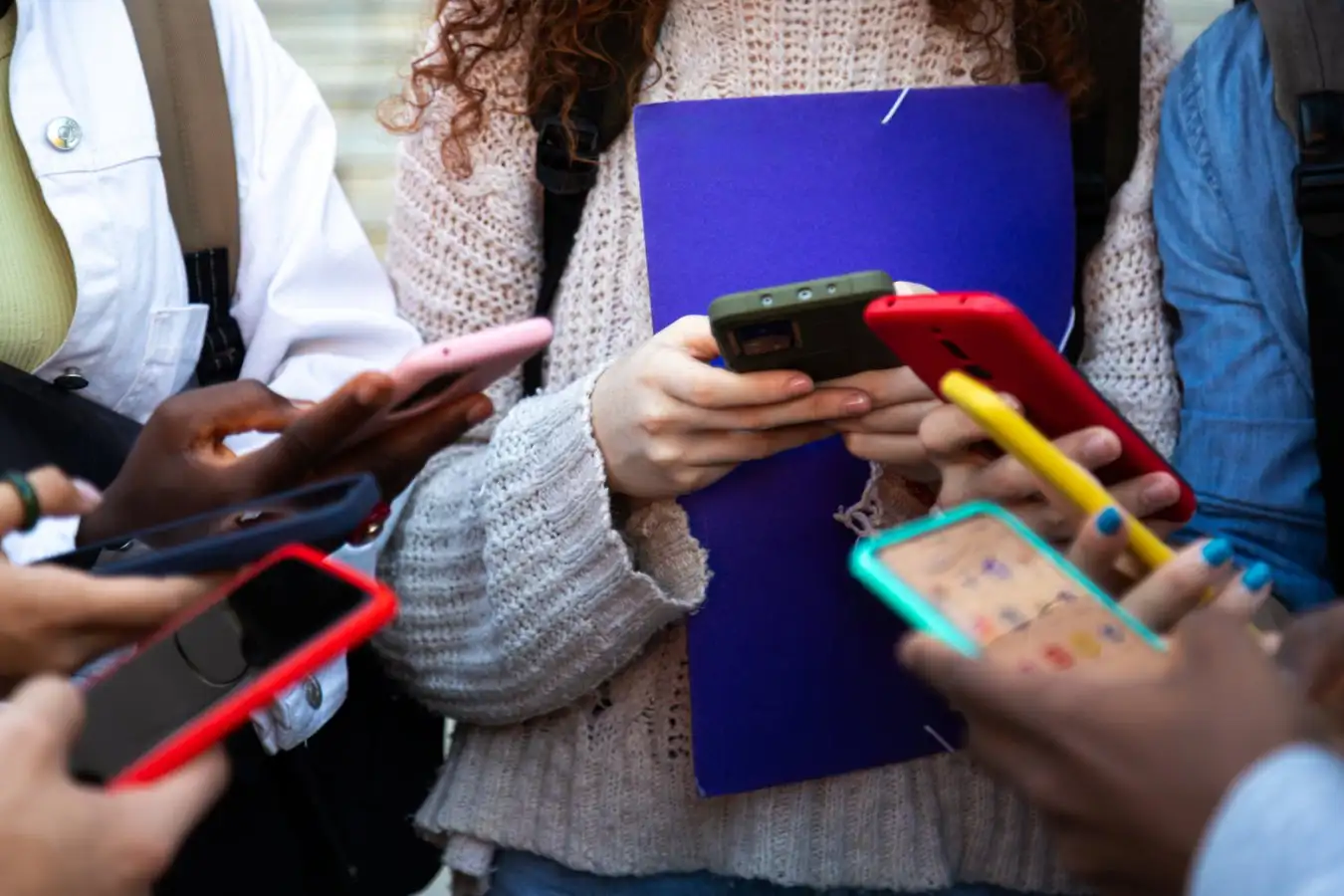
Teens taking part in a trial that limits their social media use will soon be forced to connect IRL
Daniel de la Hoz/Getty Images
A world-first study will test whether reducing the time teenagers spend on social media really does improve their mental health. But the results aren’t due until mid-2027, by which time further governments may have already imposed out-and-out bans on social media for teens.
The trial won’t tell us whether such bans are worthwhile; robust evidence for this is lacking, yet Australia has already implemented one for under-16s, and the UK government is launching a consultation on a similar move.
What the trial does do is centre the young people themselves, including consulting them on the intervention that would be tested. To date, children and teenagers have been shut out of the design of social media and the discussions around managing it.
“Children absolutely have to be part of this conversation,” says Pete Etchells at Bath Spa University in the UK, who isn’t involved in the study.
“There is a range of evidence that social media is harming individual children and adolescents, including very severe harms,” says Amy Orben at the University of Cambridge, who is co-leader of the trial. What is less clear, she says, is “whether the time spent on social media impacts the wider population of young people”.
Answering this requires large-scale controlled research, so Orben and her colleagues are launching The IRL Trial in Bradford, UK. The aim is to recruit about 4000 12-to-15-year-olds from 10 schools. All the participants will install a bespoke app on their phones that tracks their social media use.
For half of them, the app will also restrict their time on selected social media apps, including TikTok, Instagram and YouTube, but not messaging apps like WhatsApp. “They can only use all of those apps together for a total of one hour, and they also have a nighttime curfew where they can’t use it… between 9pm and 7am,” says Dan Lewer at the Bradford Centre for Health Data Science, who is also co-leader of the trial. This represents a significant cut, he says. “The average daily screen time in this age group, 12-to-15-year-olds, is around 3 hours per day,” says Lewer. The other half of the teens will be able to continue using social media as normal.
Crucially, the kids will be randomised by year group, meaning that in a given school, year 8 might be the control group, while year 9 has their social media use restricted. The aim is to ensure that groups of children experience the same conditions as much as possible. “If you removed or reduced social media use in one child, but their friendship group was still online after 9pm, then they might feel like they’re missing out,” says Orben.
Lewer says the study was designed in collaboration with the teenagers. “They didn’t want us to test a total ban,” he says.
The full-scale study will run for six weeks around October, and the researchers anticipate publishing their first results in mid-2027.
The trial should provide more accurate information than we currently have on how much teens use social media and when, because this will be monitored via the app, rather than relying on self-reporting, says Orben. The team will also collect data on anxiety, sleep quality, time spent with friends and family, well-being, body image, social comparison, school absences and bullying.
It is crucial to learn if restricting or banning social media will help or harm young people, says Etchells. “The honest answer is that we don’t know, and that’s why studies like this are so important.”
But the sheer lack of good-quality research to date makes this trial very welcome. This was underscored by a recent report from the UK’s Department of Science, Innovation and Technology, which highlighted “the lack of high-quality causal evidence linking children’s mental health and wellbeing and their use of digital technologies, specifically, social media, smartphones and AI chatbots”.
It is crucial to work with young people when researching social media, says Margarita Panayiotou at the University of Manchester, UK. For instance, the choice to test restrictions rather than a full ban is more workable, she says, because teens in the studies she has done readily described how they would circumvent such bans. This approach may also be more ethical, because we don’t know if bans would cause harm, she says.
“[Teens] find social media a useful space to understand themselves,” says Panayiotou. But that doesn’t mean that young people don’t also see its drawbacks. “They also talk about mistrusting the platforms themselves” and about “loss of control… they’ll find themselves on social media without realising”. Adolescents have also reported issues such as a fear of being judged online, as well as body comparisons and cyberbullying.
The challenge for governments, say Etchells and Panayiotou, is to force tech companies to make social media safer and healthier for young people.
The Online Safety Act 2023 (OSA) has provisions requiring tech companies like TikTok, Meta – the parent company of Facebook, WhatsApp and Instagram – and Google – which owns YouTube – to take more responsibility for users’ safety. “If the compliance elements of the OSA were actually properly enforced, I think that would go some way to solving some of the issues that we have already,” says Etchells.
Topics:
- mental health/
- social media
Source link : https://www.newscientist.com/article/2512910-does-limiting-social-media-help-teens-well-finally-get-some-evidence/?utm_campaign=RSS%7CNSNS&utm_source=NSNS&utm_medium=RSS&utm_content=home
Author :
Publish date : 2026-01-22 12:05:00
Copyright for syndicated content belongs to the linked Source.