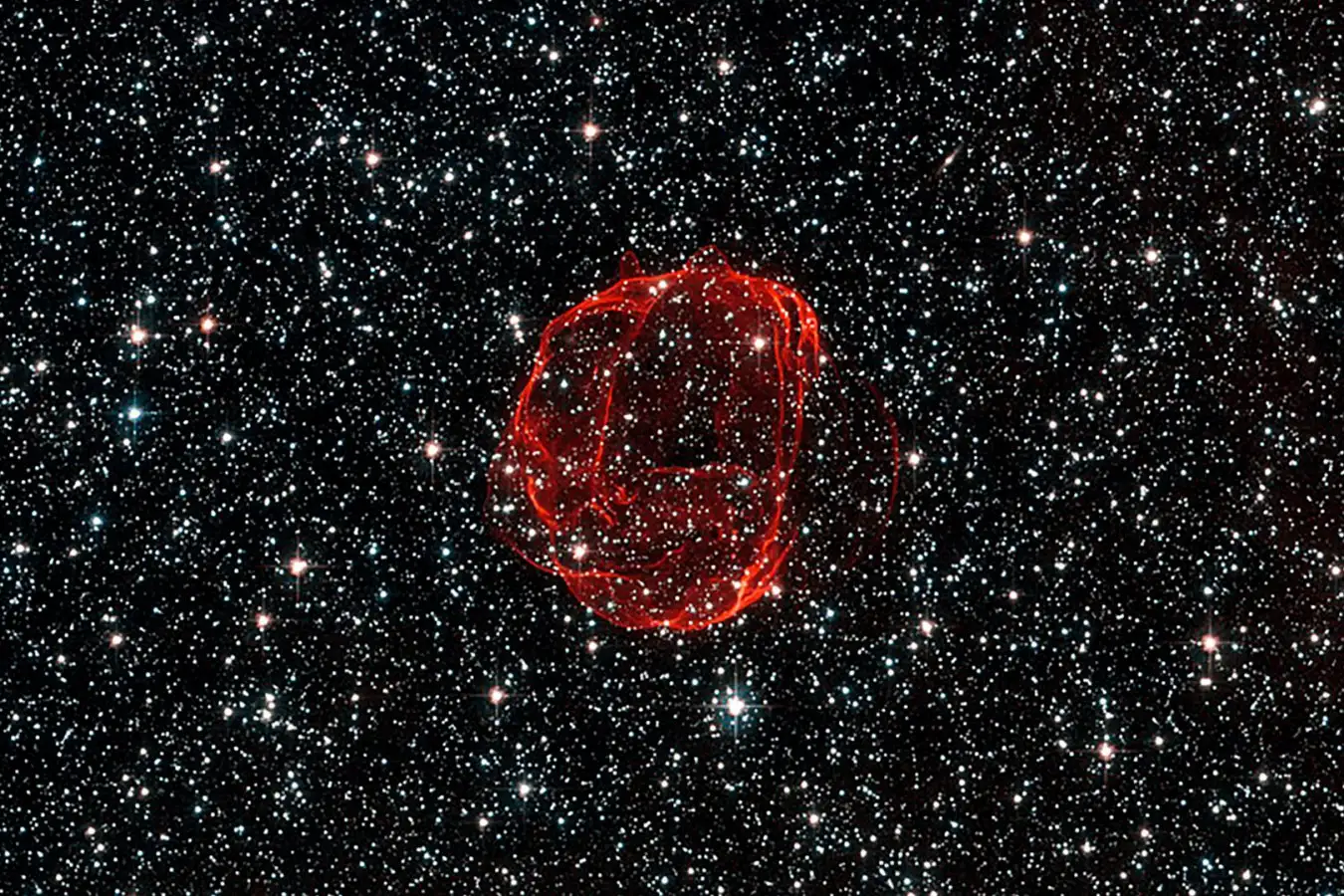
SNR 0519, the remnant of a supernova that exploded about 600 years ago
Claude Cornen/ESA/Hubble & NASA
Earth may owe some of its properties to a nearby star that blew up just as the solar system was forming. This pattern, which saw a supernova bubble envelop the sun and shower it with cosmic rays, may be ubiquitous across the galaxy – implying there could be a far greater number of Earth-like planets than previously thought.
We know, thanks to ancient meteorite samples, that the solar system used to be filled with heat-producing radioactive elements that quickly decayed. The heat from these elements drove off large amounts of water from the space rocks and comets that came together to form Earth, ensuring the planet had the right amount of water for life to later develop.
It is unclear, however, how these elements reached the solar system. Many of them are commonly found in supernova explosions, but simulations of close-by supernovae have struggled to produce the exact ratios of radioactive elements inferred from meteorite samples to have been present in the early solar system. One problem is that these nearby blasts may also have been so powerful that they would have blown apart the fragile early solar system before any planets had formed.
Now, Ryo Sawada at the University of Tokyo in Japan and his colleagues have found that a supernova could have provided the necessary radioactive ingredients for Earth without upsetting the planet formation process, as long as it was slightly further away.
In their model, a supernova that is around 3 light years from the solar system could produce the required radioactive elements in a two-stage process. Some, such as radioactive aluminium and manganese, would be produced directly in the supernova and then travel on shock waves from the exploded star to reach the solar system.
Then, high-energy particles called cosmic rays emanating from the supernova would follow behind these shock waves and hit other atoms in the solar system’s still-forming disc of gas, dust and rocks, a process that would produce the remaining radioactive elements needed, such as beryllium and calcium. “Previous models of solar system formation focused only on the injection of matter. I realised we were ignoring the high-energy particles,” says Sawada. “I thought, ‘What if the young solar system was simply engulfed in this particle bath?’”
Because this process works with a supernova that is further away than previous studies, Sawada and his team estimate that between 10 to 50 per cent of sun-like star and planetary systems could have been seeded with radioactive elements in this way and produced planets with Earth-like abundances of water. For previous models, with close-by supernovae, being hit was “like winning the lottery”, says Sawada. But moving the supernova further away implies that “the recipe for Earth is likely not a rare accident, but a universal process happening all over the galaxy,” he says.
“It’s quite novel, because it’s a fine balance between destruction and creation,” says Cosimo Inserra at Cardiff University, UK. “You need the right elements and the right distance.”
If this mechanism is correct, it could help guide future searches for Earth-like planets by planned telescopes like NASA’s Habitable Worlds Observatory, by looking for traces of ancient supernovae and finding star systems that were close to them at the time, says Inserra.
Science Advances
DOI: 10.1126/sciadv.adx7892
Topics:
Source link : https://www.newscientist.com/article/2507758-earth-and-solar-system-may-have-been-shaped-by-nearby-exploding-star/?utm_campaign=RSS%7CNSNS&utm_source=NSNS&utm_medium=RSS&utm_content=home
Author :
Publish date : 2025-12-11 10:00:00
Copyright for syndicated content belongs to the linked Source.