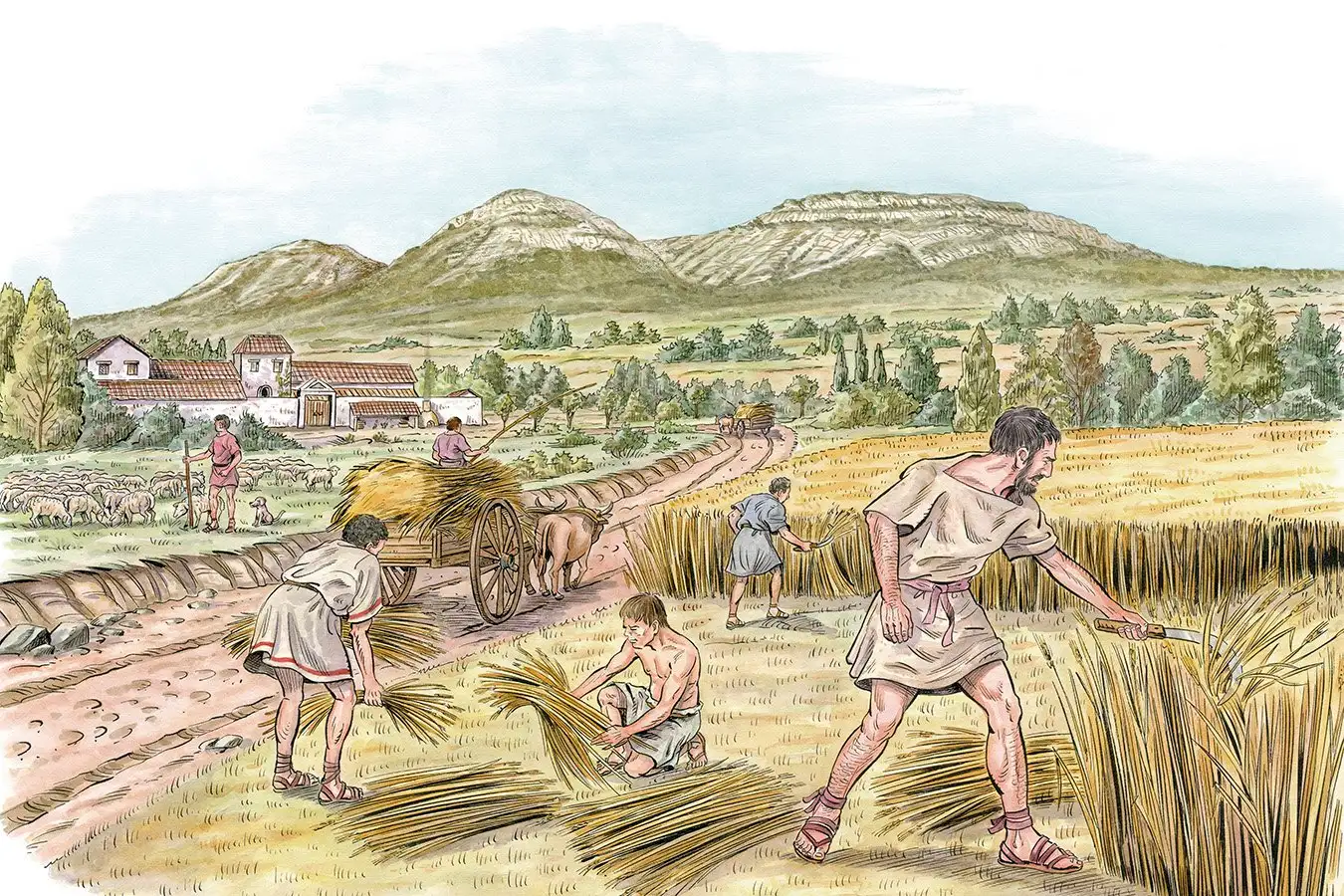
Cereal farming produced excess food that could be stored and taxed
LUIS MONTANYA/MARTA MONTANYA/SCIENCE PHOTO LIBRARY
The cultivation of cereal grains probably led to the emergence of the first states – which operated mafia-like protection rackets − and to the adoption of writing for the purposes of recording taxes.
There is wide debate over how the first large human societies emerged. Some scholars see agriculture as the root of civilisation, while others see it as an invention born of necessity when the traditional hunter-gathering life became untenable. But many propose that the intensification of agriculture provided a surplus which could be stored and taxed, and that this enabled the formation of states.
“By using fertilisation and irrigation, [early farming societies] could hugely increase the output and, therefore, there was this surplus that was available for the construction of the state,” says Kit Opie at the University of Bristol, UK.
However, the timeline for these developments doesn’t quite match up. Our first evidence of agriculture popping up is from about 9000 years ago, and it was invented at least 11 separate times on four continents. But large-scale societies didn’t emerge until about 4000 years later, first in Mesopotamia, then in Egypt, China and Mesoamerica.
To look for more evidence, Opie and Quentin Atkinson at the University of Auckland in New Zealand turned to a set of family trees mapping out the evolution of the world’s languages, representing the relationships between cultures, and borrowed statistical methods from phylogenetics, the study of evolutionary relationships.
The pair used the language data in conjunction with information from anthropological databases on hundreds of pre-industrial societies to assess the probability that events such as the emergence of a state, taxation, writing, intense agriculture and the cultivation of cereal grains emerged in a specific order.
They found that the use of intensive agriculture was indeed coupled with the emergence of states, but the relationship wasn’t straightforward. “It looked more likely that it was the states causing the intensification, rather than the intensification causing the states,” says Opie.
A previous study of Austronesian societies also found that political complexity was more likely to have driven intensive agriculture than to have been a result of it.
“It makes sense that once you’ve got a state with money and people at its disposal, it can start doing irrigation,” says Opie.
But he and Atkinson also found that states were very unlikely to emerge in societies that didn’t already have widespread production of cereal grains such as wheat, barley, rice and maize, whereas they were very likely to emerge in societies with cereal grains as their main crop.
The results show that grain production and taxation were often associated, and taxation was less likely to arise in societies without grain.
This is because cereal grains have great taxable potential, says Opie. They can be easily assessed because they are grown in fixed fields, above ground, ripen at predictable times and can be stored for long periods. “Root crops like cassava or potatoes were hopeless for taxation,” he says. “The argument is that states, or protection rackets, would defend these fields from external states in exchange for tax.”
When it came to writing, Opie and Atkinson found that the practice was very unlikely to be adopted in societies without a tax system but very likely in those that did have one. Opie suggests that writing was invented and adopted to record those taxes. The elites of societies who raked in the taxes then created institutions and laws, maintaining the emerging hierarchical social structure.
The results also indicate that once formed, states were more likely to stop producing non-grain crops than non-states. “I would argue that we find strong evidence that they actually got rid of roots, tubers and fruit trees so that all the possible fields could be used for grain because none of the other things were good for taxation,” says Opie. “People were forced into using these kinds of crops, and it had a bad effect on us and, I would argue, still does.”
Although the move towards cereal cultivation was associated with a population boost in the Neolithic period, it also led to a decline in overall health, height and dental health.
“Applying phylogenetic methods to cultural evolution is innovative, but it may oversimplify the complexity of human history,” says Laura Dietrich at the Austrian Archaeological Institute in Vienna. Archaeological evidence shows that in south-west Asia, intensified agriculture in prehistoric times culminated in sustained state formation, whereas in Europe it didn’t, she says. To her the crucial question is why these regions diverge so markedly.
David Wengrow at University College London says that “from an archaeological perspective, it has been clear for decades that there was no single ‘prime mover’ for the emergence of early states in different parts of the world”. In Egypt, for example, he says, the first stirrings of bureaucracy seem to be linked more closely to the logistical organisation of royal rituals than to routine needs of taxation.
Topics:
Source link : https://www.newscientist.com/article/2505641-easily-taxed-grains-were-crucial-to-the-birth-of-the-first-states/?utm_campaign=RSS%7CNSNS&utm_source=NSNS&utm_medium=RSS&utm_content=home
Author :
Publish date : 2025-11-25 10:00:00
Copyright for syndicated content belongs to the linked Source.