


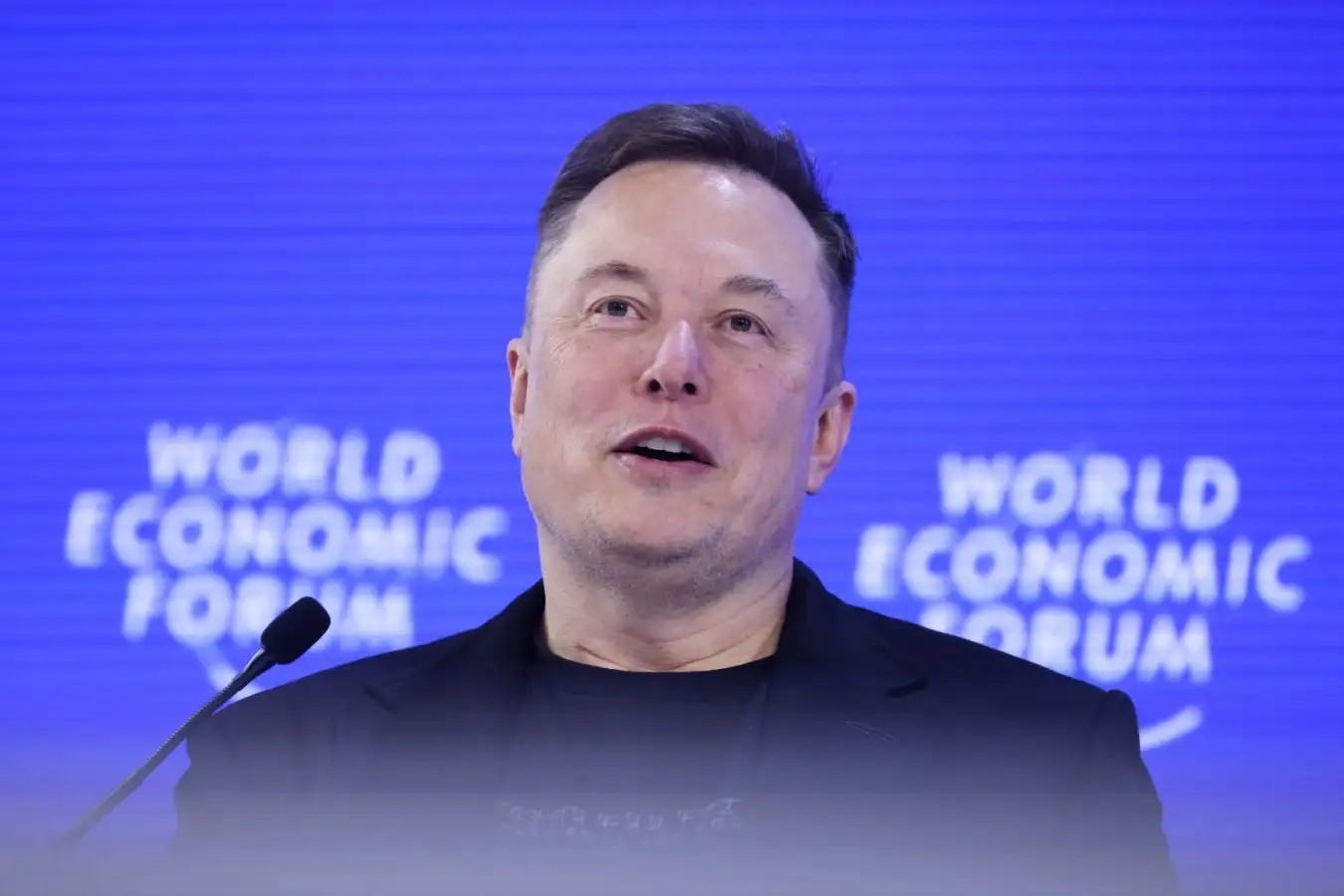
Billionaire Elon Musk recently spoke at the World Economic Forum
Krisztian Bocsi/Bloomberg via Getty Images
Elon Musk is a busy man, heading up multiple billion-dollar companies. While he is increasingly a divisive figure, there is no doubt that Tesla and SpaceX, his two most important ventures, have done much to advance the future of electric cars and spacecraft, respectively. But a series of corporate moves this week suggests Musk has a new vision of the future – and he may be combining all his companies to get there.
First, Musk’s electric car company, Tesla, announced that it was halting production of two of its flagship vehicles, the Model S and Model X. The decision doesn’t mean Tesla will stop making vehicles altogether, but the factories for these two models will now be repurposed into a facility to produce Tesla’s Optimus humanoid robots. At the same time, Tesla said it would invest $2 billion in xAI, another Musk firm that owns the social media site X and its controversial chatbot, Grok.
Put together, it suggests that Tesla is shifting priorities towards more AI-intensive activities, which is where the next major revelation comes into play. According to reporting by Bloomberg and Reuters, Musk is planning to merge SpaceX with Tesla or xAI – or perhaps even both – as part of a plan to list the space firm on the stock market this year.
So, what could Musk be hoping to achieve through consolidating his business empire? “By merging xAI and SpaceX, Musk is likely looking for resource optimisation across data flows, energy and computing,” says Merve Hickok at the University of Michigan. “He had also entertained the possibility of a merger with Tesla to use each [vehicle] as a distributed computing resource.”
The calculation appears to be that Tesla’s planned future in humanoid robots – Musk said this week that he wants to produce 1 million units of the third-generation Optimus robot per year from his newly converted Tesla factory – will need a lot of computing resources for AI. Interaction with a built-up environment alongside people, as humanoid robot adherents hope will happen, requires specialist AI models to crunch through lots of data.
But the generative AI revolution is already stretching energy supplies to their limit. Musk’s xAI was recently censured by the US Environmental Protection Agency for breaching legal limits of power generation for its Colossus data centre in Memphis, Tennessee. He has also previously spoken about the need to put data centres in space: at the recent World Economic Forum in Davos, Switzerland, Musk called the idea a “no-brainer” and said full-scale deployment was possible within two or three years. It should be noted that others are less bullish on these proposals, as a host of technical difficulties from cooling to radiation protection need to be solved first.
Those objections aside, getting data centres into orbit means launching them – and SpaceX is one of the most reliable suppliers of rockets and launches to the private and public sectors, as well as being experienced in satellite orbits, thanks to its Starlink internet arm.
“SpaceX is putting grids of satellites up in space – they already have 9000 – and those grids are about internet distribution,” says Robert Scoble, a technology analyst Unaligned. “xAI is doing internet distribution and news, but they are really about building new kinds of AI models to run our cars, our humanoid robots, and our lives.” He says that “adding these two together makes a lot of sense”.
In other words, Musk seems to believe that combining SpaceX, Tesla and xAI will let him dominate the future of AI in a way that will be difficult for competitors like OpenAI, Google and Microsoft to match. None of the three companies responded to a request for comment, nor did Musk himself.
However, not everyone agrees that’s what’s behind the plans. “They all lack the economics, with the exception of Tesla, which is heading in the wrong direction, to fund their growth,” says Edward Niedermeyer, author of Ludicrous: The unvarnished story of Tesla motors. He sees the decision as a “defensive” move designed to shore up their futures – and to engage a wider range of financing from public investors.
That public investor cash will be vital, reckons Niedermeyer, because of the rate at which Musk’s companies are reportedly running through cash is significant: the cost of training and then running AI models is expensive, as many AI companies are discovering. “It has to burn just insane amounts of cash,” says Niedermeyer – and so Musk may be hoping that putting all of his eggs into one readily investable basket will make his vision attractive enough for people to part with their funds. If not – or if his envisioned future fails to come to fruition – it may all come crashing back to Earth.
Topics:
Source link : https://www.newscientist.com/article/2513831-elon-musk-is-making-a-big-bet-on-his-future-vision-will-it-work/?utm_campaign=RSS%7CNSNS&utm_source=NSNS&utm_medium=RSS&utm_content=home
Author :
Publish date : 2026-01-30 14:24:00
Copyright for syndicated content belongs to the linked Source.