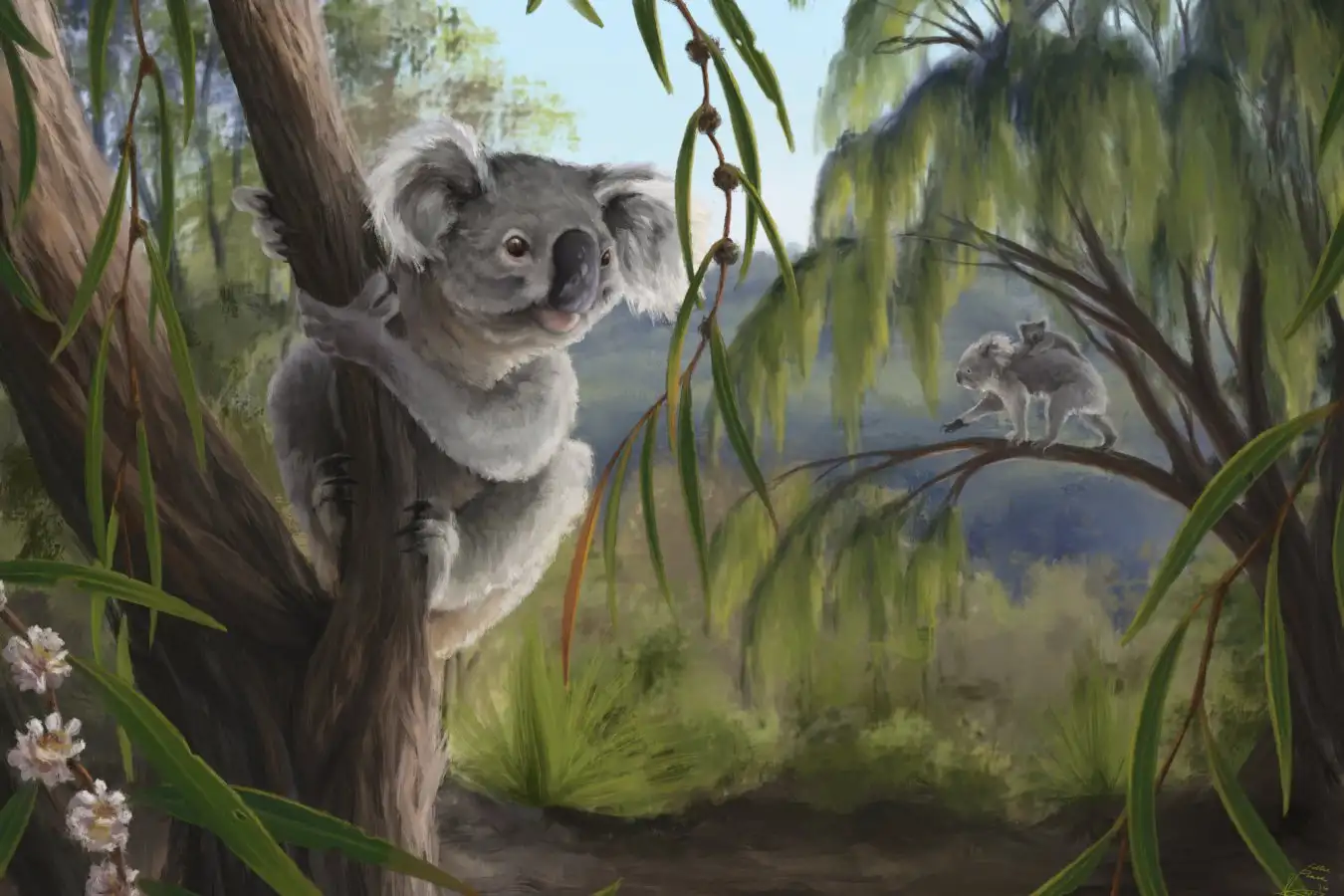
An artist’s impression of the Western Australian koala
WA Museum
Australia was once home to a second species of koala that lived only in the west of the continent, where it became extinct around 30,000 years ago.
Today, there is only one koala species: Phascolarctos cinereus. It is found almost exclusively in eucalyptus forests in eastern Australia and is threatened by habitat loss, disease, collisions with cars and predation by introduced species.
Numerous koala fossils, aged between 137,000 and 31,000 years old, have been collected in Western Australian caves over the past century. Until now, however, there wasn’t enough material to conclude that the remains were from a different species.
In the past 25 years, more fossils have become available to researchers, including skulls donated by the family of late speleologist Lindsay Hatcher, who discovered numerous ancient remains during his expeditions in caves in the south-west of Western Australia.
“Amongst the donation was a koala skull in very good condition,” says Kenny Travouillon at the Western Australian Museum. “Upon examination of that skull, we noticed differences with modern koalas that got us to start working on the fossil material in the collection.”
To the untrained eye, the new species, named Phascolarctos sulcomaxilliaris, would have been difficult to distinguish from P. cinereus, but there are subtle differences.
“In short, the Western Australian koalas were same-same but different,” says Travouillon. “They had shorter heads, for sure, and they seem to have less-well-developed chewing muscles than the east-coast koalas. But they simply chewed in a different way by having larger teeth and having a more efficient, shorter jaw to break down the leaves.”
A large groove on the cheek of P. sulcomaxilliaris suggests the animal had a larger muscle attached there that was used to either move a larger lip, with which it perhaps grabbed leaves, or inflate its nostrils to be able to smell leaves over a greater distance. Its skeleton was also less agile, suggesting it spent less time moving between trees.
When the climate dried and Western Australia’s forests disappeared about 30,000 years ago, P. sulcomaxillaris vanished, along with many other animals that once shared its habitat. “There would have been [Tasmanian] devils, thylacines, giant echidnas, short-faced kangaroos and the giant marsupial Zygomaturus,” says Travouillon.
“Our first peoples in Western Australia would have lived amongst them and they would have been witness to their extinction.”
Tim Flannery at the Australian Museum in Sydney says the study makes a “convincing case for the distinctiveness of the Western Australia koalas as a unique species”. “I look forward to seeing if any DNA can be extracted from the fossils,” he says.
Fossil hunting in the Australian outback
Join this extraordinary adventure through the heart of Australia’s fossil frontier. Once a shallow inland sea millions of years ago, eastern Australia is now a hotspot for fossils. Over 13 unforgettable days, you’ll travel deep into the outback, tracing the footsteps of prehistoric giants and uncovering the secrets of Earth’s ancient history.
Topics:
Source link : https://www.newscientist.com/article/2525306-extinct-relative-of-koalas-discovered-in-western-australia/?utm_campaign=RSS%7CNSNS&utm_source=NSNS&utm_medium=RSS&utm_content=home
Author :
Publish date : 2026-05-06 00:01:00
Copyright for syndicated content belongs to the linked Source.