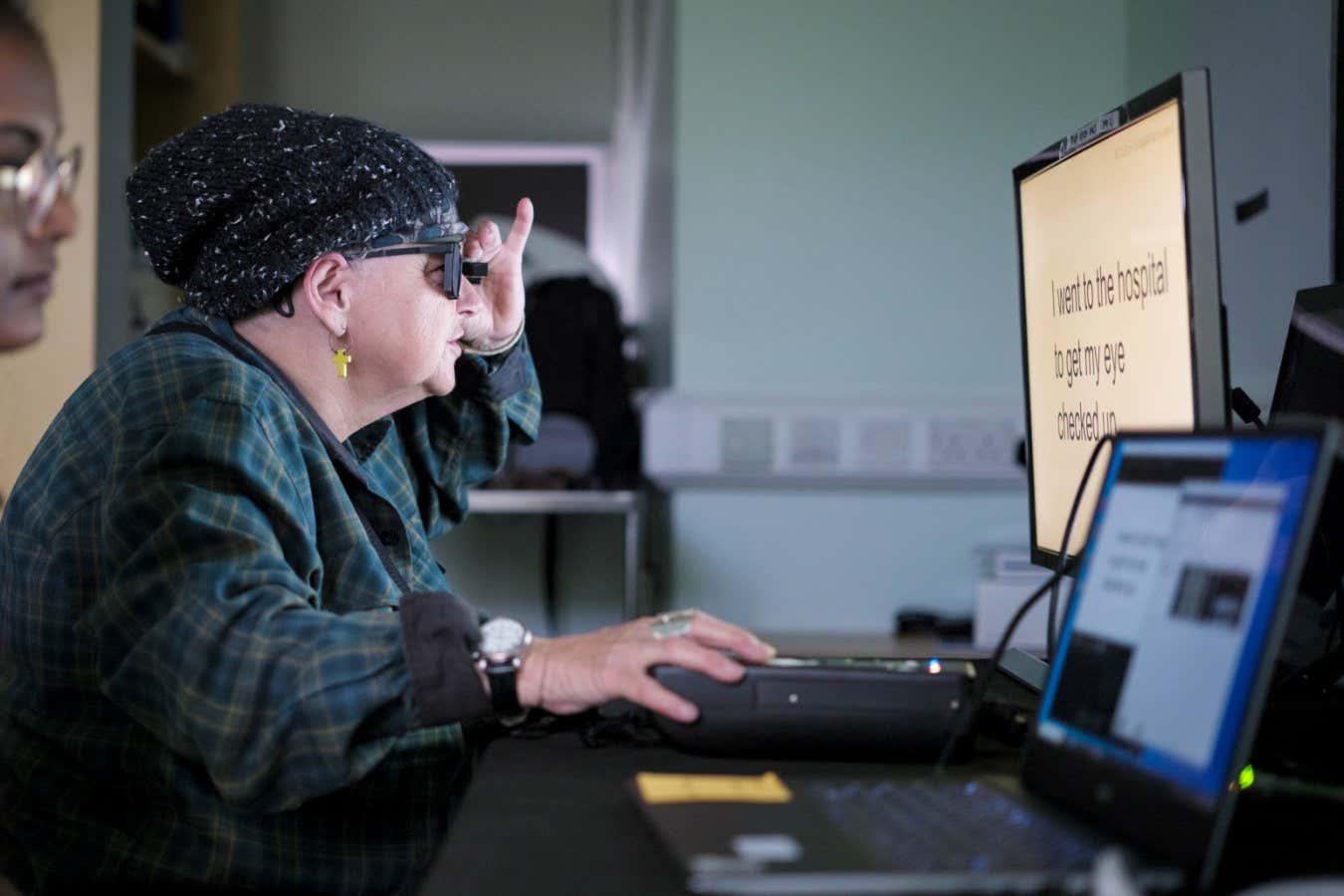
A study participant testing her reading after being fitted with a retinal implant
Moorfields Eye Hospital
People with severe vision loss have been able to read again, thanks to a tiny wireless chip implanted in one of their eyes and a pair of high-tech glasses.
Age-related macular degeneration (AMD) is a common condition that affects the middle part of someone’s vision, often worsening over time. Its exact cause is unknown, but it occurs when light-sensitive photoreceptor cells and neurons in the centre of the retina become damaged, making it hard to recognise faces or read. Approved treatments can only slow its progression.
An advanced stage of AMD is known as geographic atrophy, but even here, people usually retain some photoreceptor cells that allow for peripheral vision and enough retinal neurons to pass visual information to the brain.
Taking advantage of this, Daniel Palanker at Stanford University in California and his colleagues have developed a device called PRIMA. It involves a small camera mounted on a pair of glasses that captures images, then projects them via infrared light to a 2-by-2-millimetre solar-powered, wireless chip implanted in the back of the eye.
The chip then converts the image information into an electrical signal that retinal neurons can pass to the brain. Infrared light is used because we can’t see in this wavelength, so the process doesn’t interfere with any existing vision. “This means patients can use both prosthetic and peripheral vision simultaneously,” says Palanker.
To put it to the test, the researchers recruited 32 people aged 60 or older who had geographic atrophy. Their vision in at least one eye was worse than 20/320, which means they could only see at 20 feet (6 metres) what a person with 20/20 vision could see at 320 feet (97.5 metres).
The researchers first implanted the chip in the eyes of one of the participants, then, four to five weeks later, the volunteers began to use the glasses in their daily lives. The glasses allowed them to magnify what they were seeing by up to 12 times and to adjust the brightness and contrast.
After a year, 27 of the participants could read again, as well as perceive shapes and patterns. They could also see an additional five lines, on average, on a standard eye test chart, compared with what they could discern at the start of the study. Some could even read with the equivalent of 20/42 vision.
“When you watch them starting to read letters and then words, it’s an increasing joy on both sides. I recollect one patient telling me: ‘I thought my eyes were dead and now they are alive again’,” says team member José-Alain Sahel at the University of Pittsburgh School of Medicine in Pennsylvania.
There are indications that stem cell implants or gene therapy could help restore sight lost due to AMD, but these are still at early experimental stages. By giving the trial participants the ability to perceive shapes and patterns, PRIMA represents the first eye prosthesis to restore functional sight in people with the condition.
About two-thirds of the volunteers experienced short-term side effects as a result of the implant, including high pressure in the eye, but this didn’t prevent vision improvements.
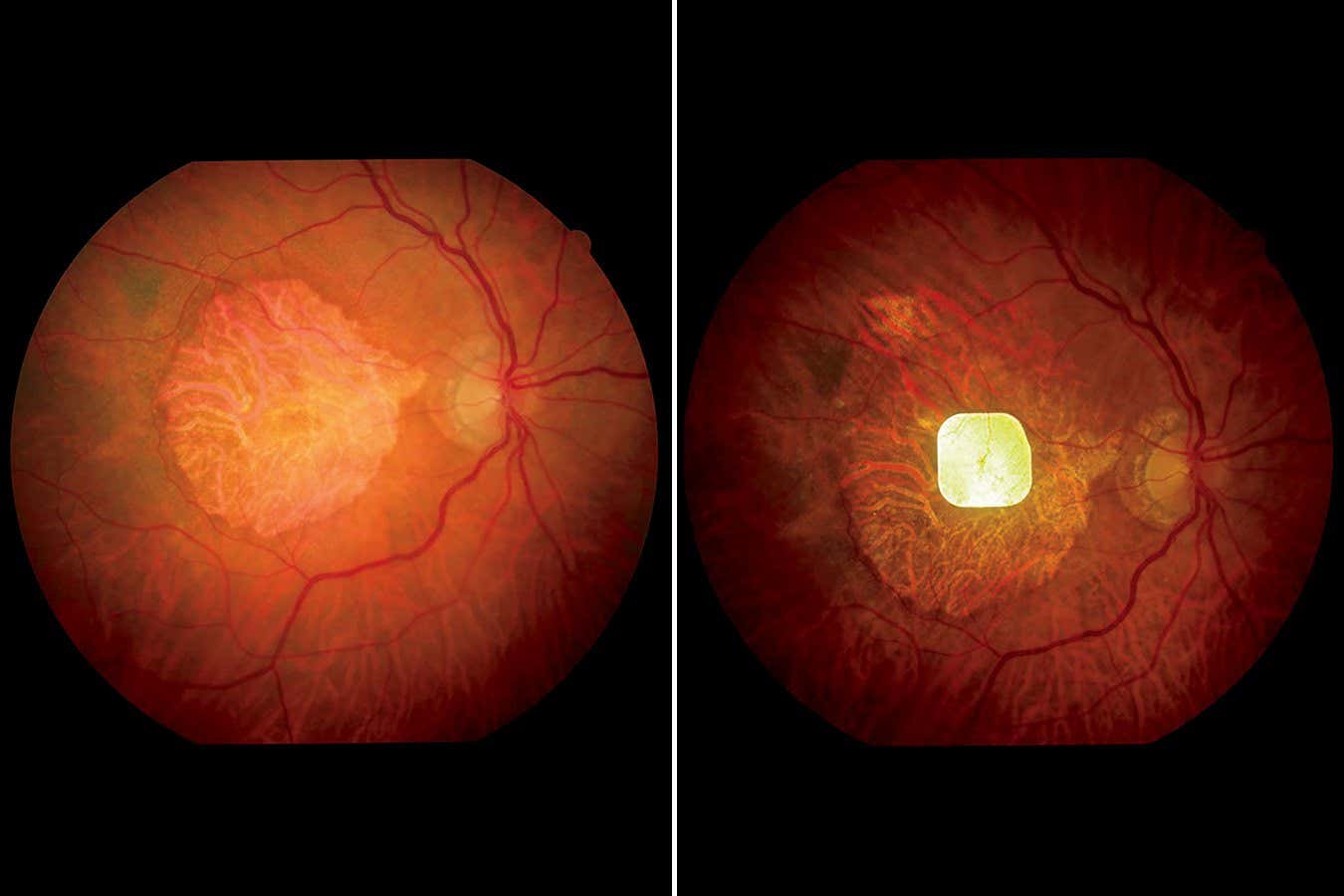
A trial participant’s eye without (left) and with the retinal implant (right)
Science Corporation
“This is an exciting and significant study,” says Francesca Cordeiro at Imperial College London. “It gives hope for providing vision in patients for whom this was more science fiction than reality.”
The boosted vision the participants experienced is in black and white. “Our next goal is to add the software that will help resolve grey scales and enhance them for face recognition,” says Palanker. The researchers don’t expect to be providing colour vision any time soon, though.
Palanker also plans to boost PRIMA’s resolution, which is limited by the size of pixels affecting the number that can fit on the chip. He has been testing a more advanced version in rats. “This would correspond to a visual acuity of 20/80 in people, and with electronic zoom, we can go all the way to 20/20,” he says.
Topics:
Source link : https://www.newscientist.com/article/2500626-eye-implant-and-high-tech-glasses-restore-vision-lost-to-age/?utm_campaign=RSS%7CNSNS&utm_source=NSNS&utm_medium=RSS&utm_content=home
Author :
Publish date : 2025-10-20 13:00:00
Copyright for syndicated content belongs to the linked Source.