
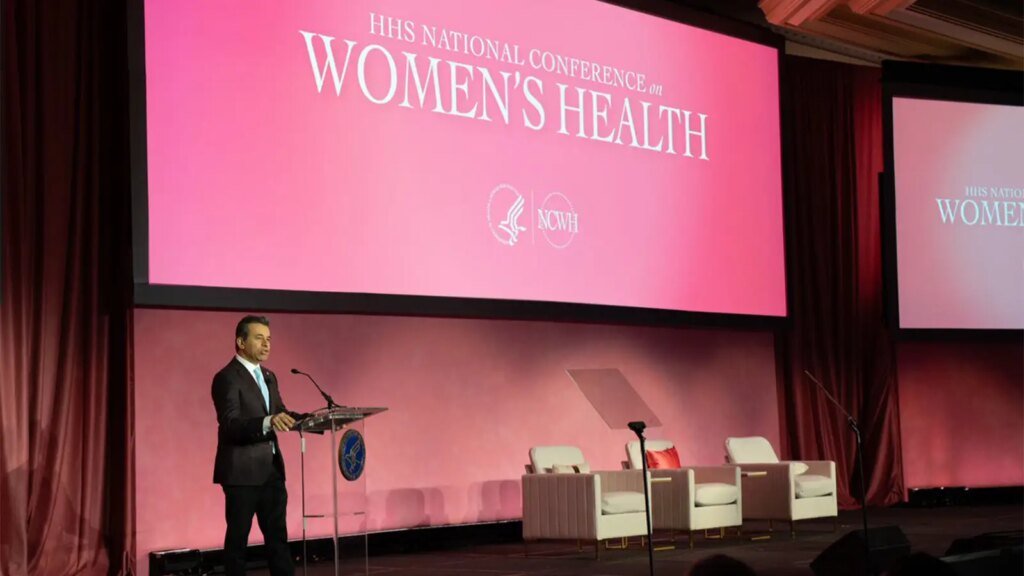
FDA Commissioner Marty Makary, MD, MPH, said at a national meeting last week that he wouldn’t give his young child antibiotics “unless he is on his deathbed or suffering.”
The comments, made at the HHS National Conference on Women’s Health, didn’t sit well with some pediatricians.
“All clinicians could probably use fewer antibiotics, but to say we’re going to wait for someone to be ‘suffering’ or ‘on their deathbed,’ is really just too extreme,” Lori Handy, MD, MSCE, an infectious diseases pediatrician at the Children’s Hospital of Philadelphia, told MedPage Today.
“If you wait that long, you will have waited too long,” Handy added.
Even an early infection in a young baby has the chance to become invasive, she said. For instance, Streptococcus pneumonia can start as mild pneumonia but can go on and cause bloodstream infections, complicated pneumonia, and brain infections, she said.
William Schaffner, MD, an infectious diseases physician at Vanderbilt University Medical Center in Nashville, Tenn., noted that the push to improve antibiotic stewardship, including in pediatrics, has been going on for decades.
Distinguishing between viral and bacterial infections in children isn’t always easy, but Schaffner said in some situations it’s important to do so — such as in the case of middle ear infections.
“The antibiotics have absolutely no effect to cure the viral infection,” Schaffner said. “We used to say ‘use the antibiotics like a rifle, not a shotgun.'”
Pediatricians have developed tactics to curb their antibiotic use as well. Handy gave the example of a 3-year-old with an ear infection who is stable and can communicate their pain. In that case, the doctor may prescribe amoxicillin but may advise parents to “wait-and-see for a day or 2. If it doesn’t resolve, we want you to use the antibiotic.”
“That’s very different from a 3-month-old who has an infection … [that] might become more severe or spread to other parts of their body, like their brain, in which case, we’re not going to wait and see,” she said. “We’re going to immediately stop that infection with antibiotics.”
One of Makary’s chief complaints was that physicians “never talk” to patients “about the effect of an antibiotic on their microbiome.” He said they “don’t discuss issues like inflammation and insulin resistance with patients, even though these are the root cause of most illness.” He cited a study published in Mayo Clinic Proceedings in 2020 showing higher rates of obesity among kids who took antibiotics than those who did not.
Later in the talk, Makary acknowledged that these are “nuanced topics. … Sometimes you need an antibiotic.”
“I watched lives saved right in front of my eyes within hours because of antibiotics in the hospital,” he added. However, he continued to stress the “profound effect” of the microbiome on a person’s health.
Handy noted that there’s “nothing conclusive at this point to say a child who has a 5- or 10-day course of antibiotics is definitely going to be more obese than their peers later in life.”
“Effects, that will happen 5, 10, 20 years later are really only relevant if they survive the infection,” Handy said, “and there are many infections right now that can be deadly for children.”
Please enable JavaScript to view the comments powered by Disqus.
Source link : https://www.medpagetoday.com/pediatrics/generalpediatrics/120319
Author :
Publish date : 2026-03-16 17:48:00
Copyright for syndicated content belongs to the linked Source.