
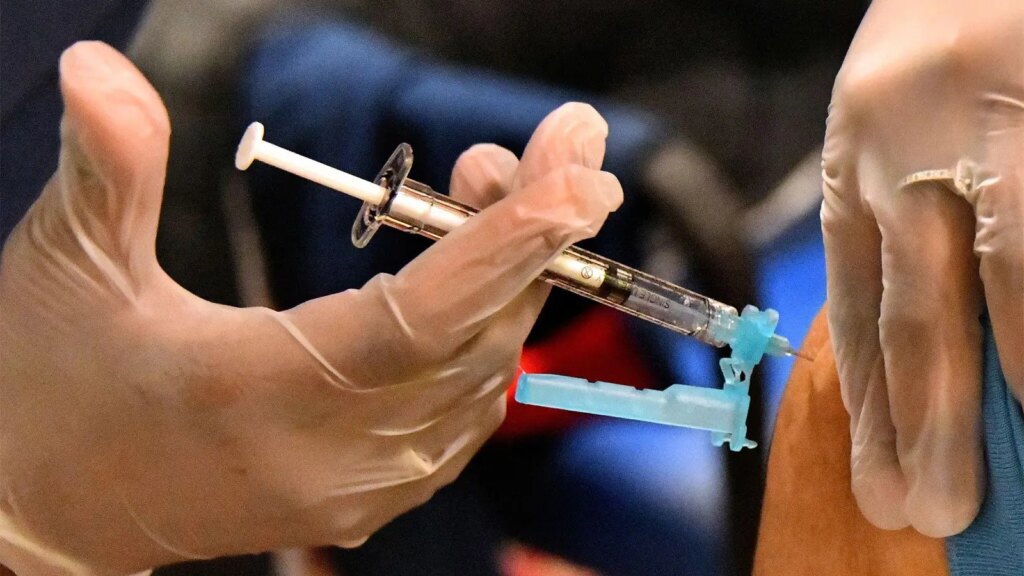
The FDA’s vaccine advisors voted 8 to 0, with one abstention, in favor of a monovalent XFG vaccine for COVID-19 shots for the 2026-2027 season.
The Vaccines and Related Biological Products Advisory Committee (VRBPAC) also discussed the need to target the long-simmering BA.3.2 variant, also known as “cicada,” though most expressed confidence that targeting XFG was the right way to go.
“The XFG variant is the most common variant in the U.S. right now, and looking at the other JN.1 variants that may be coming up, I still think that the BA.3.2 variant is not as common. I think we have to keep surveillance very vigilant though,” said Anna Durbin, MD, of Johns Hopkins Bloomberg School of Public Health in Baltimore, adding that the “immunogenicity of the vaccines looks good, so I was very comfortable voting yes.”
Stanley Perlman, MD, PhD, of the University of Iowa in Iowa City, who chaired the meeting, noted that the World Health Organization recommended the LP.8.1 strain for next year’s vaccines, which “would have been fine,” he said. The currently available vaccines from Moderna and Pfizer target LP.8.1.
“I was also really swayed by the fact that Sanofi made the XFG vaccine,” Perlman said. “They don’t have LP.8.1, and given that the two are very similar, I think that for the U.S., having XFG is a good choice.”
Perlman was referring to Sanofi’s Nuvaxovid, the protein subunit vaccine acquired from developer Novavax that takes longer to develop and manufacture compared with its sister products, which use mRNA technology.
Hana El Sahly, MD, of Baylor College of Medicine in Houston, abstained from voting because she said all the data shown indicated that the XFG vaccine “is interchangeable with LP.8.1 in terms of the breadth of the response and the height of the response.”
“We might be missing the opportunity to expand the breadth of response to the NB.1.8.1 and BA.3.2 variants that are increasing, especially in children who are engines of transmission of respiratory viruses,” El Sahly added.
She noted during the BA.3.2 discussion that while this variant has been inefficient thus far, it did become the dominant strain in Germany and South Africa. “I would be concerned if BA.3.2 starts to acquire mutations and goes up in frequency over the next few months, because our choice of XFG, or LP internationally, is quite robust for JN.1, but not for BA.3.2,” she said.
The BA.3.2 discussion also expanded into another key question that came up during the day, as to whether annually in late spring was the right timing for COVID shot strain selection, given that it has both late summer/early fall and winter surges, rather than just peaking in the winter as influenza does.
The researchers also raised concerns about not having sufficient epidemiologic and genomic surveillance data to make the best decisions about strain selection. “The stronger our systems are, the better we’ll be in position to make decisions for variants that are going to continue to emerge,” said Flor Munoz-Rivas, MD, MSc, also of Baylor College of Medicine.
During the meeting, all three vaccine manufacturers — Moderna, Pfizer, and Sanofi — presented immunogenicity data showing XFG vaccines provided high levels of neutralizing antibodies against JN.1 family variants, including NB.1.8.1, but they have more limited neutralization of BA.3.2 lineages.
All three companies also tested BA.3.2 lineage vaccines, showing better neutralization of those variants but at the cost of lower neutralization of JN.1 family variants.
The meeting opened with presentations from the CDC on the epidemiology and viral genomics of COVID-19 and vaccine effectiveness (VE) data — notably, the interim data that were suppressed from publication by CDC leadership last month. (MedPage Today‘s Editor-in-Chief Jeremy Faust, MD, obtained a copy of that paper and published it.)
Amanda Payne, PhD, MPH, of the CDC’s surveillance and prevention branch within the National Center for Immunization and Respiratory Diseases (NCIRD), presented the agency’s analysis of its VISION system, showing overall interim VE for the 2025-2026 season of 49% against emergency department and urgent care; 58% against hospitalization; and 49% against critical illness through 6 months following vaccination. In most cases, VE estimates were higher for the first 60 days following vaccination.
Natalie Thornburg, PhD, chief of the laboratory branch within NCIRD’s COVID division, presented epidemiologic data showing that hospitalization rates for 2025-2026 were lower than all previous years, and those rates have been decreasing each year.
Hospitalizations were highest in those ages 75 and up, followed by infants ages 6 months and under, she said. Earlier data from 2022-2024 showed that among those infants, 76% had no underlying medical conditions, she noted.
Please enable JavaScript to view the comments powered by Disqus.
Source link : https://www.medpagetoday.com/infectiousdisease/covid19vaccine/121483
Author :
Publish date : 2026-05-28 21:26:00
Copyright for syndicated content belongs to the linked Source.