
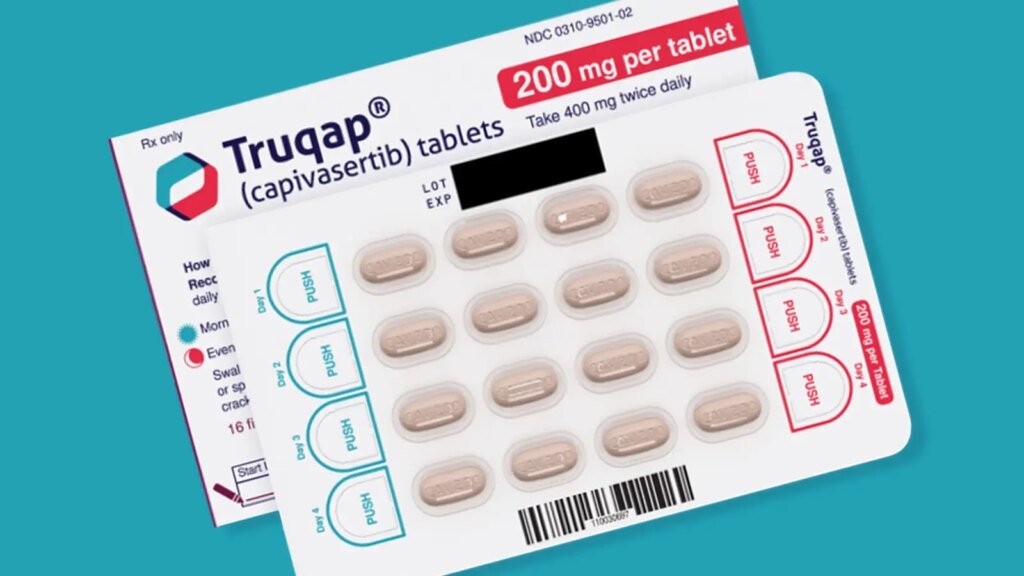
FDA’s independent advisors on Thursday endorsed the use of capivasertib (Truqap) for treating an aggressive subtype of prostate cancer.
By a 7-1 vote, and with a single abstention, the Oncologic Drugs Advisory Committee agreed that the benefits of adding the AKT inhibitor to abiraterone (Zytiga) and prednisone outweighed the risks in patients with PTEN-deficient metastatic hormone-sensitive prostate cancer (HSPC).
The primary support for the proposed indication came from the phase III CAPItello-281 trial, where the addition of capivasertib demonstrated a 7.5-month median improvement in radiographic progression-free survival (PFS; 33.2 vs 25.7 months, P=0.034).
“My impression is that the 7-plus months is meaningful,” said William Gradishar, MD, of Northwestern Feinberg School of Medicine in Chicago. “I don’t think this will be a therapy for everybody. I think as physicians become more acquainted with the drug, and the management for the right patients, it could have a meaningful outcome.”
The therapy could benefit a particular patient population — those with a 99% or 100% PTEN loss, said Toni Choueiri, MD, of Dana-Farber Cancer Institute in Boston. “How can they receive this targeted treatment if we don’t approve it?”
“This was definitely not an easy vote,” said Choueiri, but he added that “the evidence demonstrates this is a statistically significant trial. It’s absolutely biologically plausible.”
PTEN-deficient tumors occur in approximately 25% of patients with metastatic HSPC. Compared to patients with intact PTEN, it is associated with poor prognosis and characterized by more aggressive disease, faster progression to castration-resistant prostate cancer, and significantly shorter overall survival (OS).
In CAPItello-281, no significant OS benefit was observed at an interim analysis (HR 0.90, 95% CI 0.71-1.15).
Capivasertib was first approved in 2023 for locally advanced or metastatic breast cancer in patients whose tumors harbor PIK3CA, AKT1, or PTEN alterations.
The positive vote — in effect recommending the agency expand the approval to HSPC — was at odds with the views of FDA staffers, who in briefing documents ahead of the meeting expressed concerns about added toxicity with the combination and suggested the PFS benefit may not be “clinically meaningful,” noting it was smaller compared with previous approvals in metastatic HSPC.
In the absence of a large PFS improvement, “a statistically significant improvement in OS may be needed to support a clinically meaningful treatment effect,” according to the agency’s reviewers.
Speaking to the added toxicity — more diarrhea, rash and skin reactions, hyperglycemia, and diabetes ketoacidosis — Neil Vasan, MD, PhD, of NYU Langone Health in New York City, said the panel’s discussion indicated “this is not only something that we as a field can manage, but also something that would be tailored individually for a patient with an individual conversation.”
The lone “no” vote came from Brian Rini, MD, of Vanderbilt University Medical Center in Nashville, Tennessee, who said he was “swayed mostly by what I perceived as a relatively marginal benefit, and the magnitude and duration of toxicity.”
While the FDA is not required to follow its advisory committees’ recommendations, it typically does.
Please enable JavaScript to view the comments powered by Disqus.
Source link : https://www.medpagetoday.com/hematologyoncology/prostatecancer/121067
Author :
Publish date : 2026-05-01 16:22:00
Copyright for syndicated content belongs to the linked Source.