

[ad_1]

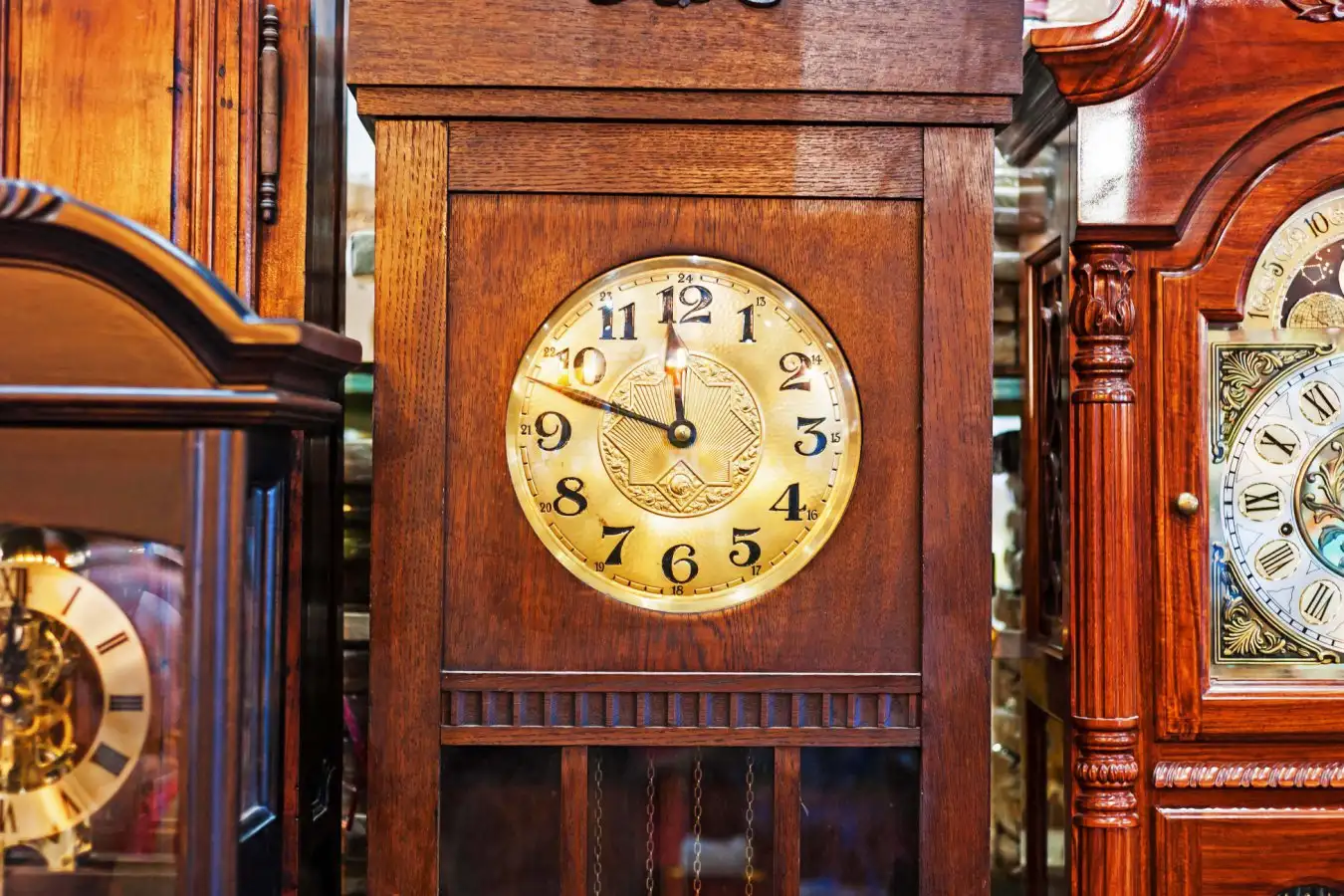
Pendulum clocks were much more accurate than those that came before
Panumas Nikhomkhai / Alamy
The first complete design for a quantum grandfather clock uses a single atom, tiny mirrors and light. Building it could help our understanding of what makes any clock accurate in the quantum realm and explore ideas at the edge of physics.
At the most rudimentary level, time can be measured with something simple, like sand trickling through an hourglass. But timekeeping became a lot more accurate once mechanical clocks, like the grandfather or pendulum clock, were invented in the 17th century. Matteo Brunelli at Collège de France and his colleagues have now shown that such clocks have a quantum equivalent.
“We asked ourselves the question: ‘Can a pendulum clock work according to the laws of quantum mechanics?’ We couldn’t be sure,” he says.
Each pendulum clock has three basic elements, starting with the pendulum that defines the clock’s ticks with its swings. Next are the weights within the clock that leverage gravity’s downward pull to make the pendulum move. Finally, a pendulum clock requires an “escapement mechanism”, which converts the pendulum’s swings into the motion of the clock’s arms and provides the pendulum with little kicks of energy to prevent friction from slowing it down. Specifically, for the pendulum to keep swinging left-to-right by the same amount every time, the escapement mechanism must control the up-and-down motion of the weights.
The researchers developed a mathematical model that replicated all these features with quantum objects. In their design, the clock is a cavity comprising two mirrors that face each other – one is fixed and the other can oscillate back-and-forth. Between the mirrors sits an atom that can have three different energies. Tiny temperature fluctuations in the cavity’s environment make the atom transition from one energy to another, and some transitions are accompanied by the atom emitting a photon. This photon bounces between the mirrors, making one of them oscillate, analogous to falling weights setting the pendulum into motion.
The atom plays the role of the escapement mechanism, repeatedly moving through its energy states, ensuring a sequence of ticks and tocks. Brunelli says that this is the smallest an escapement mechanism can possibly be. The team’s mathematical analysis showed that if everything was tuned correctly, the quantum clock would settle into stable, reliable, ticking behavior – just like a pendulum clock should.
Brunelli says that unlike the world’s best atom-based clocks that need to be controlled by lasers, this clock would be autonomous, operating more like a self-standing thermodynamic machine. Autonomous quantum clocks have been designed before, but because they didn’t maintain the same even oscillations through the escapement mechanism, they were less accurate, he says.
In fact, the new clock broke an accuracy limit called the “thermodynamic uncertainty relation” that constrained many past autonomous clocks. This is because any clock’s accuracy relates to how much effort it would take to make it run backwards – and the new clock’s accuracy was proportional to its irreversibility in the way thought to be favourable for particularly good timekeeping.
Sreenath Manikandan at the Tata Institute of Fundamental Research Hyderabad in India says that understanding autonomous clocks is critical for understanding timekeeping because they do not rely on another clock to remain accurate, so they capture the most elementary version of the process. And the more we understand quantum clocks at the most elementary level, the more useful they can be for probing new physics, such as how gravity behaves in the quantum realm, he says. “A deep understanding of the working mechanisms of a clock is highly desirable, and I think that the new work presents a major progress in this direction,” says Manikandan.
Experiments with tiny cavities and photons are common, so many of the ingredients that would be necessary for building the new clock in the lab already exist. However, Brunelli says that the escapement mechanism is novel enough to make building such an experiment technically challenging. “But it’s not completely unreasonable,” he says.
Topics:
[ad_2]
Source link : https://www.newscientist.com/article/2527807-first-quantum-grandfather-clock-could-probe-where-gravity-comes-from/?utm_campaign=RSS%7CNSNS&utm_source=NSNS&utm_medium=RSS&utm_content=home
Author :
Publish date : 2026-05-27 11:00:00
Copyright for syndicated content belongs to the linked Source.