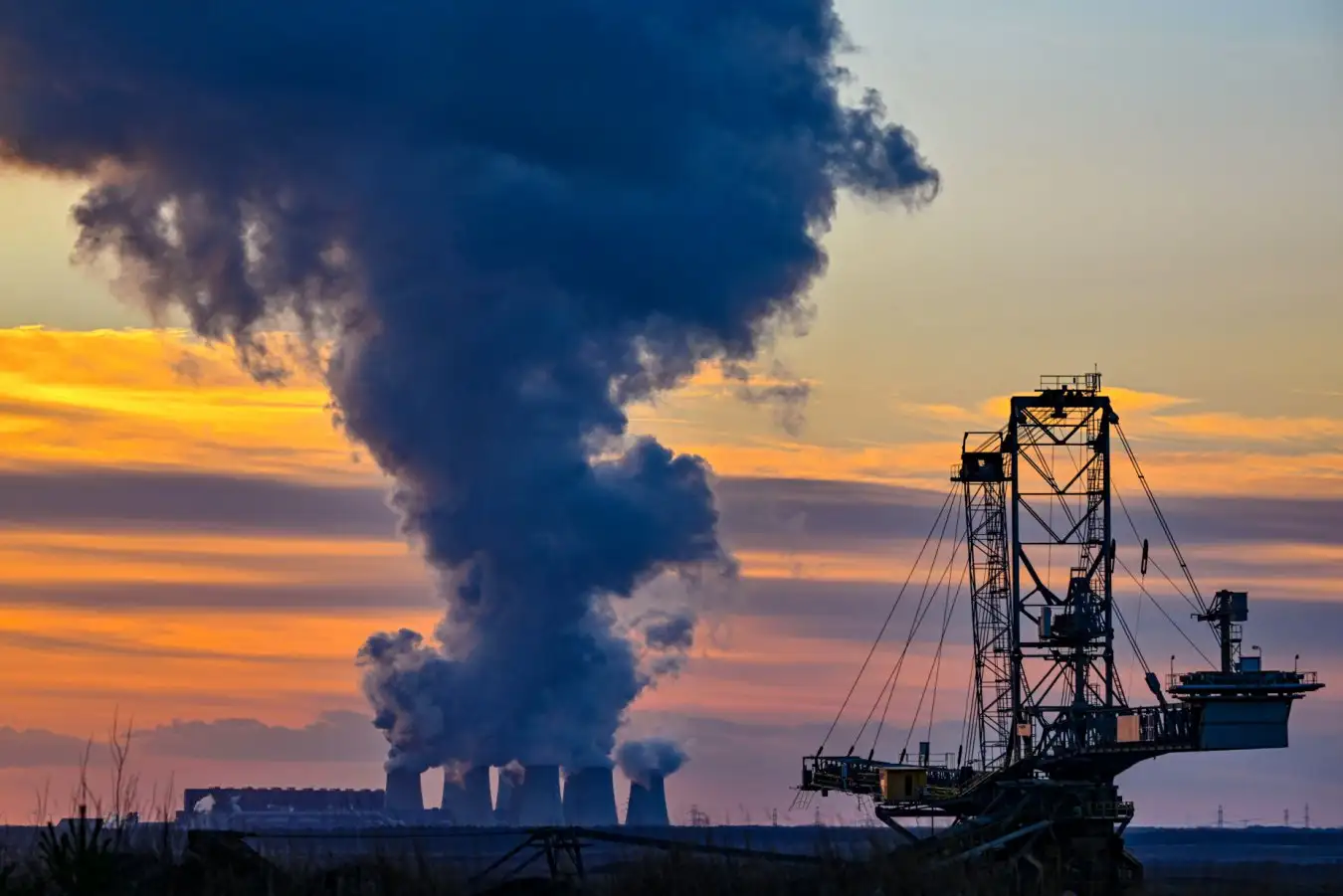
A lignite power plant in Germany
Patrick Pleul/dpa/Alamy
Worldwide fossil fuel emissions are set to rise 1.1 per cent in 2025, reaching another record high as humanity burns hydrocarbons at ever greater rates, according to the annual Global Carbon Budget report.
In a positive sign, emissions from China, the world’s biggest emitter, appear to be levelling off, raising hopes that they may be reaching a peak and that global emissions might follow.
“We’re not yet in a situation where the emissions go down as rapidly as they need to to tackle climate change,” says Corinne Le Quéré at the University of East Anglia, UK, who worked on the report. “But at the same time there is a lot of positive evolution with China’s and India’s emissions growing less rapidly than before.”
Humanity will put out 38.1 billion tonnes of fossil CO2 emissions this year, the report says, the equivalent of 9 billion petrol cars being driven for an entire year. While renewables are displacing hydrocarbons in many places, this isn’t enough to offset the uptick in energy demand, much of which is being met by fossil fuels. The burning of coal, oil and natural gas has continued to increase this year.
Earth has now heated 1.36°C since the pre-industrial era, according to the report. With emissions at the current level, keeping warming below the 1.5°C target of the Paris Agreement is virtually impossible, the report’s authors say. Overshooting 1.5°C heightens the risk of catastrophic climate impacts, including irreversible tipping points such as the collapse of the ice sheets.
Last month, the United Nations secretary general António Guterres told world leaders gathered before the COP30 climate summit that exceeding 1.5°C is now inevitable, and humanity needs to slash emissions to keep this overshoot as small as possible.
If carbon absorption by ocean and land ecosystems is taken into account, global CO2 emissions are actually down slightly in 2025. This is largely due, however, to the end of warm El Niño conditions, which had stifled photosynthesis in major sinks like tropical rainforests.
As the climate gets warmer, those sinks are absorbing less carbon, according to a separate study by the team behind the Global Carbon Budget report.
Nonetheless, total emissions have increased more slowly in this decade than in the previous one, says Pierre Friedlingstein of the University of Exeter, UK, one of the report’s authors. “Things are looking better,” he says. “If you look at the growth rate, it’s much lower now.”
The report estimated a 0.4 per cent increase in China’s emissions in 2025. But an analysis by Carbon Brief found its emissions have been flat through the third quarter of the year. Solar power has grown 46 per cent there year-on-year, compensating for increased electricity demand, it said. Rising electric vehicle sales cut pollution in the transport sector, but a surge in oil-intensive chemical and plastic production made for static emissions overall.
The think tank Ember said in another report that thanks to the solar boom, fossil fuel power generation fell 1.1 per cent in China in the first three quarters of 2025, marking a “structural change in the country’s electricity system.” It declined by 3.3 per cent in India, which is also building record amounts of solar and wind power.
For the first time since covid-19, global fossil power generation – which doesn’t include transport, industry and other emitters – will not grow in 2025, Ember said.
Topics:
Source link : https://www.newscientist.com/article/2504092-fossil-fuel-emissions-rise-again-but-chinas-are-levelling-off/?utm_campaign=RSS%7CNSNS&utm_source=NSNS&utm_medium=RSS&utm_content=home
Author :
Publish date : 2025-11-13 00:01:00
Copyright for syndicated content belongs to the linked Source.