


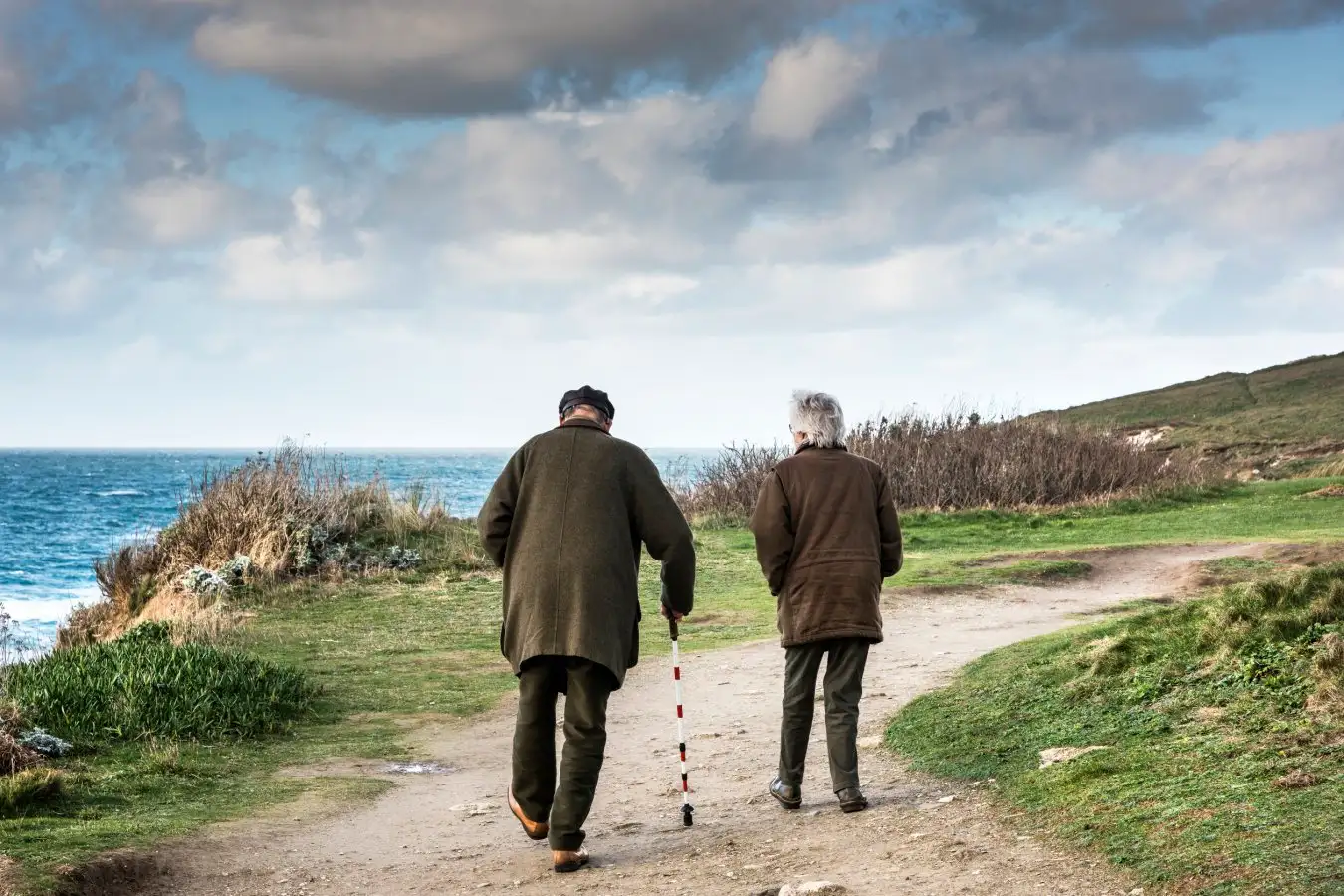
Slow walking speed is a common feature of frailty
Gordon Scammell/Loop Images/Universal Images/Getty Images
An experimental stem cell therapy could treat frailty by targeting the condition at its biological roots. Frailty – which raises the risk of falls and infections – is typically only mitigated through lifestyle changes, like doing strength training and balance exercises. But now, it seems that a novel infusion of stem cells from young, healthy people into older individuals significantly improved their mobility.
“Frailty is a major source of disability and diminished quality of life in older individuals,” says Joshua Hare at Longeveron, a biotechnology company in Miami, Florida. “There is a major unmet need to find biological treatments.”
Hare and his colleagues at Longeveron are developing a therapy that they hope will target some of the underlying mechanisms of ageing, such as inflammation and impairment of the metabolic processes that make muscles contract. The therapy – called laromestrocel – is made up of mesenchymal stem cells that can develop into many different types of cells, including muscle and cartilage, taken from healthy bone marrow donors aged 18 to 45.
After success in early-stage trials for frailty – which affects around 1 in 4 people aged 65 and over – they have now tested various doses of laromestrocel against a placebo in a larger group of 148 people.
The researchers measured how far the participants – who were aged 74 to 76 and had mild-to-moderate frailty – could walk in 6 minutes before and after laromestrocel. They found that a single infusion improved their performance in a dose-dependent fashion, with no serious safety concerns. For instance, those who got the maximum dose could walk 41 metres further than those who received the placebo six months after the infusions – rising to 63 metres at nine months.
Laromestrocel inhibits enzymes called matrix metalloproteinases, according to the team, which have a degenerative effect on structural proteins in the blood vessels and other tissues. This means laromestrocel could regenerate the vascular system, which then benefits muscle fibres involved in endurance, says Hare.
It did not, however, lead to improvements in walking speed or grip strength. “Clinically, the most important issue is the 6-minute walk distance, which is known to correlate with health status and longevity,” says Hare.
“This seems very promising,” says Daisy Wilson at the University of Birmingham in the UK. “I was impressed by the overall change demonstrated in the 6-minute walk time.”
What’s more, the trial may have led to a biomarker for frailty, which could help identify people who will benefit from the treatment the most – possibly even before symptoms arise. The researchers screened a panel of eight potential biomarkers that are known to be involved in inflammation and blood vessel formation. When analysing the participants’ blood, they observed that levels of a fragment called sTIE2, which reflects impaired vascular function, decreased progressively with rising doses of laromestrocel.
This suggests that people with high sTIE2 could benefit most from the therapy, says Wilson. “Frailty is very heterogeneous,” she says. “I think the most important part of geroprotector medicine [interventions that slow the ageing process] going forwards is matching the right patient to the right treatment.”
However, she also raised practical concerns about the cost of stem cell therapies and their feasibility. “Given how expensive this is likely to be, I am not sure how you would be able to justify its use when there have been trials of walking programmes, which have improved 6-minute walk test [performance] by more than 50 metres,” she says. “My other thought is how difficult it is to obtain stem cells from volunteers. There would need to be a lot of volunteers to treat everyone with frailty.”
Hare counters this by saying that various companies are making technological advances to scale up stem cell therapies to reach more people. “There is a lot of work ongoing regarding the ability to make these kinds of stem cells in large quantities, and I am confident the need will be met,” he says.
Topics:
Source link : https://www.newscientist.com/article/2517139-frailty-can-be-eased-with-an-infusion-of-stem-cells-from-young-people/?utm_campaign=RSS%7CNSNS&utm_source=NSNS&utm_medium=RSS&utm_content=home
Author :
Publish date : 2026-02-27 15:00:00
Copyright for syndicated content belongs to the linked Source.