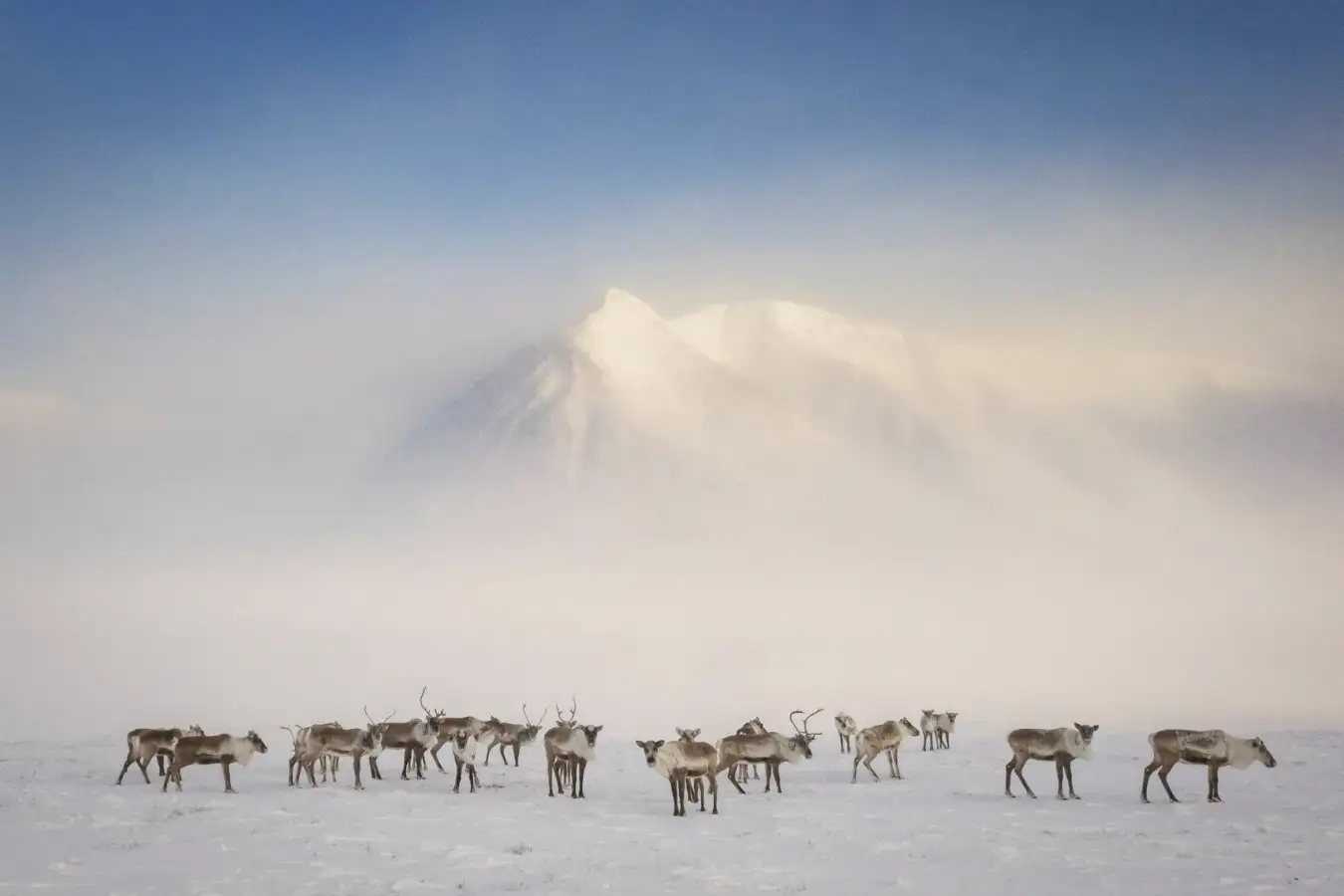
A herd of caribou outside Anaktuvuk Pass, Alaska, in the spring migration
KATIE ORLINSKEY
Frostlines
Neil Shea, Picador (UK, 12 February) Ecco Publishing (US, available now)
IN SO far as those of us further south consider the Arctic at all, we tend to think of it as a monolith: an expanse of white, with walruses and a few polar bears. Some may even imagine penguins, in fact to be found at the other pole, illustrating the remoteness of these extreme landscapes and their otherworldly foreignness.
But a new book argues that we neglect the Arctic at our peril – not least because of its importance to our rapidly heating planet. In his first book Frostlines: A journey through entangled lives and landscapes in a warming Arctic, journalist Neil Shea brings together his findings from two decades of reporting, mostly for National Geographic.
In this lyrical, unexpectedly moving work of narrative non-fiction, Shea brings the wonders of the Arctic to life for readers who will never journey there, while mounting a persuasive case for why we must at least cast our minds northwards.
He begins Frostlines with a startling image from his first trip to the Arctic back in 2005, camping on the sea ice at Canada’s Admiralty Inlet. Looking out to the open water from an ice floe, Shea was treated to a mass gathering of narwhals, the males brushing their tusks against each other in a what is thought to be a display of sexual dominance, while being swarmed by fish, birds and other wildlife.
That spectacle of “all those lives converging, colliding… stories that could never fit into any magazine” instilled in Shea a fascination for the Arctic. For all his misgivings about the limits of the written word, Shea quickly and effectively extends his passion to the reader through vivid imagery and enviable encounters with wildlife.
On Ellesmere Island, Shea befriends a population of white wolves that have never learned to fear people – one even steals his inflatable pillow from his tent. Deep in Alaska’s Kobuk Valley National Park, he camps among vast herds of caribou and becomes “neighbourly” with a brown bear.
“
Melting ice is making the Arctic attractive, as evidenced by President Trump’s threats against Greenland
“
It would have been possible to focus this book on the Arctic wilderness and wildlife alone; Shea writes beautifully about both. But to do so would have been to sell this complex, unique region short, and play to our generally vague preconceptions of it. Instead, Shea aims for a more granular picture, even if it is a more uncomfortable one.
That area between the North Pole and the Arctic circle is far from a homogeneous expanse of snow, encompassing eight modern states with 4 million residents. Some 400,000 are Indigenous people, belonging to dozens of distinct tribes and speaking many different languages and dialects.
In his lively portraits of the people he spends time with, Shea vividly conveys the realities of daily life across this region, as well as the increasingly existential challenges of an Arctic warming three or four times more rapidly than anywhere else on Earth.
Some of Shea’s Inuit interviewees are eager to share the changes they have witnessed over mere decades, and their efforts to protect their communities and traditional way of life. Others are more reluctant and even resentful, having seen so many Westerners over the years come, ask questions, take notes and leave.
Shea finds that “no one wants to talk about climate change” while camped on top of a frozen lake and otherwise at the mercy of nature for survival. Yet the consequences are already at hand, unbalancing the Arctic’s fragile ecosystems and opening it up to further threats.
Melting ice is allowing more ships to access the Arctic and making it an attractive territory, as evidenced by US President Donald Trump’s threats against Greenland. Meanwhile, the Ukraine war has closed other areas off. Frostlines concludes with Shea on the Norway-Russia border, where migrants make life-threatening bids to find refuge and not even reindeer can cross freely.
As remote and removed as the Arctic may seem, Shea reveals it to be both a part of our familiar modern world and a region increasingly endangered by our activities. We are more connected to the ice than we might think, and the people and animals that live in the Arctic don’t have the luxury of ignoring the worsening cracks.
Elle Hunt is a writer based in Norwich, UK
Topics:
Source link : https://www.newscientist.com/article/mg26935811-000-unexpectedly-moving-book-makes-the-case-for-the-arctic/?utm_campaign=RSS%7CNSNS&utm_source=NSNS&utm_medium=RSS&utm_content=home
Author :
Publish date : 2026-02-04 18:00:00
Copyright for syndicated content belongs to the linked Source.