[ad_1]
The phase III OPTIMA trial, presented at this year’s American Society of Clinical Oncology (ASCO) annual meeting, showed that some patients with high-risk, early-stage, estrogen receptor (ER)-positive, HER2-negative breast cancer may be able to avoid chemotherapy based on genomic testing, without compromising outcomes.
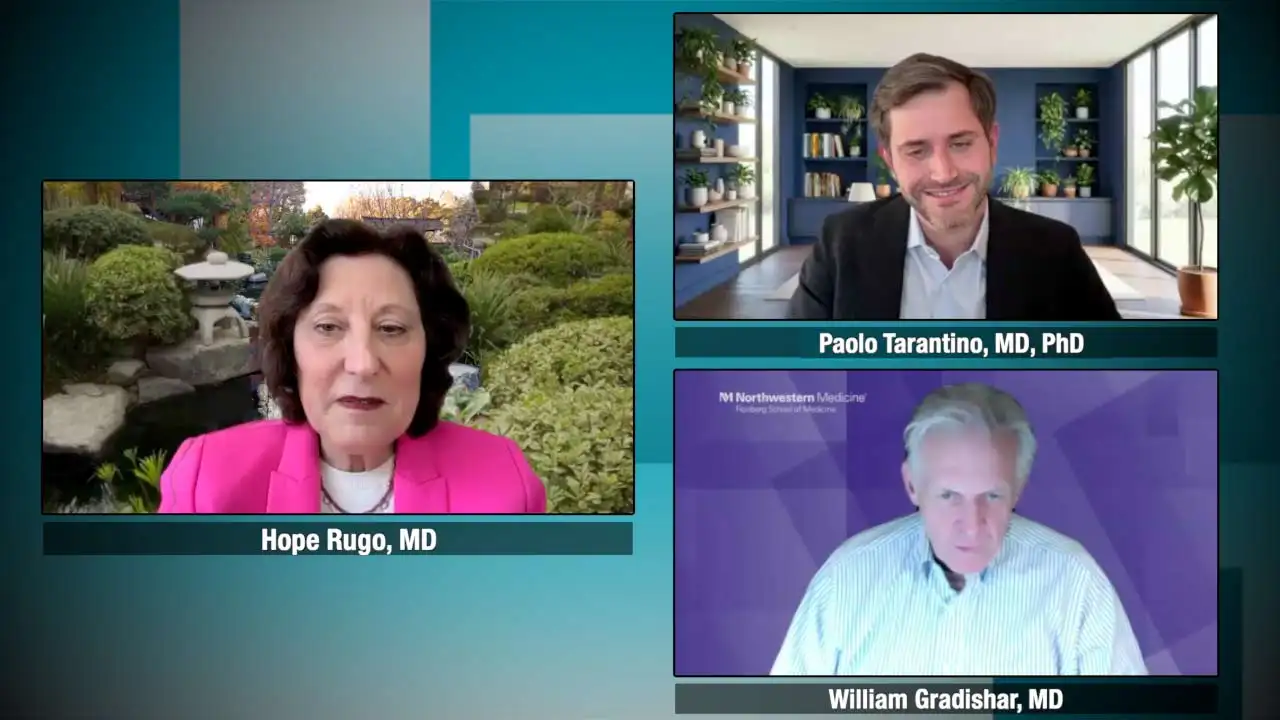
MedPage Today brought together three expert leaders in the field: Moderator Hope S. Rugo, MD, of the City of Hope Comprehensive Cancer Center in Duarte, California, is joined by William J. Gradishar, MD, of Northwestern University Feinberg School of Medicine in Chicago, and Paolo Tarantino, MD, PhD, of Dana-Farber Cancer Institute in Boston, for a virtual roundtable discussion. This first of four exclusive episodes focuses on the OPTIMA trial results.
Following is a transcript of their remarks:
Rugo: Hello and welcome to MedPage Today and our review of the most recent and clinically important updates from ASCO 2026. We’re just going to cover a few controversial topics. Having just come back from ASCO, I think this is the perfect time to talk with our smart colleagues to figure out how they would interpret this data and place it into clinical context. I’m Hope Rugo from the City of Hope Comprehensive Cancer Center. I’m joined by Paolo Tarantino and Bill Gradishar. Please introduce yourselves.
Tarantino: Hi, everyone. I’m Paolo Tarantino from Dana-Farber Cancer Institute. Such a pleasure to join this roundtable.
Gradishar: And I’m Bill Gradishar from Northwestern in Chicago. Happy to be here.
Rugo: So we saw some really interesting data and I just want to start by saying there was tons of data we can’t discuss. So in this brief area, we’re going to try and talk about controversies more than actual, just everything that was worth seeing and understanding.
So I think that the most practice-changing presentation at ASCO, interestingly, was the OPTIMA trial. This was a phase III trial that is a non-inferiority trial and that’s interesting because we don’t have a lot of those, trying to see whether or not you could use a gene expression test to decide which patients with high-risk, early-stage, ER-positive, HER2-negative breast cancer need chemotherapy in addition to endocrine therapy.
So what they showed was essentially equivalency, which was interesting. So they looked at the subpopulation of patients who got control with a risk of recurrence less than or equal to 60, or test-directed, meaning they got endocrine therapy, and they saw an identical outcome for invasive disease-free survival and recurrence-free interval. There was some concern about menopausal status, but they actually showed that the same was true for women who were premenopausal.
So, Bill, how would you incorporate this into clinical practice and will you?
Gradishar: So I think it’s intriguing because the use of molecular tools to decide whether or not to give chemotherapy has been around for a while, but, at least in the U.S., we more or less used Oncotype as our primary tool. Some are attracted to MammaPrint, but Prosigna is distinctly unusual to be used in the U.S. and that’s probably the biggest hurdle.
Now there is no reason to be of the belief that this isn’t a good test. It’s widely used in other parts of the world. And I think the one thing that was really interesting is, even in RxPONDER, we’re going to a lower nodal burden. Here we had up to nine nodes, and about 18% of those patients were in that four to nine node group. So it’s a higher-risk group. And basically demonstrating equivalence with using that score of less than 60, risk of recurrence score less than 60, they did as well as the patients who were on the other treatment arm.
So again, this tool may allow us to avoid chemotherapy in a lot of patients, including higher-risk patients that we’re not accustomed to using these tools in.
Rugo: Yeah, I think that’s a really good point. And Paolo, how about you? And would you be ordering Prosigna now and in which patient population?
Tarantino: So yeah, I think the data was striking. I wasn’t expecting the curves to be so overlapping, basically suggesting, I think, two important things. First of all, that chemotherapy doesn’t become magically effective in premenopausal patients with indolent tumors, but that probably, as you mentioned, in RxPONDER the role of OFS [ovarian function suppression], the lack of OFS could have led to the results of a benefit of chemo. And also the chemo doesn’t magically become effective after three positive nodes. Irrespective of positive nodes, there didn’t seem to be a benefit. So I think I will definitely consider Prosigna in those patients that were not informed well by RxPONDER.
I do feel that one issue is the follow-up because we have less than 5 years of follow-up. We do need more follow-up. We do need more information about patients with N2 disease. It was a small population. We know that these patients can recur after 5 years, so I think we need more data.
But even with this data, I think it’s enough to request a test to inform better our patients. And it really seems if there’s a benefit of chemotherapy in this population with recurrence score less than 60, it’s very small and it’s in the order of the rate of severe side effects with chemotherapy. So I think we’ll give much less chemotherapy in the future.
Rugo: Yeah, I think it was really important too because we had been looking at patients with one to three positive nodes and thinking maybe if we get an Oncotype score, we could try and decide which patients could be treated with ovarian function suppression and an AI [aromatase inhibitor] and a CDK4/6 inhibitor instead of chemo, which may be a better treatment for them biologically. So I think that this does help in that group.
I have to say for 49 positive nodes, I think the follow-up is too short. I don’t know. There’s not enough patients and I probably would still be giving those patients chemotherapy in general just because of also risk of heterogeneity. But I thought it was interesting. There was a 1.6% 5-year difference. It’s very small in patients with one to three involved nodes and four to nine involved nodes, both of them.
So it does speak to your question about the 4 years of follow-up, but [Robert C.] Stein, the presenter, said that doesn’t really matter because the chemo benefit is all going to be front-loaded, but I don’t think we know that completely. So I think we just need to wait and see.
But Bill, will you order Prosigna?
Gradishar: Well, I’ve never ordered it before, but I might think about it now. And the other thing about this too is more and more patients like this would probably get a CDK4/6 inhibitor in the adjuvant setting so that may color the results a little bit or make them challenging to interpret as time goes on.
But I think longer follow-up is the key and just the general lack of familiarity, at least by American physicians, with Prosigna.
[ad_2]
Source link : https://www.medpagetoday.com/meetingcoverage/ascoexpertroundtablebreastca/121667
Author :
Publish date : 2026-06-09 16:18:00
Copyright for syndicated content belongs to the linked Source.