[ad_1]
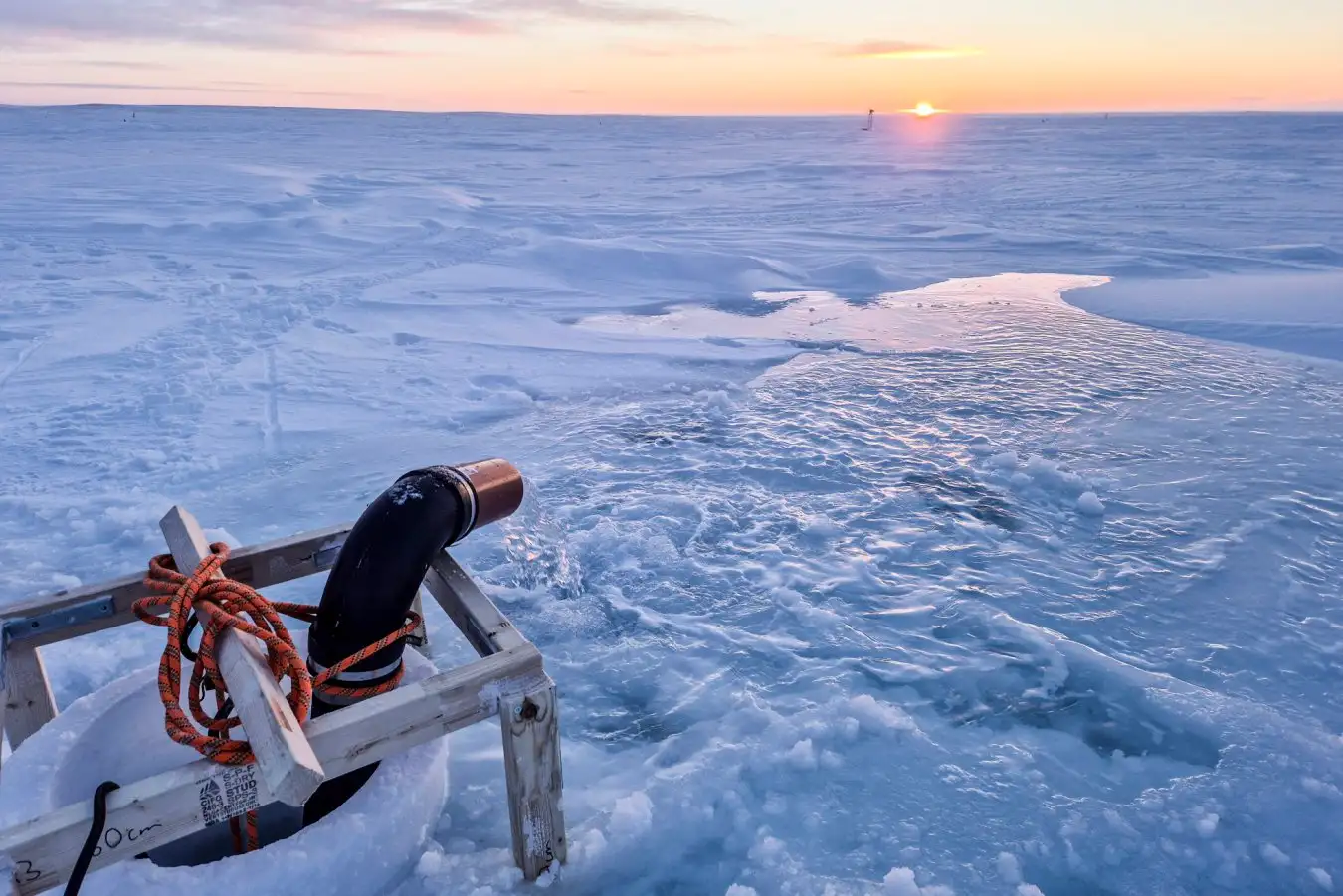
The Real Ice trial in Canada pumped seawater from below the ice sheet onto the surface
Real Ice
Each winter, Canada builds more than 7000 kilometres of ice roads, in part by drilling holes in lake ice and pumping water onto the surface, where it freezes and thickens the ice for massive vehicles, as seen in the TV series Ice Road Truckers.
If we did the same thing on top of Arctic sea ice, could we thicken it enough to stop it from disappearing? That’s the question tested by geoengineering researchers in field trials in Canada and Norway in 2024 and 2025. It’s one relevant to the whole planet, since Arctic sea ice, which is expected to disappear completely in the summertime as early as the 2030s, reflects more of the sun’s warmth back into space than open ocean.
While both trials thickened sea ice, the scientists in Canada said this slowed the ice’s melt when summer came, while those in Norway found it didn’t. Both groups have continued doing trials.
“Yes, the ice is getting thicker, but how it delays the eventual disappearance of the ice remains an open question,” says Christian Haas at the Alfred Wegener Institute in Bremerhaven, Germany, who worked on analysing the Norway trial results.
There, the Dutch company Arctic Reflections drilled a hole through nearly a metre of ice in a lagoon in the Svalbard archipelago in April 2024 and shoved an ice road pump into it. For a little over an hour, a stream of seawater flooded the roughly 20-centimetre layer of snow on top of the ice.
The team repeated the process the following day to create a 1500-square-metre puddle of slush that froze hard within the next three days, increasing the total sea-ice thickness from 90 centimetres to 1.16 metres. But a camera left at the site through June showed that although the thickened ice started “rotting” later, it ultimately still melted away on the same day as a control site in the lagoon.
Then, between December 2024 and February 2025, the UK company Real Ice drilled holes and pumped water onto sea ice at eight sites in the Northwest Passage, just south of the Inuit village of Cambridge Bay, Canada. These researchers flooded and froze the snow layer over a total of 250,000 square metres, thickening some sites twice.
By May 2025, the average thickness at sites flooded in January and February was 1.93 metres, compared with 1.62 metres at three control sites.
When seawater freezes, it expels salt as a briny liquid. The thickening process heated the sea ice and made it saltier as this brine drained through pores in the ice.
If the thickened ice remains saltier and more porous into the melt season, that could speed up its melt, much like putting salt on an icy road, worries Haas. “It’s not about the thickness, but about the quality of the ice,” he says.
But the brine pores could also drain meltwater and slow the ice’s disappearance, according to Andrea Ceccolini of Real Ice. Long wires of temperature sensors drilled into the ice suggested the test sites in Canada melted more slowly than the historical average, lasting an estimated seven to 10 extra days.
Both trials found thickening made ice brighter, with Real Ice’s test sites showing up as white spots amid blue meltwater in satellite imagery in June. “We were contributing to reducing the heating of the planet,” says Ceccolini.
The Arctic Reflections study, however, estimated that the cooling effect barely compensated for the warming from pump and vehicle emissions.
A few years of research is needed to assess whether thickening could help preserve Arctic sea ice, says Michel Tsamados at University College London. He is working on modelling that, with support from a £9.9 million UK government grant, which is also funding Real Ice and Arctic Reflections.
“It can work locally,” he says. “Then what about 10 kilometres? What about 100 kilometres? Should it be done?”
The effects on wildlife, like ice algae, polar bears or seals, also aren’t clear. But if sea-ice thickening proves to be feasible, someday 500,000 underwater drones could refreeze 1 million square kilometres of sea ice, melting upward through the ice with heated hoses, according to Real Ice.
Arctic Reflections is considering refreezing a few crucial areas, like straits where sea ice flows south to melt.
But last year, 42 scientists authored an article arguing that polar geoengineering, including sea-ice thickening, was unfeasible and could distract from reducing emissions.
“This technique might have limited use as a small-scale stopgap in some localised regions, but it doesn’t represent a practical large-scale solution,” says Michael Meredith at the British Antarctic Survey, who wasn’t involved in any of the research.
Topics:
[ad_2]
Source link : https://www.newscientist.com/article/2528409-geoengineering-can-thicken-arctic-sea-ice-but-for-how-long/?utm_campaign=RSS%7CNSNS&utm_source=NSNS&utm_medium=RSS&utm_content=home
Author :
Publish date : 2026-06-01 08:00:00
Copyright for syndicated content belongs to the linked Source.