[ad_1]
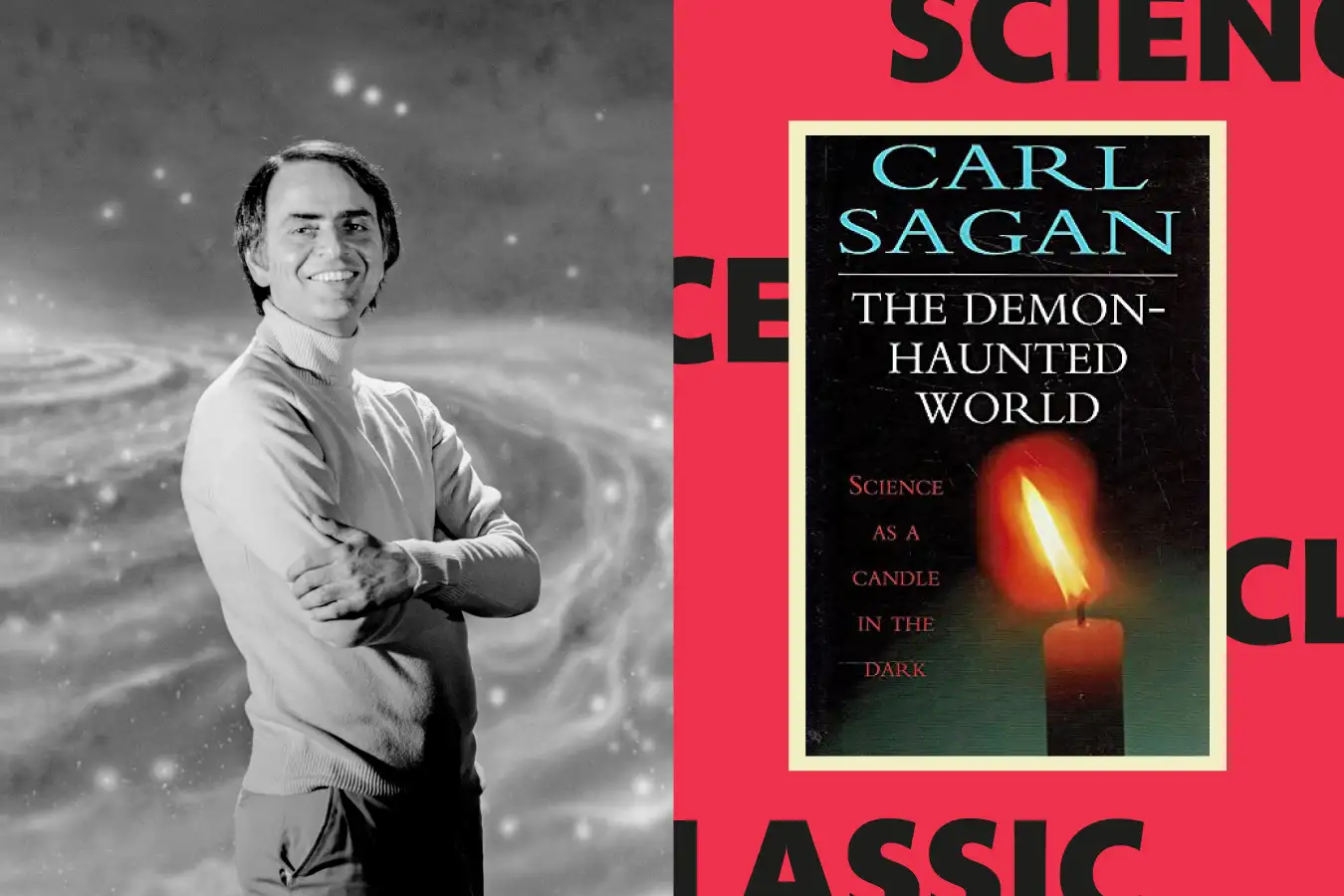
How does Carl Sagan’s The Demon-Haunted World hold up today?
Once every few months or so, some passage or another from Carl Sagan’s The Demon-Haunted World: Science as a candle in the dark goes viral online for its seemingly prescient descriptions of a world in which critical thought and skepticism are waning, leaving behind a morass of misinformation and credulity. This one, for example: “I have a foreboding of an America in my children’s or grandchildren’s time – when the United States is a service and information economy; when nearly all the manufacturing industries have slipped away to other countries; when awesome technological powers are in the hands of a very few, and no one representing the public interest can even grasp the issues… when, clutching our crystals and nervously consulting our horoscopes, our critical faculties in decline, unable to distinguish between what feels good and what’s true, we slide, almost without noticing, back into superstition and darkness.”
Sagan wasn’t some sort of Nostradamus, but he believed powerfully in the scientific method, in evaluating claims based only on the evidence behind them. An understanding of the future requires an incisive understanding of the present and the past, and he understood far more than most do. In some ways, The Demon-Haunted World is a manual for understanding, in which Sagan sets out to explain through vignettes and examples what the scientific method truly is and how to apply it in everyday life. That’s what makes it so important now, when the world is increasingly difficult to understand and when so many have simply stopped trying.
When deciding which of Sagan’s many books to dub his greatest, it was tempting to pick Cosmos, his ode to the universe. After all, his writing is achingly beautiful, and his descriptions of the universe never fail to inspire awe. But in these times, The Demon-Haunted World is nothing short of required reading for anyone who considers themselves a critical thinker (or who would like to be one). It still contains the sort of stunning prose that helped make Sagan so iconic – in rereading it, I occasionally found myself staring at a sentence over and over again, wondering if I’d ever produce something so lovely, or if I should just quit writing now.
On John Glenn seeing “fireflies” outside his orbiting capsule that were actually specks of burning paint, Sagan wrote: “The lure of the marvelous blunts our critical faculties. (As if a man become a moon is not marvel enough.)” Even those words are a marvel!
Behind all that beautiful writing is a sense of warmth, of genuine awe at the wonders of the universe, of empathy and humanity and generosity of spirit. It’s clear that Sagan isn’t looking down on anyone even as he debunks the ideas they hold dear – it’s key that he debunks the ideas rather than the people. If one were to write The Demon-Haunted World now, in today’s increasingly polarised, increasingly angry world, it would be difficult to keep it from turning into a manifesto or even a screed. That’s part of what makes Sagan’s warmth, humour and considered arguments so refreshing: when it comes to the so-called demon of misinformation, he is, genuinely, not angry, just disappointed. He acknowledges that misinformation can be a systemic problem, not an individual one, but it’s one that we can nevertheless resist as individuals.
It’s never been easier to find information, and it’s also never been easier to find wrong information. That’s what makes this book so relevant now. It’s not just debunking misinformation or giving the latest scientific information. In fact, much of the actual science cited in the book is a bit dated – it was published in 1995, after all – but in the end, that’s practically irrelevant. This isn’t a book about scientific discoveries; it’s about the process of science. It’s a handbook for thinking.
After all, the process of science isn’t cloistered away in laboratories; it’s how we evaluate any of the ideas with which we’re constantly presented every single day. That’s harder and harder to do, and The Demon-Haunted World is both a helpful reminder that all that hard work is worthwhile and a guide to distinguishing between truth, falsehood, and outright lies. It isn’t always obvious, and the tools Sagan presents in his so-called baloney detection kit are genuinely useful and worth keeping in mind. It won’t turn you into some sort of Nostradamus, just like it didn’t for Sagan, but it will help you understand the world. All that with a side order of marvels.
Topics:
[ad_2]
Source link : https://www.newscientist.com/article/2531003-carl-sagans-the-demon-haunted-world-is-still-supremely-relevant-today/?utm_campaign=RSS%7CNSNS&utm_source=NSNS&utm_medium=RSS&utm_content=home
Author :
Publish date : 2026-06-18 13:00:00
Copyright for syndicated content belongs to the linked Source.