
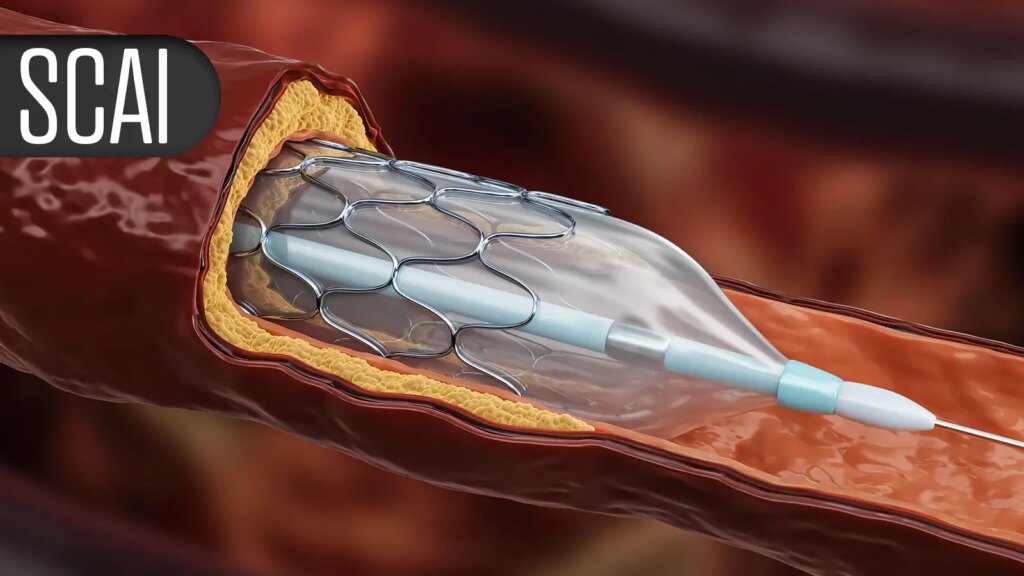
There were tradeoffs for early adopters going the transradial route for infrainguinal peripheral artery intervention, according to a retrospective study using data from the XLPAD registry.
Among cases of lower extremity peripheral artery disease (PAD) revascularization, a major limb-threatening event (a composite of all-cause mortality, clinically driven repeat revascularization, and major amputation) occurred in 15.8% of those using radial access compared with 8.1% of those using conventional femoral access at 6 months (P=0.006), reported Sameh Sayfo, MD, MBA, of Baylor Scott & White, the Heart Hospital in Plano, Texas.
In addition, target vessel revascularization occurred in 11.7% of the radial access group versus 5.1% of the femoral access group (P=0.006), while death and major amputation occurred in 3.3% and 1.1% of each group, Sayfo said at the Society for Cardiovascular Angiography and Interventions annual meeting held in Montreal.
Radial access was also associated with a higher rate of minor procedural complications, namely non-flow-limiting dissections (5.5% vs 0%, P<0.001).
On the other hand, advantages with radial access included shorter hospitalizations (median 5 vs 24 days, P<0.001) and lower contrast volume (mean 100.3 vs 173.2 mL, P<0.001).
“The way I look at radial-to-peripheral intervention nowadays is that we are in the first inning. We’re similar to where we were in radial-to-coronary intervention 15 years ago. There’s a lot of interest in it, but there’s still limitation,” Sayfo said during a press conference.
Early setbacks are to be expected with a new technology, he suggested. “There’s a limitation of technology, and also the experience of the operator, where the femoral access operator had much, much more experience and almost all the equipment that they need. I think that may have affected some of the results.”
Even so, the radial arm had fewer strokes at 6 months versus the femoral arm, though this did not reach statistical significance (0% vs 0.7%, P=0.5).
Additionally, radial access demonstrated noninferior technical success within a prespecified margin of 15% (94.9% in the femoral arm vs 87.2% in the radial arm).
The interest in transradial access for PAD interventions started with the success of this approach in coronary interventions, in which its benefits include reduced bleeding and access site complications, lower mortality, improved patient comfort, and shorter hospital stays. For radial access and lower-limb interventions, there is also the operator advantage of not having to work as close to the x-ray source as with transfemoral access, on account of the feet-first patient position.
However, the equipment required for transradial peripheral intervention is still maturing.
“The technology [with] radial access is limited to a certain degree, we don’t have all the equipment we need,” Sayfo noted. “The technology is improving. Every year we’re getting more and more industry interest in providing the new technology.”
“With proper training, experience, and the right equipment, many patients can be safely and effectively treated by a transradial approach to treat their PAD,” he concluded in a press release. “Continued research and device innovation will be important to advance the technique further. We hope these findings help inform future randomized trials and ultimately contribute to meaningful changes in clinical guidelines for peripheral arterial interventions.”
Sayfo and colleagues performed the retrospective analysis using the multicenter, core-laboratory adjudicated XLPAD registry.
Propensity score matching yielded mostly comparable radial access and femoral access cohorts of 273 patients each. Mean age was 71 years, 32% were women, and 89% were white. Chronic limb-threatening ischemia was observed in 14.5% of participants, and 40.8% had diabetes.
Despite matching, the radial access group still had significantly more patients with myocardial infarction (30.4% vs 16.8%) and prior stroke (19.0% vs 10.3%) in their medical history compared with the femoral group.
The rate of procedural success favored the femoral access cohort (94.5% vs 83.2%, P<0.001).
The duration of the PAD intervention was no different between groups, and use of fluoroscopy was also comparable.
Major complications such as flow-limiting dissection and major bleeding were also not significantly different between groups.
The observational analysis left room for residual confounding, Sayfo acknowledged, adding that there could be operator bias in the selection of treatment modality based on expertise, device availability, and cost.
“What’s really going to make a difference is to move from the retrospective model to a prospective, multicenter study, where we’re looking at all-comers, and we divide them into radial versus femoral,” he said. “I think that will give you a true story of what radial [access] can achieve in the future.”
Please enable JavaScript to view the comments powered by Disqus.
Source link : https://www.medpagetoday.com/meetingcoverage/scai/121024
Author :
Publish date : 2026-04-29 18:30:00
Copyright for syndicated content belongs to the linked Source.