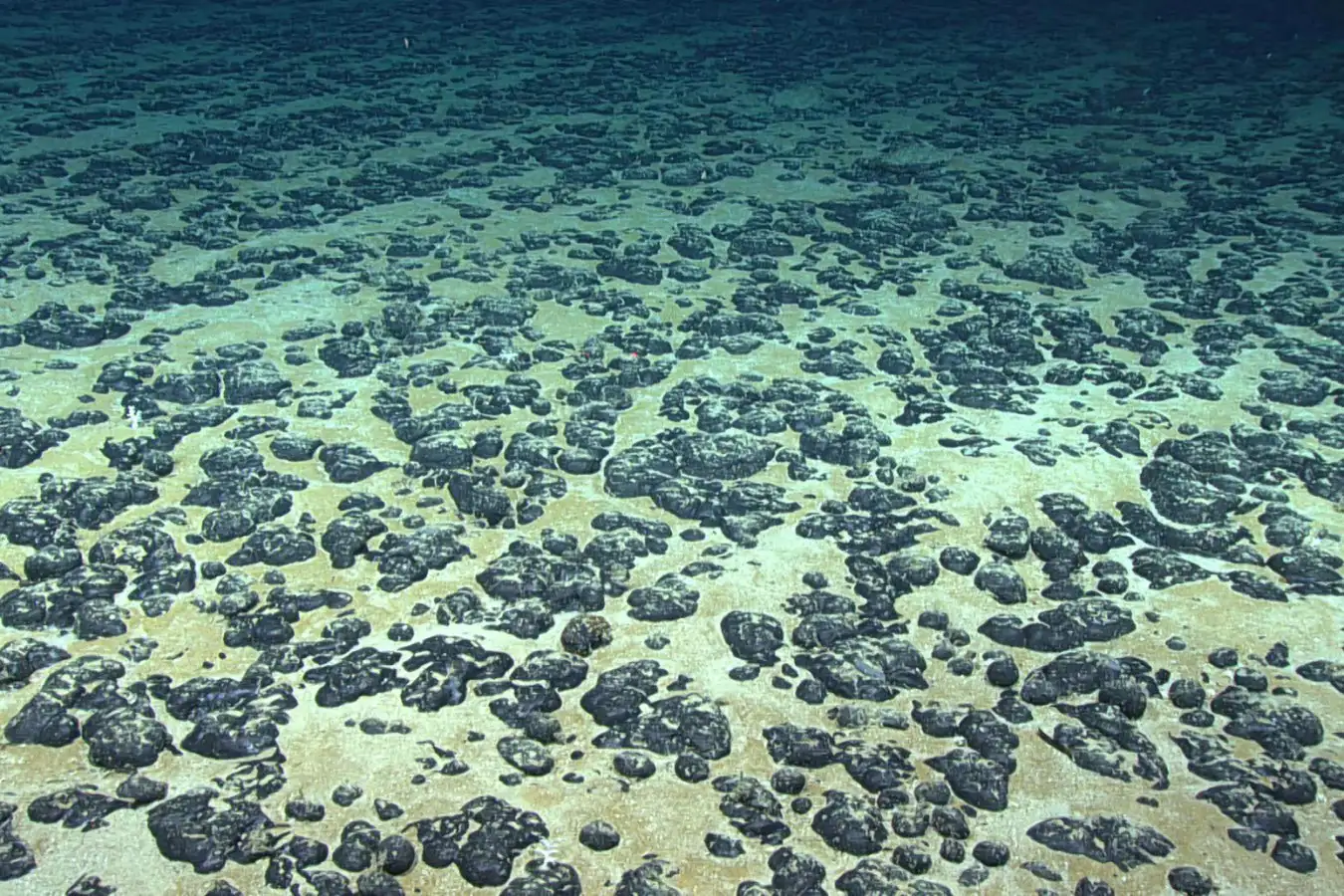
Seafloor covered with manganese nodules
Science History Images/Alamy
A process to extract metals from their ore with hydrogen could make deep-sea mining for valuable materials more sustainable than mining on land, a new study claims.
Swathes of the ocean floor are littered with nodules the size of tennis balls. These polymetallic nodules are comprised largely of manganese, with smaller amounts of nickel, copper and cobalt, as well as other elements. As the construction of solar power and electric vehicles booms, demand for these metals is increasing because they are vital components of batteries and wiring. But plans to mine for the polymetallic nodules are highly controversial because operations to collect them would potentially harm the deep-sea floor – one of the last pristine ecosystems on Earth.
Even so, some researchers suspect that deep-sea extraction will eventually take place. “I think there is a good chance that someday people… will mine the nodules,” says Ubaid Manzoor at the Max Planck Institute for Sustainable Materials in Germany. “So better to have a good process [for extracting metals] after mining than to have one more dirty process.”
The Metals Company, a Canadian deep-sea mining company that has applied for a deep-sea mining permit from the Trump administration, plans to extract metals using a fossil fuel-based approach involving coke and methane. Its process involves placing the nodules first in a kiln and then an electric arc furnace – a greener alternative to a traditional blast furnace. Even so, the company says its approach will produce 4.9 kilograms of carbon dioxide emissions for every 1 kilogram of valuable metals.
Manzoor and his colleagues have found a way to lower these extraction-related emissions. Their system doesn’t involve a kiln. Instead, the nodules would be ground into smaller pellets and placed straight into an arc furnace that also contains hydrogen and argon gas. High-energy electrons flowing from an electrode in the furnace to the pellets would knock electrons off the molecules of hydrogen gas, forming a plasma that can be heated up to temperatures exceeding 1700°C.
The hydrogen ions in the plasma then react with the oxygen in the pellets, stripping the oxides away from the alloy and leaving pure metal behind. Besides water, the only by-products are manganese oxide and manganese ligates, which can be used for making batteries and steel.
If the hydrogen gas used in the furnace is “green” – meaning it is produced by splitting water with electricity from renewable sources – and the electricity to run the furnace is generated from renewable sources, the process should emit no CO2, according to the researchers. Today, the vast majority of hydrogen is produced using fossil fuels.
Metals like manganese are found on land as well as on the seafloor, but at concentrations about 10 times lower. Mining them on land involves moving large amounts of earth, and extracting the metal from the ore often relies on sulphuric acid. The process can result in razed rainforests and polluted rivers.
However, land-based mining could be better regulated to prevent environmental destruction, and the smelting of the metals could be done with green hydrogen and renewable electricity rather than fossil fuels, argues Mario Schmidt at Pforzheim University in Germany. At that point, vacuuming up nodules from the seabed wouldn’t necessarily be more sustainable.
“We do not see any fundamental advantage for deep-sea mining in terms of carbon footprint,” he says. “The sustainability of deep-sea mining fails because of the threat it poses to the biodiversity of deep-sea flora and fauna.”
But the process that Manzoor and his colleagues have developed could help deep-sea mining become more economically viable, according to David Dye at Imperial College London.
“In addressing how you would do the extraction metallurgy downstream of actually picking it up off the seabed, you may be able to then open up the business case and the environmental case to make that attractive,” he says.
Manzoor stresses that the research isn’t meant to advocate for deep-sea mining, and the environmental impacts should be fully investigated.
Topics:
Source link : https://www.newscientist.com/article/2505450-have-we-found-a-greener-way-to-do-deep-sea-mining/?utm_campaign=RSS%7CNSNS&utm_source=NSNS&utm_medium=RSS&utm_content=home
Author :
Publish date : 2025-11-24 12:15:00
Copyright for syndicated content belongs to the linked Source.