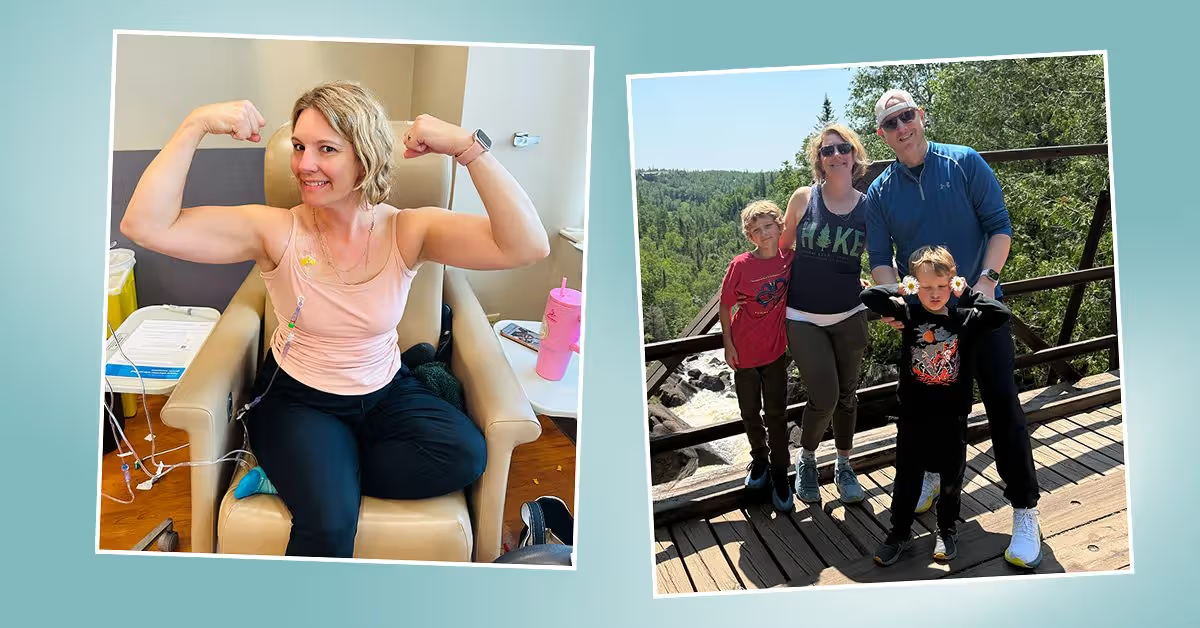
- Heather Kaiser was diagnosed with early onset colon cancer at 42. She shares the story of her diagnosis, treatment, and living a full life with cancer.
- As an overall healthy person, she never expected that her life would be turned upside down with a cancer diagnosis.
- As a mother of two young boys, Kaiser’s greatest concern was how she could continue to show up for them amid her battle against colon cancer.
Heather Kaiser is a mom of two boys and an attorney living a full and busy life. When she went in to see her doctor in 2025 at age 42 about gastrointestinal issues, she had no idea she would be facing an indefinite medical journey.
The doctor sent her home, telling her that her symptoms were most likely related to hormones or her diet. She began to feel better and joked to her friends that there was no way she could have cancer.
However, her symptoms soon returned despite eating a healthy diet. Within a month of symptom recurrence, Kaiser found herself in the emergency room. She was once again sent home, this time being told that it was “women’s issues.”
At a follow-up with her OB-GYN, she said her symptoms were finally being taken seriously, and she received a referral to a gastroenterologist.
However, when she came out of a colonoscopy, the doctor was visibly upset. He told her, “I cannot believe I have to tell you this. I found a mass the size of a fist.” He continued to tell her that it would have to be surgically removed and that it was most likely cancer.
“I held out hope for a good week, as we waited for pathology,” Kaiser said. “But when I got it back, I was like, ‘OK, so … I have cancer.’”
She didn’t tell anyone, even her husband, for at least a day. She needed the time to process the news herself before she told others.
“We all believed that we had caught it early, and I was just gonna be able to do surgery,” Kaiser said. “It just hasn’t been my story.”
It was initially thought that Kaiser had a traditional form of colon cancer, which is generally slow-growing.
After talking with surgeons, she scheduled her surgery for June 2025, six months after her initial visit to the ER.
“[It] was kind of far out, but there was life going on. I have two small boys, who were 10 and 5 at the time. I wanted to wait until they were done with school,” she said.
While the surgery went well overall, Kaiser’s surgeon was fairly certain they didn’t achieve clean margins. Clean margins indicate that no cancer cells were present at the outer edges of the tissue removed during surgery.
Kaiser was then referred to an oncologist, who sent the tumor out for genetic testing.
“I remember sitting in the hospital, and I was so afraid of chemo,” she said. “I was afraid of how I was gonna feel, how I was gonna look, and mostly, how I was gonna be able to show up as a mom.”
Typically, colon cancer spreads to the lungs and liver. However, in her case, it spread to the lymph nodes surrounding the lungs and the liver.
Kasier’s health team noted how unusual this was and wanted to wait for her biomarker results before making a treatment plan.
When the biomarker testing results came back, Kaiser learned that she had a unique type of colon cancer called BRAF, a mutation only present in around 10% of metastatic colorectal cancers.
Kaiser had a BRAF mutation known as V600E, which appears in approximately 96% of BRAF colorectal cancer.
This meant that there would be a completely different treatment for her cancer.
“The prognosis was 13 months,” she said. However, there were clinical trials going on for that specific V600E mutation at the time.
‘Patient zero’ in a clinical trial
In August 2025, she became part of the protocol designed by the
“I called myself Patient Zero, even though I’m sure I was never [actually] called that!” Kaiser joked. “Mayo Clinic was following me, Minnesota Oncology was following me, I’m being followed by the [University of Minnesota], because I’m just so new.”
She began a regimen of four different drugs — three were administered by IV, and one was an oral medication called Braftovi.
Prior to Braftovi, Kaiser’s specific colon cancer mutation was chemo-resistant, which is why her outlook was so grim.
However, Braftovi not only targets the cells that allow cancer to reproduce, but also enhances the effects of other drugs.
“I was really cold sensitive. I couldn’t have anything cold. I couldn’t touch anything cold. It was really rough,” Kaiser said.
She tried many medications to help with symptoms like nausea, but nothing worked. She felt like she would just have to live with the nausea and spend her life eating toast and applesauce all the time.
“I take an oral cannabis pill. And that finally helped with the nausea. I take it before bed, and I take a gummy in the morning to help with the nausea and fatigue during the day.”
Kaiser went in for her first CT following treatment in October 2025. She had done eight rounds of treatment at that time.
“The CT scan came back, ‘complete response to treatment, no evidence of disease,’ which was a shock. It was a shock to my doctors. They didn’t even see those kinds of fast results in the trial.”
Kaiser’s doctors began to examine what might have contributed to her remarkable response to the treatment.
They said her age and overall health were possibilities. She had always exercised regularly and had continued to do so through treatment.
“My oncologist also thought that my positive attitude contributed to my quick response,” she said.
Despite her CT results, Kaiser has had to continue treatment. This is because the V600E mutation isn’t curable and doesn’t go into remission.
“They’ve never had anyone live for five years yet,” Kaiser said. “But they just don’t have people who are living and not treating.”
Now, at 43, Kaiser said that despite her stage 4 cancer diagnosis, she leads a full and busy life.
The most challenging part, she said, is navigating motherhood, work, and family life without the energy and stamina she once had.
Still, Kaiser’s supportive community of family, friends, and neighbors has made a big difference in her recovery and ongoing treatment. Knowing she has help when she needs it, and even when she doesn’t know she needs it, has allowed her to continue working full-time and be the best mom to her boys she can be.
Kaiser said the best advice she can give to people who are living with cancer, especially those like her who face indefinite treatment, is the way she has lived since she began treatment.
“The best thing to do for me was to plan my life, and then just fit cancer in there, rather than [allowing] cancer to run my life,” she said.
Kaiser added that she tries to run her life first and then make space for the cancer.
“I have this really busy, awesome, full life, and I have a chronic disease I also have to treat,” she said.
Kaiser currently works with the legal team of RVO Health, the parent company of Healthline.
Source link : https://www.healthline.com/health-news/first-person-pov-heather-kaiser-colon-cancer
Author :
Publish date : 2026-04-12 08:08:00
Copyright for syndicated content belongs to the linked Source.