
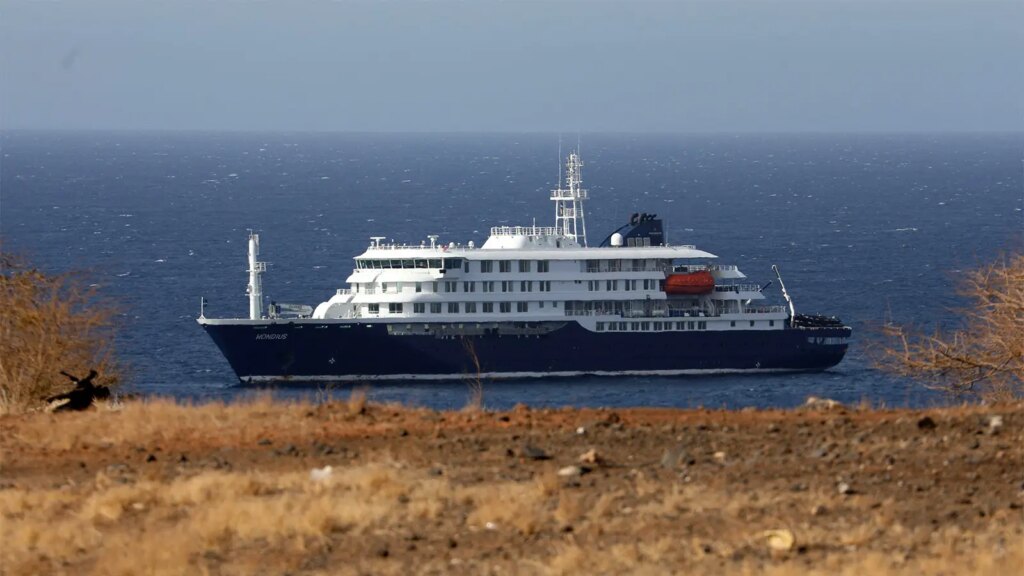
Passengers aboard the MV Hondius, the ship afflicted by a hantavirus outbreak, remain at sea, with plans to dock in the Canary Islands on Sunday.
James Lawler, MD, MPH, of the University of Nebraska Medical Center’s Global Center for Health Security in Omaha, is an expert on outbreak response and led teams aboard the Diamond Princess cruise ship when it had an outbreak of COVID in the earliest days of the pandemic.
MedPage Today asked Lawler about what’s expected to happen when the MV Hondius can finally dock, about how Americans who disembarked the ship weeks ago and returned to the U.S. are being monitored, and potential risks to healthcare workers. He also discusses a project that can help hospitals improve their infection prevention and control strategies.
An edited transcript of the conversation follows.
Why does it usually take so long for ships to dock when there’s an infectious disease on board?
Lawler: Unfortunately it’s a common occurrence when we have outbreaks of high-consequence infectious diseases. There’s obviously a huge fear factor among the general population and then politicians and policymakers often respond to those pressures and … many times end up making what are maybe not the best decisions, certainly in the interest of controlling the outbreak or in caring for the people who are affected.
That often works against the public health workers and healthcare workers trying to manage cases, trying to contain the outbreak. Delaying the ship’s docking until Sunday not only means we won’t be able to take people off of the ship until then if something happens, but it also means that responders and epidemiologists won’t have access to the ship, which is going to be an important part of doing a full investigation.
Passengers who are currently symptomatic were evacuated, but if more people develop symptoms — and this is a disease where you can decompensate pretty quickly — not being able to get them critical care until Sunday seems like a big deal.
Lawler: It does. It is a little bit more of a difficult disease to manage in that sense because the incubation period is so long, 6 or 7 weeks in some cases, and because people do tend to decompensate quickly once they start going down that path.
Usually there are several days of prodromal illness where you don’t have a lot of lung or respiratory involvement. But when the phase of disease hits where you start to get dysfunction of the cardiopulmonary system and people start experiencing shortness of breath or cough, in many cases those folks can decompensate within 24 hours, and that means that they may go from being OK, sitting around on room air, to being on a ventilator with a breathing tube down their throat.
You were aboard the Diamond Princess cruise ship in Japan during COVID. Can you talk a little bit about what the expected response would look like in this case?
Lawler: I think it’s probably true that if you’ve seen one shipboard outbreak response, you’ve seen one shipboard outbreak response, and they’re all going to be different depending on the ship, the circumstances, and the pathogen.
Things on the Diamond Princess were a bit unusual because it was very early in COVID. We really didn’t understand a whole lot about that virus: how it was transmitted, how severe the disease was, what the most important environmental and human contact risk factors were. And there were a lot of different interpretations of what appropriate infection prevention control measures should be.
It was a large outbreak that involved Japanese and American assets. This will be quite a bit smaller. It’s a much smaller ship, a much smaller group of passengers and crew. I think that the response teams will be smaller and probably a bit more organized, although it’s still going to be somewhat make-it-up-as-you-go.
It helps a lot understanding what virus you’re dealing with and what the predominant modes of transmission and risk are. So that makes it a bit easier, I think, for folks to essentially adopt the appropriate infection prevention control posture. Although I will add that there are still a lot of open questions we have about Andes virus in particular.
We’ve learned a lot over the last 6 years, particularly from COVID, but that also prompted us to reevaluate a lot of data on additional diseases that make us realize that maybe the very rigid approach we had to bucketing different types of infection risk probably didn’t really reflect how things occur in nature and we need to think about more of a continuum.
What will the procedures for bringing these people home look like?
Lawler: There will probably be multiple countries [involved]. … There will be an in-depth assessment of [individuals’] potential risk: Did they have contact with known cases? Did they have contact with people who were symptomatic?
Everybody’s been on this ship together for weeks now, sharing meals, and it’s not a large ship. There’s pretty significant mixing of all of these people together. So it’s going to be really hard in some instances to differentiate risk. I think it’s almost impossible in this situation to say that somebody is at zero risk.
At the end of the day, I think anybody who was on that ship is probably going to need to be in quarantine, or at least under close observation, for a period of time. Often these decisions will end up being situational and individual.
For some people, it may make the most sense for them to have their quarantine period in an actual dedicated quarantine unit to be able to observe them. For others, they may have home monitoring, as long as they are not in a situation where others might potentially be at risk.
All of that assessment will be done, and then there will probably be some sort of choreographed movement of those persons who are repatriated on some sort of official aircraft. Historically, for the U.S., the State Department has run those operations and uses chartered aircraft with folks that have been trained and worked with their teams in moving high-risk exposed persons or even infected patients. That was done in the 2014 Ebola crisis and in a lot of different circumstances.
Many passengers have returned home already, including several Americans. Is it a concern that they’ve been back in the community without monitoring?
Lawler: It certainly is a concern and public health officials have been working hard to track down all of these folks to do risk assessments to make sure they’re not symptomatic and to then put them in some sort of monitoring status.
Because the incubation period is so long, the period of risk goes out quite a long time, and some of these patients may have been on an aircraft with one of the symptomatic persons at that time.
Your clock starts for your incubation time and observation time at the last point of contact. That would be a point of contact that was not that long ago. They’re still well within the incubation period window and will be potentially for another month or more.
I think the [World Health Organization] made it clear that this is not the next COVID pandemic. This is not a virus that has explosive transmission potential and is going to run through a community quickly. But it does present risk potentially to people who’ve had contact with ill folks. And certainly if people do get sick, it can cause very severe disease, which is difficult to manage, often requiring intensive care and high levels of supportive care to get folks through it if they can survive.
They could still seek care in the community. What are the risks to U.S. healthcare workers?
Lawler: It certainly is a concern if any of these people end up encountering healthcare, and particularly if they’re symptomatic.
The risk in the healthcare setting, historically with this virus, has not been as severe as with many other viral diseases we deal with. The hemorrhagic fevers like Ebola, as well as SARS-CoV-2, or even influenza are much more transmissible in the healthcare setting. But there have been cases of transmission to healthcare workers and transmission to other patients in healthcare settings as well [with Andes virus].
If the passengers being monitored seek care per the correct protocols, how would they be treated?
Lawler: We would consider this a high-consequence pathogen. It has significant transmission risk from person-to-person. It has a very high lethality, about 30% for all-comers. We don’t have specific medical countermeasures for it. And so all of those things combined put this in a special category along with Ebola, Marburg, and Lassa — all the ones that we would monitor in a biocontainment unit.
I think in most cases, folks would want to move this case to a biocontainment unit where you have not only dedicated built infrastructure, but more importantly, you have a team that has been training on how to manage these cases, how to implement appropriate infection prevention control practices, how to use personal protective equipment [PPE] appropriately.
If somebody’s sick with Andes virus infection, they probably are going to end up in one of the patient biocontainment units across the country. These are the 13 top-tier centers that have been developed since the 2014 Ebola crisis. There’s now a second tier that’s being reconstituted, so there are more facilities than just those 13 that certainly have the ability to care for them. But those 13 are the top-tier dedicated units that would be used for this.
It’s important to recognize — and obviously we saw this early in COVID — we have nationally a very limited capacity for providing isolation care, particularly for high-consequence infections that require more aggressive infection prevention control posture precautions against contact droplet and airborne transmission. And so it is very demanding in terms of the resources required from a hospital to support this.
You’re involved with a project that aims to improve U.S. capacity for managing high-consequence infectious disease patients. Tell us more about it.
Lawler: Having isolation rooms at hospitals is a big capital investment. Our PPE supply chains are relatively fragile still, and there’s a waste management challenge. Finally, most hospitals don’t have the resources for a dedicated biocontainment team. All of that means it’s really difficult to take care of these patients using our current paradigm. And if it’s this challenging in the U.S., you can only imagine how challenging it is in resource-limited settings in low- and middle-income countries.
So we were thinking about creative ways to change the game, so to speak. That’s where we came up with the ISTARI project. Our partner, an engineering design firm out of San Francisco, had designed a prototype during the Ebola crisis in response to a DARPA [Defense Advanced Research Projects Agency] challenge.
They took the current paradigm of how healthcare workers put on PPE and we go interact with the patient and then we come back and we take it off. Our approach is, what if you were to put the protection around the patient? And then the healthcare worker could interact with the patient through that barrier, but not have to constantly don and doff.
We ended up developing four different products that fit different use cases, but the device that got pushed to the front was a smaller footprint device that could be used in an emergency department or a small clinic or hospital setting. We eventually took it through FDA clearance, which we got in 2024.
CareCubes started marketing the device just about a year ago to U.S. hospitals. They’ve had a number of hospitals that have made purchases, and some of the 13 [national biocontainment facilities] are going to be early adopters for this.
It’s our hope that we can use those teams to be subject matter experts for some of the smaller hospitals in their regions, because it’s not only for the potential Ebola case that comes back from West Africa. Many rural hospitals in the U.S. are seeing TB [tuberculosis] cases, and not uncommonly, drug-resistant TB cases. Unfortunately, they’re seeing a lot more measles cases now, which are incredibly infectious and transmitted in healthcare settings. They’re seeing flu, which you worry about in areas where there’s heavy poultry and livestock production because of the risk of avian influenza. All of those would benefit from early and aggressive isolation care.
The intent of this was to make it easy enough to be integrated into routine care. So somebody comes in with a fever and a cough. Until they get worked up and characterized, you could care for them through one of these devices. And now your healthcare workers are safe. All of the other patients and bystanders around them are safe. It just allows you to deliver much better care in a way that limits opportunities for outbreaks and spread.
Please enable JavaScript to view the comments powered by Disqus.
Source link : https://www.medpagetoday.com/special-reports/features/121181
Author :
Publish date : 2026-05-09 13:00:00
Copyright for syndicated content belongs to the linked Source.