
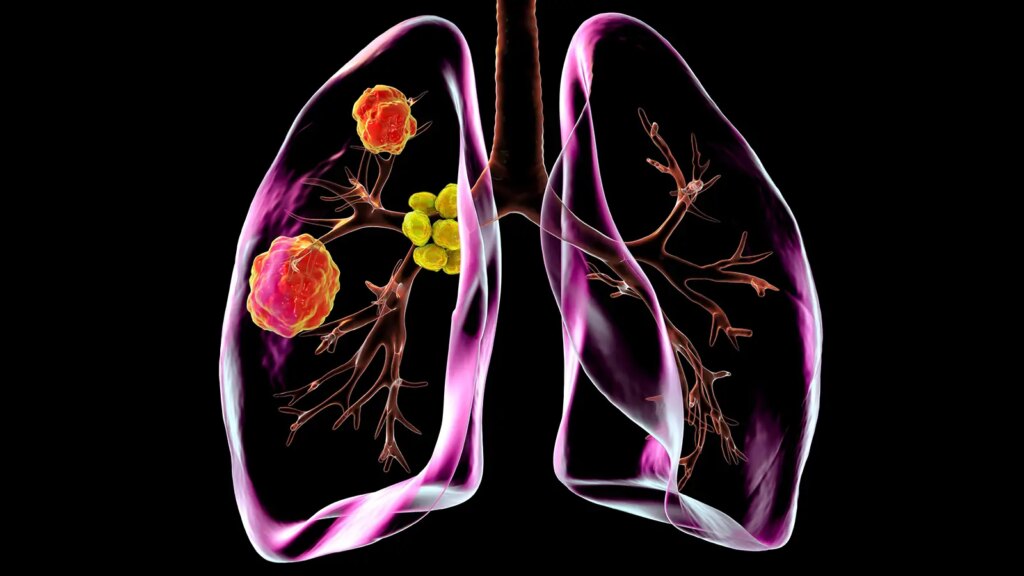
- Adding immunotherapy to neoadjuvant chemotherapy more than doubled mediastinal lymph node clearance rates compared with historical controls.
- The treatment facilitated complete tumor removal, with 93% of surgical patients achieving clear resection margins.
- Three-fourths of patients who underwent surgery remained alive and free of clinical events at 18 months.
Mediastinal lymph node clearance in stage III non-small cell lung cancer (NSCLC) more than doubled with the addition of immunotherapy to chemotherapy and facilitated more complete surgery, a small prospective study showed.
Almost three-fourths of patients had N2 (mediastinal) nodal clearance with neoadjuvant durvalumab (Imfinzi) and platinum-based chemotherapy. That compared with historical clearance rates of about 30%. Among 30 patients who had surgery after neoadjuvant therapy, all but two had clear surgical margins (R0) afterward. Three-fourths of the patients who underwent surgery remained alive and free of clinical events at 18 months.
Grade ≥3 treatment-related adverse events (TRAEs) occurred infrequently, reported Linda W. Martin, MD, of the University of Virginia Cancer Center in Charlottesville, and colleagues in Lung Cancer.
“What is unique about this trial is the focus on the subset of patients with N2 involvement, a historically challenging group of patients treated with curative intent, but with varying degrees of success,” Martin told MedPage Today. “Furthermore, this trial had rigorous requirements for documenting nodal involvement with a biopsy of the nodes pretreatment. Other studies of neoadjuvant chemo and IO [immuno-oncology] cover stages IB-III, and staging documentation is more loosely defined in those trials, thus difficult to do post-hoc, subset analysis to evaluate stage III outcomes accurately in the larger perioperative or preoperative trials.”
The trial corroborated results of previous studies showing benefits from adding immunotherapy to neoadjuvant chemotherapy, said co-author David Kozono, MD, PhD, director of Alliance Foundation Trials, which sponsored the study.
“It is the first trial to evaluate N2 nodal clearance as the study’s primary endpoint,” said Kozono, of Mass General Brigham Cancer Center in Boston. “This is important since the complete resolution of involved mediastinal lymph nodes is expected to be associated with improved survival, and because surgical resection by lobectomy or greater is well suited to achieving negative margins when it comes to removing the primary tumor.”
Although the trial used the PD-L1 inhibitor durvalumab, “it is generally felt that the mechanisms of action of other PD-(L)1 inhibitors are likely similar, and so one would hypothesize a similar benefit with the other drugs,” he added.
Previous studies of neoadjuvant therapy for resectable NSCLC usually had pathologic complete response as the primary endpoint because of its close association with event-free survival (EFS), said Jonathan Riess, MD, of the University of California Davis Comprehensive Cancer Center in Sacramento, who was not involved in the study.
“Here they used N2 nodal clearance as their primary endpoint, and they also found a good pathologic complete response rate, which was a secondary endpoint,” said Riess, a member of the NSCLC guidelines panel for the National Comprehensive Cancer Network. “The standard of care [for this population] is chemoradiation followed by immunotherapy for 1 year, but we do consider this type of approach with chemoimmunotherapy in select N2 patients.”
“This just reinforces this approach as a good option in select patients with N2 disease and stage III non-small cell lung cancer,” he added. “I would consider this a practice-affirming study.”
Stage III NSCLC with N2 involvement can be challenging to treat because the disease can invade critical structures in the chest and is not always amenable to surgery. Chemotherapy, with or without radiation therapy, has been the standard approach to shrink the tumors but has met with limited success, Martin and colleagues noted in their background information.
Use of surgery in patients with stage III NSCLC has decreased since publication of the landmark PACIFIC trial, which showed significant improvement in survival with chemoradiation followed by durvalumab. Currently, about 10-15% of patients with stage III disease undergo surgery, the authors continued.
Induction therapy that achieves higher response rates is appealing because of the potential to allow more patients to undergo surgery and the potential for better disease control. For example, the NADIM trial of chemoimmunotherapy with nivolumab (Opdivo) showed a 5-year OS of 69% in a mixed stage III patient population. That compared with 43% in the PACIFIC trial.
For the AFT-46/CHIO3 study, investigators sought to determine whether the favorable results with chemoimmunotherapy could be applied specifically to the N2 subgroup of patients with stage III NSCLC. Eligible patients had potentially resectable, previously untreated stage IIIA/B NSCLC with pathologically proven N2 disease. Patients with non-squamous NSCLC received durvalumab plus pemetrexed-cisplatin neoadjuvant chemotherapy, and those with squamous histology received durvalumab with docetaxel-cisplatin chemotherapy. Carboplatin could be substituted for cisplatin in either group.
Prior to surgery and 4-8 weeks after completion of neoadjuvant therapy, patients underwent staging with CT and FDG-PET imaging. Patients with no evidence of disease progression in the chest or elsewhere, including stable disease, were eligible for surgery. The primary endpoint was clearance of N2 disease.
The trial had an accrual goal of 55 patients with 42 expected to undergo surgery. The study ended early after enrollment of 38 patients (37 evaluable) because the primary endpoint had been met (≥50% improvement over the historical rate of 30%).
Subsequently, 30 patients (81%) underwent resection, and 22 (73.3%) had N2 nodal clearance. The neoadjuvant therapy led to a pCR rate of 30%, and 28 of 30 patients (93.3%) achieved R0 status.
After a median follow-up of 16.3 months, the 18-month EFS was 60.6% in all patients and 73.4% in the 30 patients who had surgical resection. Grade ≥3 TRAEs occurred in six of 37 (16%) patients, most commonly lymphopenia.
Data analysis will continue, with a focus on the completeness, safety, and functional recovery associated with the surgery, given the complex nature of the operations, said Martin. The resulting information will be useful going forward, as interest in surgery has increased substantially since publication of the NADIM results.
Please enable JavaScript to view the comments powered by Disqus.
Source link : https://www.medpagetoday.com/hematologyoncology/lungcancer/121030
Author :
Publish date : 2026-04-29 21:02:00
Copyright for syndicated content belongs to the linked Source.