
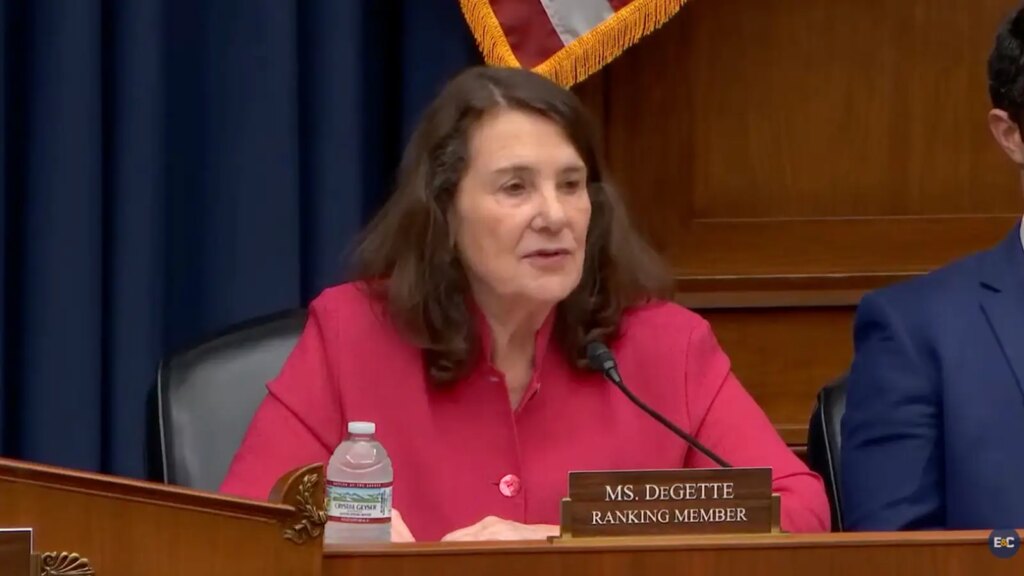
A House hearing on how to improve the Medicare Physician Fee Schedule and encourage more use of advanced alternative payment models (AAPMs) included lots of agreement on problems, but not as much discussion of solutions.
“Medicare payments to physicians impact not just the 70 million Medicare beneficiaries, but essentially all patients, given that more than 95% of clinicians are paid through the program,” Rep. Diana DeGette (D-Colo.), ranking member of the House Energy and Commerce Health Subcommittee, said at a hearing Wednesday. However, she added “these payments aren’t keeping up with inflation, which means that America’s physicians are paid less and less every year. In fact, Medicare physician payment has declined 33% in real terms since 2011.”
Even the Medicare Payment Advisory Commission, “not exactly known for recommending reckless spending of tax dollars, has called for an inflationary update to Medicare physician payments,” said DeGette. “An increase based on the Medicare Economic Index [MEI, a measure of healthcare inflation], among other reforms, would not only ensure payment keeps up with the rising input costs, but also simplify the healthcare payment system.”
The inflationary update was something almost all the players agreed on. “End Physician Fee Schedule budget neutrality and create stable and predictable annual physician reimbursement updates linked to the MEI,” said William Fox, MD, an internist and former board chair of the American College of Physicians.
“Reform budget neutrality requirements and provide an inflationary update,” said Steven Furr, MD, former president of the American Academy of Family Physicians.
“Budget neutrality” refers to the requirement that any spending included in a congressional bill must also include a corresponding cut to “offset” the spending; that requirement often pits specialties against one another when an increase in payments to one physician specialty results in decreases in payments to another.
Rep. Raul Ruiz, MD (D-Calif.), touted a bill he is cosponsoring with Rep. Gus Bilirakis (R-Fla.) that would add in the inflationary update based on the MEI. “Many providers cannot effectively plan from year to year when they are concerned about cuts every year,” said Ruiz. “This legislation would help physicians keep up with the rising costs of practicing medicine.”
Another point of agreement was the problems with the Medicare Access and CHIP Reauthorization Act of 2015 (MACRA), which instituted a quality-based payment program with two “tracks.” Under the first track, the Merit-Based Incentive Payment System (MIPS), participating clinicians receive rewards or penalties based on their performance. Under the second track, clinicians receive annual bonuses for participating in certain types of AAPMs that feature value-based payments.
“The one-size-fits-all value-based models under MACRA do not adequately reflect the role of consultative referral-based physicians like radiologists,” said Dana Smetherman, MD, MPH, CEO of the American College of Radiology. “We need models that are more specialty-specific, more clinically relevant, and less administratively burdensome.”
“The purpose of the original MACRA framework was to provide both carrots and sticks to encourage practices to join AAPMs instead of remaining in fee-for-service and MIPS,” said Farzad Mostashari, MD, former head of the Office of the National Coordinator for Health Information Technology under President Obama and currently CEO and co-founder of Aledade, a company that helps doctors set up and run accountable care organizations.
“Unfortunately, the implementation of MACRA has played out differently than Congress had hoped,” Mostashari said. “Most practices do not see a stark difference between AAPMs and remaining in fee-for-service and MIPS. CMS has been reluctant to significantly penalize lower-performing practices, so MIPS has neither driven care improvements nor provided an incentive for practices to leave fee-for-service.”
Payment disparities based on site of service were another universal complaint at the hearing. “My clinic is on the campus of a major hospital in Dallas,” said Rick Snyder, MD, a cardiologist in independent practice. “When I perform an echocardiogram in my office, Medicare pays my practice a technical fee of about $123. My patient’s copay for that fee is roughly $24. But if a patient walks out my door and takes the elevator down one floor to a hospital outpatient lab in the exact same building, the cost of [that echocardiogram] for Medicare and for the patient more than quadruples. That’s what I call magic and a very disturbing elevator ride.”
Rep. Buddy Carter, BSPharm (R-Ga.), expressed concern about the increasing amount of practice consolidation. “We all want accessible, affordable, quality healthcare,” he said. “But we’ve got to make sure this consolidation …. doesn’t get out of control.”
Carter said he and some other members of Congress recently met with the staff of the Congressional Budget Office. “I said, ‘Give me one example of where consolidation in healthcare has saved money,'” he said. “None of them could give me one example … Where’s Teddy Roosevelt when you need him? We need him to come in and bust this up.”
The issue of how billing codes and their values get decided upon also came into focus at the hearing. During questioning by Rep. Lori Trahan (D-Mass.), Fox was critical of the work done by the RBRVS Update Committee (RUC), a group of specialists convened periodically by the American Medical Association to review billing codes and assign relative values to them. “I think there are real methodologic concerns about how they value codes,” said Fox. “Their methodology is, like, 40 years old now, from the 1980s, and if there was true accurate valuation of physician services, I don’t think we would see these [current] inequities.”
“I think we need to dedicate ourselves to modernizing the process, and many people have talked about how to do this better,” he added. The RUC currently sends out surveys to providers to determine how much time and overhead is spent on various procedures, but “there’s a very low return rate … We have newer methods now, including interrogating EHRs [electronic health records] and time-motion studies and operating room logs for [various] procedures.”
Trahan seemed to like what she heard. “We’d love to dig into modernizing those methodologies,” she said.
Please enable JavaScript to view the comments powered by Disqus.
Source link : https://www.medpagetoday.com/publichealthpolicy/medicare/121415
Author :
Publish date : 2026-05-21 21:40:00
Copyright for syndicated content belongs to the linked Source.