Light is both a wave and a particle, and we know it for sure now
Anna Bliokh/Getty Images
The following is an extract from our Lost in Space-Time newsletter. Each month, we dive into fascinating ideas from around the universe. You can sign up for Lost in Space-Time here.
When physicist Clinton Davisson received the Nobel prize in 1937 for discovering that electrons, which had been considered to be particles, could sometimes unexpectedly behave like waves, he made a point of taking a jab at light. He said, “the perfect child of physics [had] been changed into a gnome with two heads”. It was already known to not be one or the other, but both wave-like and particle-like. Physicists used to think that being a particle and being a wave was mutually exclusive, yet here we had, in light and now also electrons, two examples contradicting that. Somewhat baffled, Davisson couldn’t help but reach for a grotesque metaphor.
He was in good company – 10 years earlier, Albert Einstein had a famous argument with Niels Bohr over this seeming absurdity. The two forefathers of quantum theory charged at each other armed only with gedankenexperiments, or thought experiments, as they didn’t have the technology to realise them in the lab. But their feud is no more. In 2025, the experiments that Einstein and Bohr furiously dreamt up were carried out in the lab, and more than once. Light emerged with both heads intact.
The question of light’s true nature had always been contentious. In the 17th century, it divided two other great scientists. Mathematician Christiaan Huygens argued that light was a wave, while physicist Isaac Newton claimed that it was a stream of particles. Huygens published his Treatise on Light in 1690, close to his death, but it was overshadowed by Newton’s arguments and reputation.
Light’s other head could only remain hidden for so long. In 1801, physicist Thomas Young devised the now-famous double-slit experiment, trying to force light to reveal its true nature. What it did was equivalent to screaming “I am a wave” at any physicist that would listen. For a while, the field bought in. But by 1927, Einstein and Bohr were not only arguing about light’s true nature again, but also arguing about the double-slit experiment itself.
In this experiment, a barrier with two narrow, parallel slits is placed in front of a screen. What comes next is simple. Shine light on the slits, then watch the screen. If light were a particle, the screen would show two blotches of light, one behind each slit. But what Young and many physicists after him saw was more complex – a beautiful interference pattern, which leaves dark and light stripes alternating across the entire screen. This is a hallmark of a light’s wave-ness. Light waves spill through the slits and where they meet at their peaks, their brightness becomes amplified, creating a bright stripe. A pairing of a peak and a trough leaves a dark stripe.
So, what was there to argue about a century later? For one, Einstein was holding tight to previous results from an experiment where light was shined on a piece of gold, in which he explained its mysterious tendency to push out the gold’s electrons by positing that light is made from particles called photons. This experiment showed only one of light’s heads, and a different one than Young’s experiment – but Einstein kept looking for signs of light’s particle-ness across experiments.
Quantum theory made this even more difficult as it asserted that the interference pattern would appear even if the double-slit experiment was carried out with one photon at a time. Physicists struggled to imagine how one photon could simultaneously spill through two slits. The details of the interference pattern eliminated the possibility of the photon somehow splitting into two, making it seem like the gnome was pulling some magic trick.
Bohr suggested that one way to deal with this was through the principle of complementarity. The photon’s wave and particle nature could both be coaxed into view in experiments, but never simultaneously. Einstein wasn’t having it. Enter gedankenexperiments.
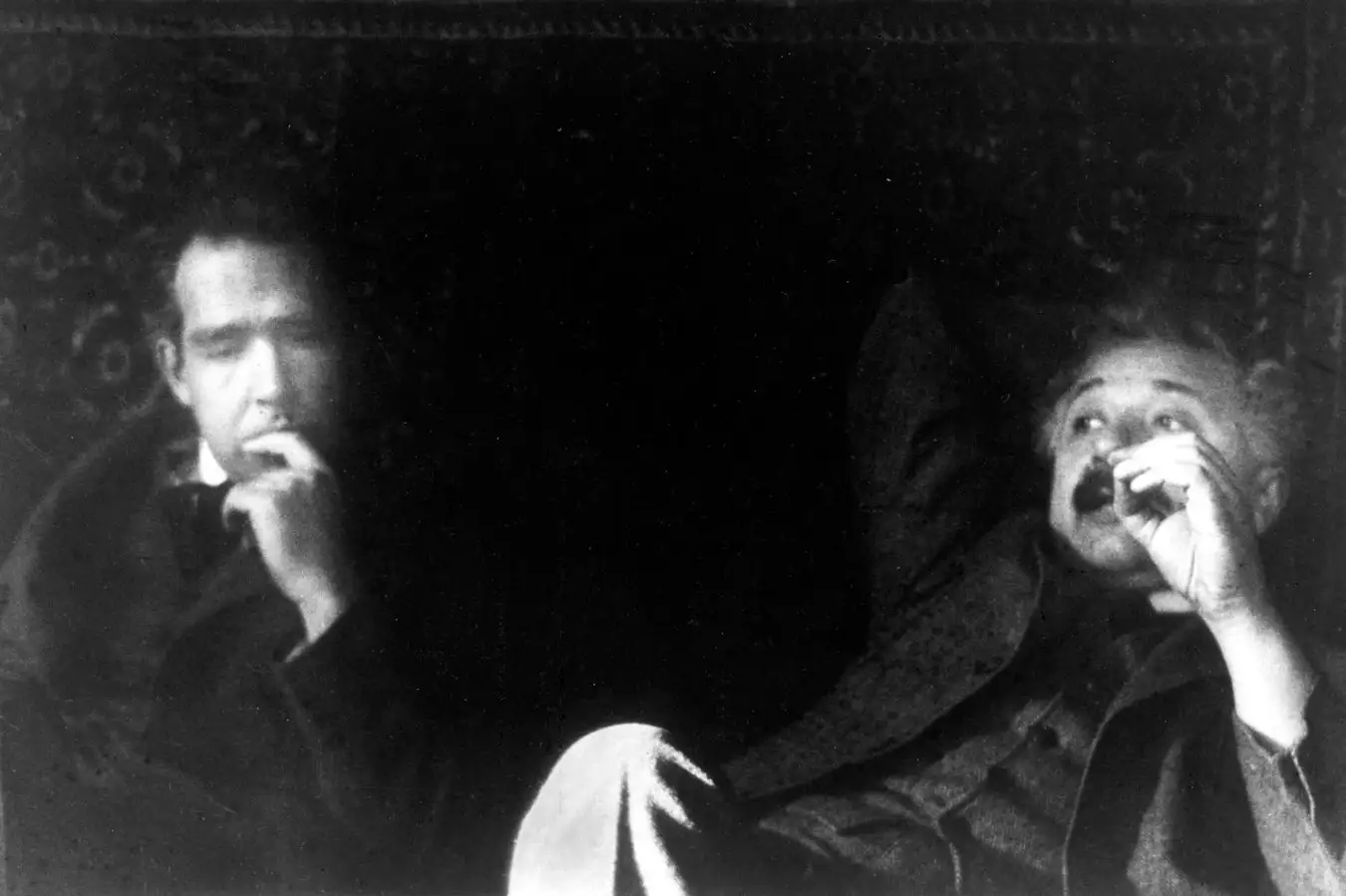
Niels Bohr and Albert Einstein in a photo taken by Paul Ehrenfest at his home in the Netherlands
Alamy
In Einstein’s thought experiment, there is an additional slit for light to pass through before the usual pair, and it is equipped with springs so it recoils when a photon traverses it. He imagined that physicists could observe whether the springs compressed or extended after being hit by the photon and consequently determine whether the photon went through the top or bottom slit. In this way, Einstein argued, they could learn which slit the photon passed through, which is very particle-like behaviour, but they would still see the telltale wave-like pattern on the screen. He thought he had devised a way to glimpse both of the photon’s heads.
Bohr’s counterargument relied on another classic feature of quantum theory – the Heisenberg uncertainty principle. According to this principle, certain measurable properties of objects come in pairs, such as momentum and position – and there’s a trade-off in the accuracy with which we can know either. For example, if researchers measure a particle’s momentum very precisely, their knowledge of its position will end up being very inaccurate. Effectively, the particle will appear like a fuzzy, spread-out blob. Bohr argued that the interaction of the photon and the slit, even Einstein’s springy one, would change their momentums. Measuring the change that the photon makes to the motion of the springs – the change in the slit’s momentum – could be used to infer the change in the photon’s momentum and this would make its position fuzzy and destroy the interference pattern, “washing out” its stripes.
Einstein and Bohr never came to an agreement, but their debate became famous. “Every researcher in the field of quantum science has encountered it in one way or the other,” says Philipp Treutlein at the University of Basel in Switzerland. I called him after learning that two separate research teams had turned this famous gedankenexperiment real. The results of the experiments were beautiful, he says – they so closely mimicked what Bohr and Einstein envisaged.
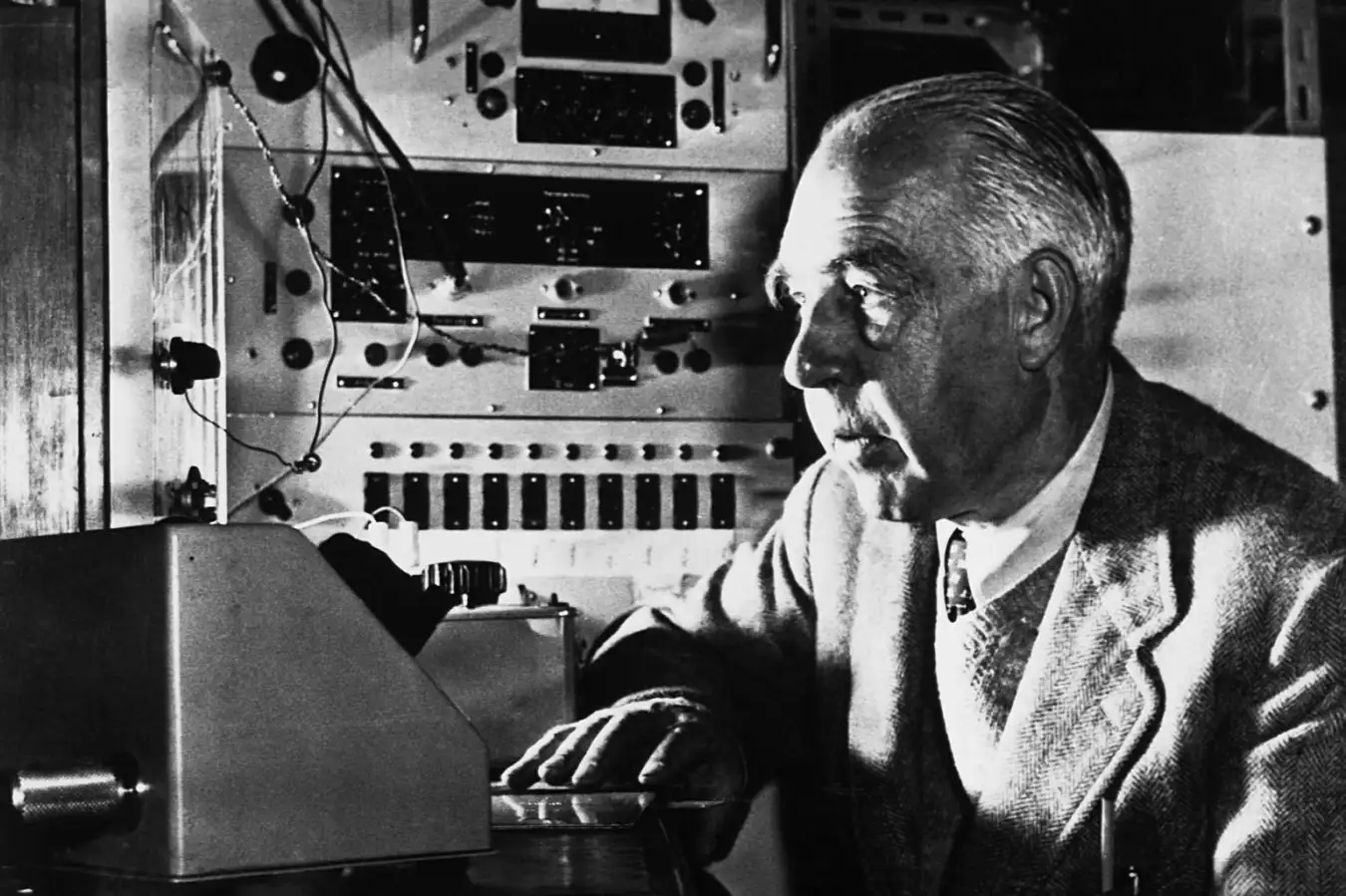
Niels Bohr, 1922 Nobel Prize winner
Corbis via Getty Images
But Treutlein also told me that contemporary physicists typically consider the debate already settled. Still, it took a hundred years for it to be concretely tested in the lab. This is because photons are tiny and massless, so making meaningful slits for the experiment required remarkable control of tiny quantum components. Anything you may imagine when you read “narrow slit” is probably a quadrillion or more times too large to work in this experiment, says Chao-Yang Lu at the University of Science and Technology of China (USTC). To circumvent this, his team at USTC and another at the Massachusetts Institute of Technology (MIT) constructed their slits under extremely cold temperatures, which makes it possible to control individual atoms with laser beams and electromagnetic pulses, turning them into useful slit stand-ins.
The two teams used two different designs to construct their ultracold, springy slits. And 21st-century atomic physics has well-established tools for measuring how an atom is affected by a passing photon. Wolfgang Ketterle, who led the MIT team, likened it to detecting a slight breeze by looking at tree leaves. “In Einstein’s picture, the photon is going through a slit. Does the slit notice that a photon has gone through? Does the slit rustle? We were now able, with modern techniques, to prepare atoms in such a state that when a photon goes through the ‘slit’, the atom rustles,” he says. Both teams found the trade-off Bohr predicted between the sharpness of the interference pattern and how the atoms’ momentum was affected by the photon. The interference pattern would, in fact, disappear just as he had predicted.
So, we can see a photon act as a particle or as a wave in the same experiment. But thanks to advances in atomic physics, we can do even more than that: we can catch its dual nature in real time.
Both Ketterle and Lu told me the most exciting findings came when they measured only some amount of the atoms’ recoil information – only a faint rustle – and also observed a blurry interference pattern. Even partial recoil information meant that they were glimpsing the photon doing something particle-like. Even a hint of the interference pattern similarly revealed its wave-ness. “The visibility of the wave-like interference and the distinguishability of the particle-like path are no longer mutually exclusive yes-or-no options,” says Lu.
As it turns out, you can in fact see both of light’s heads – just not very well.
Topics:
Source link : https://www.newscientist.com/article/2522105-how-a-century-long-argument-over-lights-true-nature-came-to-an-end/?utm_campaign=RSS%7CNSNS&utm_source=NSNS&utm_medium=RSS&utm_content=home
Author :
Publish date : 2026-04-07 18:00:00
Copyright for syndicated content belongs to the linked Source.