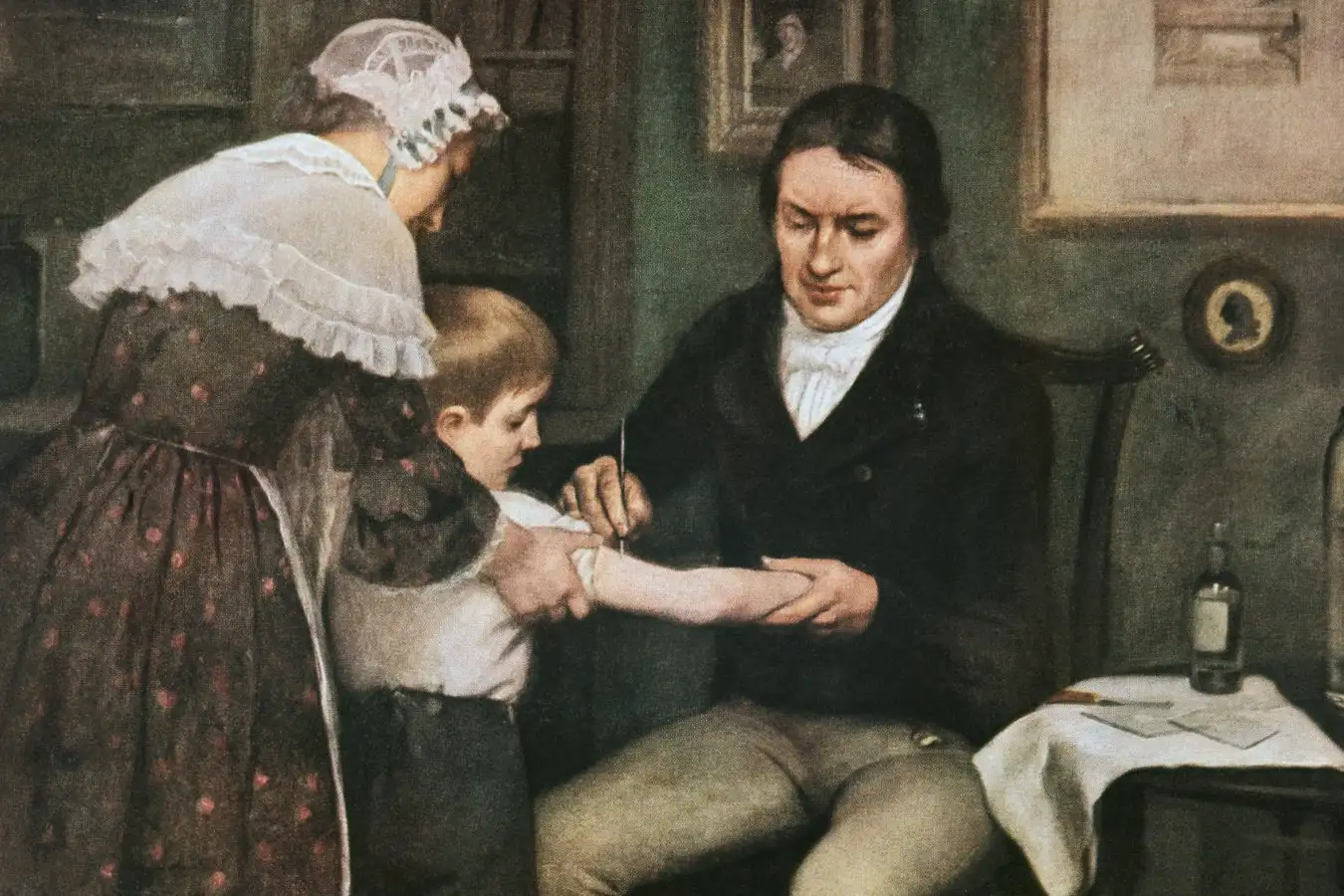
Edward Jenner performing his first vaccination against smallpox in 1796
Ernest Board/Wellcome Collection/De Agostini via Getty Images
A new look at one of the most successful vaccination campaigns in history, which rapidly eradicated smallpox in Copenhagen in the early 1800s, has uncovered possible lessons for boosting vaccine uptake in modern times.
Smallpox was a devastating disease that killed three in 10 infected people and left many others with disfiguring scars or blindness. In total, it claimed an estimated 500 million lives before a global vaccination campaign finally stamped it out for good in 1980.
One of the earliest local eradications of the disease, however, was achieved back in 1808 in Copenhagen, where smallpox had killed over 12,000 people in the previous half century.
The smallpox vaccine, the first ever vaccine, was invented by the English physician Edward Jenner in 1796. Word quickly spread to the Danish medical community and social elite, sparking “excited attention and expectation,” wrote Henrich Callisen, a leading Danish physician at the time.
Doctors in Copenhagen soon began ordering the smallpox vaccine from Jenner in England. The first recipient was the child of a Danish judge, followed soon afterwards by the child of a bishop. The vaccine appeared astonishingly effective, allowing recipients to share beds with family members who had active smallpox, wear their clothes, or even breastfeed from infected mothers, and still not catch the disease, wrote Callisen.
Based on these reports, the King of Denmark ordered the establishment of a vaccine commission in 1801. It was in charge of rolling out the smallpox vaccine as widely as possible and keeping detailed records of vaccination rates and smallpox cases.
Andreas Eilersen at Roskilde University in Denmark and his colleagues analysed these records to investigate the effects of the vaccine rollout on smallpox rates. They found that by 1810, 90 per cent of children in Copenhagen were receiving the vaccine, making Denmark the most vaccinated country per capita in Europe.
Thanks to this rapid vaccine uptake, smallpox vanished from Copenhagen just seven years after the vaccination campaign began. “[We] will be freed from one of the most terrible and destructive diseases we know,” wrote Callisen in 1809.
Eilersen and his colleagues identified several factors that contributed to these high vaccination rates. Firstly, the vaccine was offered free of charge to people who couldn’t afford it. Secondly, many church leaders and school teachers agreed to promote and administer the vaccine, in addition to medical professionals. In its annual reports, the vaccine commission commended a number of priests who had travelled the country to spread the word about the vaccine and administer it. One priest, for example, gave the vaccine to 1981 children in a single year.
As smallpox faded away, the commission began to worry that people would forget how diabolical it had been and become complacent about vaccinating their children. In 1810, to try to keep vaccination rates up, it decided to make the vaccine semi-mandatory, by requiring it as a condition of children’s church confirmation.
Some people refused to let their children get the vaccine, which the commission attributed to “ignorance and prejudice”. However, the vast majority of people embraced it, wrote Callisen. He admitted to having been initially fearful of the vaccine when it first arrived, but said he had “become completely convinced of the beneficial influence of vaccination on human wellbeing and happiness, and on increasing population and national strength.”
Denmark’s leaders were able to instil this widespread trust in the new vaccine by presenting a united front, believes Eilersen. “Basically, we had a bunch of different authorities – the government, the medical establishment and the church – that all agreed on what to do,” he says. “When they all collaborated like this, it helped convince the broader population that was not part of this elite group to take up the vaccine.”
In fact, Denmark continues to have high levels of trust in its government and medical authorities. It currently ranks number one in terms of its population’s trust in public institutions according to Transparency International, a group that monitors perceived corruption in 180 countries. This may explain its continuing high childhood vaccination rates. For example, about 96 per cent of children in Denmark today receive vaccines against diphtheria, tetanus and pertussis, compared to only 80 per cent in the US, which ranks number 28 in terms of trust in the public sector.
Topics:
- vaccines/
- infectious diseases
Source link : https://www.newscientist.com/article/2513279-how-an-1800s-vaccine-drive-beat-smallpox-in-denmark-in-just-7-years/?utm_campaign=RSS%7CNSNS&utm_source=NSNS&utm_medium=RSS&utm_content=home
Author :
Publish date : 2026-01-30 11:00:00
Copyright for syndicated content belongs to the linked Source.