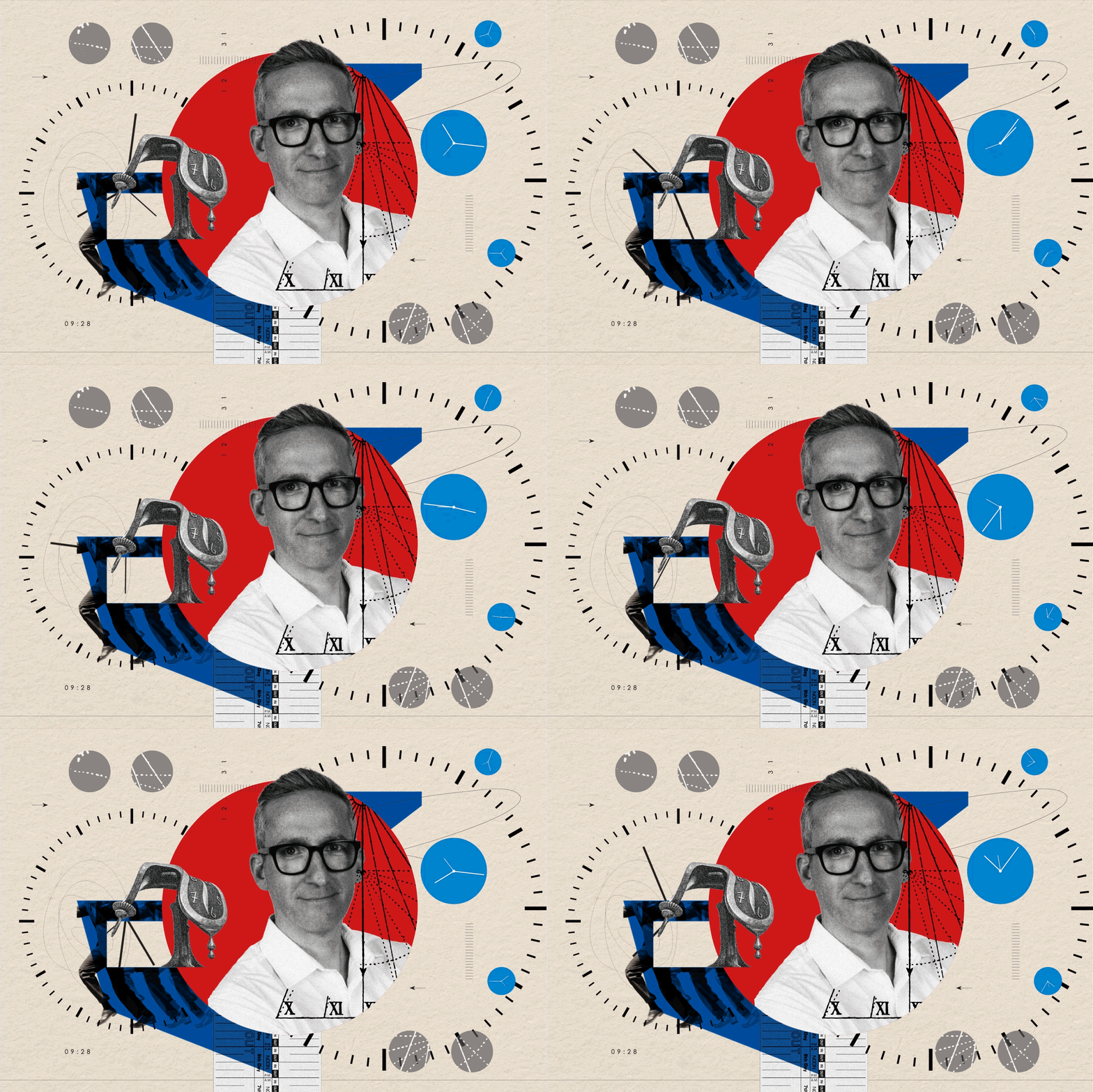
We tend to think of time as scarce, or unruly – either racing away from us or dragging by painfully slowly. As the years pass, it can feel like time is slipping by faster than ever. Thankfully, psychological research is beginning to show how we can reshape our experience of time to make it feel more abundant when we want it to, just with a few simple tweaks to our daily routine.
New Scientist spoke to Ian Taylor at Loughborough University, UK, author of Time Hacks: The psychology of time and how to spend it, to explore why rethinking our relationship with time could help us feel less pressured, less bored and more fulfilled at the end of the day.
Helen Thomson: It’s normally physicists who deal with the definition of time, arguing about how it slots into their equations to describe the universe. How does a psychologist think about time?
Ian Taylor: There’s a lot of disagreement about how to define time. Physicists argue over whether it’s an emergent property or more fundamental, for instance. I think more about the subjective perception of time and see it as a framework that links people’s memories of the past with their hopes and ideas for the future. I think of it as a perception that makes our lives coherent.
How does the brain generate a perception of time?
We don’t have a tangible place in the brain where you find the internal clock. But we do seem to have a range of different processes in the brain that work together to monitor the passing of time and give us the feeling of an internal clock. But our sense of time is not simply a function of the brain, it’s a complicated interaction between our mind, body and our feelings. Psychologically speaking, this internal clock speeds up or slows down depending on what else we are using our brain’s resources for and how much attention we give it.
When I think about time and my perception of it, I think about when my brakes failed and I crashed my car. I vividly remember considering what my instructor had told me about gently pumping the brakes in a skid, how I was going to tell my mum I’d damaged her car, and how I wished there was a different song on, because I liked it and knew I’d now find it traumatic. I did a quick equation and worked out which car in the distance I would inevitably crash into and tried to warn the couple in the front seats. I thought about the hold-up I was about to cause morning commuters. It felt like a minute, yet in reality, it all happened in under a second. It felt like a superpower of sorts, the ability to slow down time. What was going on?
We know that our emotions and motivation have a strong impact upon how we perceive time. We find in the lab that, if we make people angry or sad, their perception of time slows down. If you make them happy, it speeds up. There is a reason people say, “Time flies when you’re having fun.” However, emotions cannot just be grouped as positive or negative. You also need to consider their intensity, known as level of arousal.
Stronger arousal generally tends to make time feel slower. For example, feeling calm and excitable are both positive emotional states, but the level of intensity is very different. In your extreme example, you were likely highly aroused, so time slowed down, which might be a useful survival mechanism in life-threatening scenarios to enable clarity of thought. You weren’t thinking irrational thoughts, they were all helping you in some way. Your emotional state triggers more resources and attention to what you’re invested in and, in doing so, makes it seem like more time has passed than reality.
Having said all this, science is often messy and there’s some research that contradicts these ideas, so researchers have been looking at other explanations for time slowing or speeding up. A motivational perspective, which is my specific area of research, seems to hold some promise in this regard.
We know that when you want to achieve something or you want an experience to continue, which is called an approach-oriented motivational state, time flies. When you’re trying to avoid something or want an experience to stop, which is called an avoidance-oriented motivational state, time slows. This perspective also fits your car crash example because you were trying to avoid death.
Based on these ideas, can you slow time down or speed it up yourself?
Technically, yes, and there’s a lot of lab research on this. For instance, if you give people a picture of something desirable, like a tasty-looking cake, time feels like it passed quicker than if they’re looking at something non-desirable. There’s some gruesome research where participants view pictures of mutilated bodies and that makes time feel slower, presumably because they want to avoid the experience.

Feeling like you aren’t enjoying yourself can increase the sensation that time is slowing down
Martin Parr / Magnum Photos
We have to extrapolate from these laboratory settings into real life. But if you are trying to speed up time – say you want the next two weeks to go past really quickly – you need to take resources away from your internal clock by striving for something that you want, in the same way as the cake experiment. In other words, keep yourself occupied with things you enjoy, value or desire.
Often, it’s the other way round and people want to slow time down. I often feel so rushed or that there’s not enough time in the day – are there ways to make it feel more abundant?
Obviously, I wouldn’t recommend looking at gruesome images to slow time down. That’s why I don’t think it’s really about trying to make it feel more abundant, it’s about what we do with the time we have, so that we’re not drained by it. Let’s say, objectively, we’ve got the same activities in our diary today, but I’m really enjoying them and you’re doing them because of some obligation. Your perception of time might have slowed down in the short term because you’re not having fun, but you will also end the day thinking you haven’t had enough time, and that’s because you haven’t done anything that has felt like a valued activity.
So, feeling like you have no time really comes down to whether you’ve used your time wisely or not and how that makes you feel, not how much time you really have available. In one study, researchers asked people how much time they had to be physically active in the day and they found no relationship between how busy people objectively were and how much time they felt they had to exercise.
You refer to this in your book as having a good relationship with time. What other things can we do to cultivate this positive relationship?
To me, having a good relationship with time means that, at the end of the day, you don’t feel exhausted, you don’t feel like you’ve wasted your day and you’re feeling OK about yourself.
To do this, we need to have an awareness of time and how it affects our motivation and well-being. So, for instance, the idea of ego depletion has been around since the 1990s. Researchers thought if we use willpower once, like trying your best in an exam, we can’t use it to the same extent soon after because the underpinning resource has been depleted. That’s now been debunked because the mysterious resource was never identified, and if there was a resource, it didn’t make sense that simple things like watching TV could replenish it.
Instead, the consensus is that willpower tends to reduce over time because repeated use makes us less willing, rather than less able, to employ willpower again. This is powerful knowledge that can help us use our time more wisely. Don’t do things that rely on willpower in the evening and do things that are less valued by you personally in the morning when your cognitive resources are most easily tapped into. Things that you personally value can be done at any time because they don’t require your fading willpower at all.
An awareness of time and the motivational brain has also shown us that immediate benefits are much more powerful motivators than long-term benefits. So, if you give financial rewards at work, giving people rewards for work immediately is a more powerful motivator than giving one at the end of the year. It’s the same with exercise or diet: to stay motivated, you need immediate rewards rather than focusing on having a better body next summer or trying to avoid ill health in 30 years.

Experiences you value, like trips with loved ones, can help you feel like you have more time
Martin Parr/Magnum Photos
The reason for this advice is that the motivational power is usually contained in the outcome rather than the behaviour itself. In other words, people are motivated by the “end” not the “means”. The shorter the time frame between the two parts, the more likely the motivational power of the outcome will be associated with the behaviour. So you need to put the outcome as close in time to the behaviour as possible. That’s a really strong finding in motivation science.
Understanding that how busy we are doesn’t really have any relationship with how busy we feel can help us. People think if they’re less busy, then they’ll feel better. To some extent, yes, but you can also look at it the other way around as well. If you feel better, you will feel less busy, even though you don’t change your diary in any way. So while it’s not always easy to have control over most things you have to do in the day, trying to add some things that you value will make you feel better, and make you feel that you have more time – rather than trying to empty your diary. It’s all about understanding your relationship with time.
Finally, what about dead time – should we remove it?
It depends on what you are thinking about during dead time. In my book, I distinguish dead time from solitude. Dead time is like wallowing in negative thoughts on your commute home or waiting for a bus. Many people don’t like just being on their own with their thoughts.
One study showed that people would rather spend 15 minutes getting electric shocks than 15 minutes of time with their own thoughts – particularly men: 67 per cent of men preferred the electric shock, compared with 25 per cent of women. In dead time, we tend to reach for our mobile phones, but a recent study showed that reaching for your mobile phone and mindlessly scrolling to relieve boredom actually makes you more bored.
If we can get over our anxieties about being alone and our negative thoughts during alone time, then solitude is different and can have real benefits. There’s some interesting research from decades ago that examined prisoners in solitary confinement and other isolated experiences like polar expeditions. These studies found that if supportive conditions were provided (or prison guards didn’t abuse the inmates), successfully dealing with the challenges associated with isolation led to personal growth and enhanced self-sufficiency.
More broadly, solitude can increase creativity and emotional well-being, and help clarify thoughts. Being a bit more mindful during alone time, rather than distracting ourselves, is quite a powerful method for improving our well-being.
Topics:
Source link : https://www.newscientist.com/article/2509450-how-rethinking-your-relationship-with-time-could-give-you-more-of-it/?utm_campaign=RSS%7CNSNS&utm_source=NSNS&utm_medium=RSS&utm_content=home
Author :
Publish date : 2026-01-07 16:00:00
Copyright for syndicated content belongs to the linked Source.