
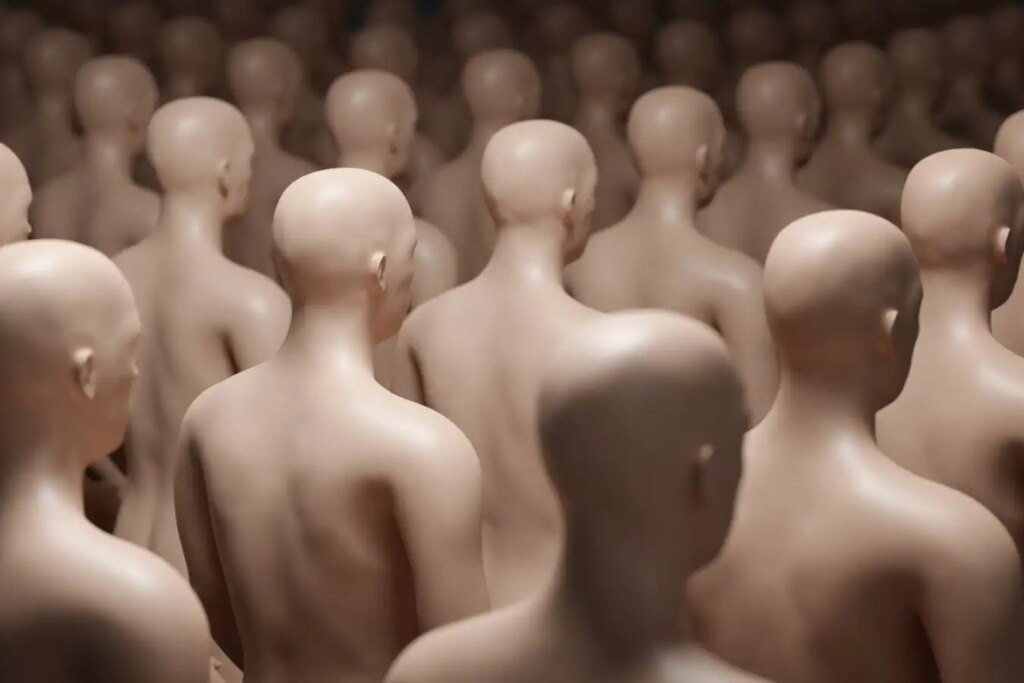

Could the super-rich be secretly pursuing human cloning?
Juan Roballo/Shutterstock
Over decades of covering the incredible advances being made in biology, I’ve seen how some ideas become fashionable, get intense media coverage for a few years, and then fade from public view again. Take human cloning.
After the first cloned mammal, Dolly the sheep, hit the headlines in 1997, there was much speculation about whether humans would be cloned next, and even a few almost-certainly-untrue claims that it had been done. But in recent years, there’s been hardly a murmur.
Yet reproductive technologies have advanced massively since the 1990s. Most notably, the first gene-edited children were created – illegally – just six years after the development of CRISPR. So, I do sometimes wonder what’s happening behind the scenes. Could human clones already be out there somewhere, unannounced? Not counting identical twins, of course.
Why would someone want to do this? Well, remember how Vladimir Putin and Xi Jinping were caught chatting at a recent meeting about life extension through organ transplants? The best way to do this would be to create clones for organ harvesting, so there would be no issue with immune rejection – as has often been explored in science fiction, from the movie The Island to the book Never Let Me Go.
Then there’s the idea that cloning creates a copy of a person and can thus confer some kind of immortality, as depicted in the TV series Foundation, where an empire is ruled by a succession of clones. But we know from identical twins that having the same genome as someone doesn’t make you the same person. As the actor Tatiana Maslany depicts so well in the TV series Orphan Black, every clone would be a unique individual. That said, rich men can, like anyone else, have irrational beliefs, and often seem especially eager to preserve and extend their lives.
For the scientists, meanwhile, there’s the glory of being the first to achieve something. A commission in China concluded that the creator of the CRISPR children had “illegally conducted the research in the pursuit of personal fame and gain”.
The goal of therapeutic cloning
So, could there be human clones out there? For a long time, it was thought that cloning mammals was impossible. While the cells in early embryos can form any part of the body, they soon become specialised, and this process was supposed to be irreversible.
Dolly proved otherwise. She was created by fusing a cell from the udder of an adult ewe with an egg emptied of its DNA. Dolly became a global celebrity after her existence was announced in February 1997.
Her birth led to many attempts to create cloned human embryos. The aim wasn’t to create cloned babies, but to derive embryonic stem cells for new types of medical therapies. Because cloned cells are a perfect match for an individual, in theory they could be used to create replacement tissues or organs perfectly suited to that person, meaning they won’t be rejected by the immune system.
But getting stem cells from cloned human embryos proved harder than expected. It wasn’t until 2004 that biologist Woo Suk Hwang claimed to have done it. At the time, I was really impressed by how well-written his paper was, addressing all possible objections. Yet the study was fraudulent and the paper retracted – a lesson I have never forgotten. These days, if a paper seems too good to be true, my starting assumption is that it isn’t.
In the end, it was only in 2013 that embryonic stem cells were genuinely obtained from a cloned human embryo. By that time, we had already developed other ways to derive matching stem cells, by switching on a few key genes, so interest in therapeutic cloning had waned.
Cloned pets and other animals
Meanwhile, though, animal cloning has become well established. There’s an occasional flurry of headlines when some celebrity reveals they have cloned a pet – most recently, former NFL star Tom Brady reportedly revealed that his dog is a clone, created by a company acquired by Colossal Biosciences.
Besides being offered as a way to “bring back” beloved pets, cloning is used in farming and in horse breeding. For instance, male horses are often castrated, so if one turns out to be a champion showjumper, say, the only way to use its genome for further breeding is to create clones.
Yet animal cloning remains extremely problematic. A 2022 paper on the first 1000 dog clones created at one lab revealed that the process is still very inefficient, with just 2 per cent of implanted cloned embryos resulting in a live birth. That’s one of the reasons pet cloning will cost you a cool $50,000.
What’s more, around a fifth of the cloned dogs had obvious physical differences, including large tongues, odd-coloured eyes, cleft palates and excessive muscle bulk. A few clones of male dogs were physically female.
But if a rich or powerful person were unbothered by all this, could they still try to clone themselves?
Why it’s so hard to clone adults
Many sources will tell you that monkeys have been successfully cloned on several occasions since 2017, suggesting it would work with people, too. What most of these sources omit to say is that, so far, all these primate clones have been created from fetal cells, not adult ones.
The issue is that reprogramming an adult cell back to the embryonic state is much harder than reprogramming a fetal cell. But to me, cloning means creating a genetically identical copy of an adult – that’s what made Dolly so remarkable.
The bottom line is that I’m fairly confident that it isn’t yet possible to clone an adult human – and in a world with no shortage of dictators and outlandish billionaires, that’s a jolly good thing.
Topics:
Source link : https://www.newscientist.com/article/2506856-could-the-super-rich-be-cloning-themselves-and-why-would-they/?utm_campaign=RSS%7CNSNS&utm_source=NSNS&utm_medium=RSS&utm_content=home
Author :
Publish date : 2025-12-04 06:30:00
Copyright for syndicated content belongs to the linked Source.