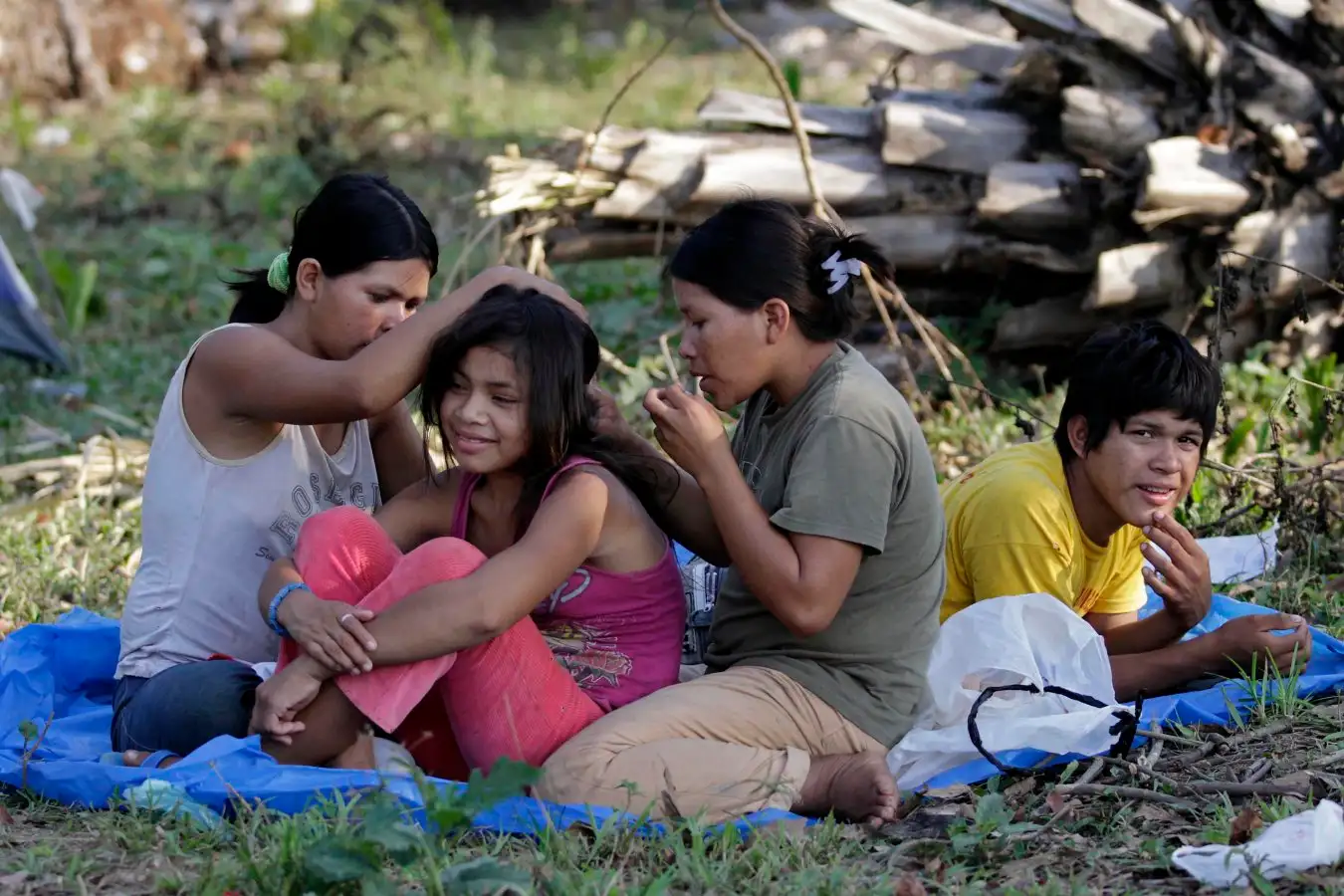
The Tsimané people in Bolivia consider humility to be a sign of a worthwhile individual
David Mercado/Reuters
It is a trope so well worn that it has become a cliché: hunter-gathers sharing their spoils equally among the tribe with a noble generosity absent from high-income societies. Only it isn’t an accurate picture, according to a review of anthropological evidence.
“There’s no society where there’s true equality,” says team member Chris von Rueden, an anthropologist at the University of Richmond, Virginia. What appears to be equality is, in fact, simply practical or even self-serving behaviour.
Observations of the apparently equal distribution of wealth in traditional subsistence societies have led some researchers to conclude that the default setting of human beings is one of altruism and equality. For instance, 19th-century philosopher Friedrich Engels – a friend of Karl Marx and a strong advocate of Marxism – based some of his ideas on reports of the egalitarian nature of traditional cultures.
“But it’s not all sharing no matter what with anybody,” says von Rueden.
After reviewing existing evidence, Von Rueden and his colleague Duncan Stibbard Hawkes at Durham University, UK, argue that some anthropologists have mistaken equal wealth in a community for a sign that there is a desire for equality driving it. And while some traditional subsistence societies do place a heavy emphasis on equality, it might be prompted more by individuals’ concerns that their personal choice may be restricted, rather than an egalitarian ethos. For example, the Mbendjele, a group living in the Republic of the Congo, have a grievance process called mosambo where people call for camp-wide attention, then loudly articulate how their rights have been impinged.
“People don’t like bullying. They don’t like coercion. They don’t like ‘big men’,” says Manvir Singh, an anthropologist at the University of California, Davis, who wasn’t involved in the study. He thinks von Rueden and Stibbard Hawkes are correct to point out that a society built around protecting individual autonomy might come to look like one that is egalitarian.
The researchers found that in addition to a desire for autonomy, equality might also be a product of self-interested behaviour. Rather than distributing the rewards of a hunt out of a sense of generosity, meat might be handed out because the hunter doesn’t want to be endlessly badgered for it. To back up this idea, von Rueden and Stibbard Hawkes note that frequent and “vociferous” demands for hunters to share food have been documented in many forager societies. For example, observations have found that among some !Kung communities – a culture found in Angola, Botswana and Namibia – about 34 per cent of daytime conversation is devoted to complaining about stinginess.
Likewise, a society in which individuals are willing to share resources and help one another isn’t necessarily one with no social hierarchy. In some cultures, status is awarded to those who are more cooperative and community-minded than others. For instance, the Tsimané people in Bolivia consider displays of humility and helpfulness to be a sign of a worthwhile individual. As such, von Rueden and Stibbard Hawkes argue that the equality that anthropologists have documented in traditional subsistence societies might be the result of a keen competition to be the most even-handed person in the group.
This study is “an important contribution that brings together a range of different ethnographic examples to show the range and diversity of egalitarianism”, says Jerome Lewis, an anthropologist at University College London. He says that Engels’s 19th-century image of the “noble savage” living in idyllic, principled groups is an outdated, “very discriminatory and biased view”. As with any human group, hunter-gatherers compete, disagree and figure out how to resolve their differences.
Lewis points out that people living in traditional subsistence societies across the world have developed “striking alternatives” to the ways that high-income nations organise their cultures and justice. Some traditional subsistence societies have existed for more than 50,000 years and continue today, which he says provides “very powerful lessons and alternative ways we might think about how we organise ourselves”.
Topics:
Source link : https://www.newscientist.com/article/2507277-hunter-gather-groups-are-much-less-egalitarian-than-they-seem/?utm_campaign=RSS%7CNSNS&utm_source=NSNS&utm_medium=RSS&utm_content=home
Author :
Publish date : 2025-12-05 15:00:00
Copyright for syndicated content belongs to the linked Source.