
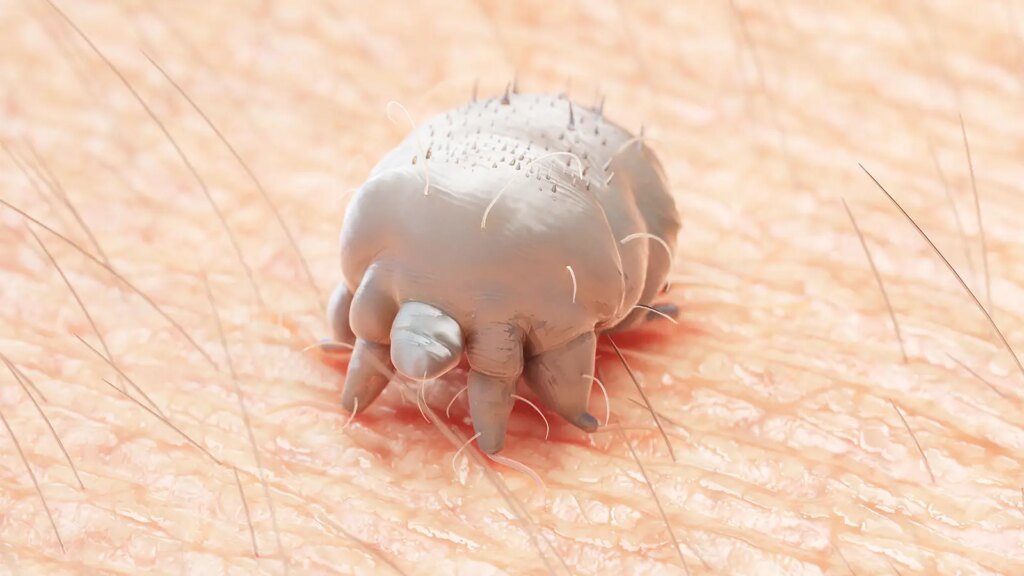
- Severe scabies doesn’t respond to the usual treatment for classic scabies due to the abundance of skin mites.
- A randomized trial showed that a higher dose of oral ivermectin was not superior to a standard dose for cure of severe scabies.
- Adherence was high in both treatment groups, with most patients completing their respective regimens.
Paired with topical permethrin, a higher dose of oral ivermectin was not superior to a standard dose for cure of severe scabies, a randomized trial showed.
Among patients using 5% topical permethrin and daily emollient cream for profuse and crusted scabies, 75% of those receiving oral ivermectin at a dose of 400 μg/kg were cured compared with 82% of those receiving a standard dose of 200 μg/kg by day 28 (OR 0.64, 95% CI 0.25-1.67), reported Olivier Chosidow, MD, PhD, of Bicêtre Hospital in Le Kremlin-Bicêtre, France, and colleagues.
“Larger randomized trials should be designed to determine whether the 82% probability of cure of severe scabies with standard-dose ivermectin can be improved,” they wrote in the New England Journal of Medicine. “Strategies for how to attain higher percentages and potentially faster rates of cure include prolonged administration of oral ivermectin, more frequent applications of possibly different topical scabicides plus keratolytic agents to enhance their penetration into thickened skin, or administration of moxidectin, a macrocyclic lactone with a longer half-life than ivermectin.”
Scabies is a highly contagious condition caused by human itch mites that is transmitted through direct, skin-to-skin contact between people. The mites burrow into the skin to feed and trigger itching and rash.
Severe scabies is rare and may be life-threatening. It encompasses profuse and diffuse manifestations of classic scabies and crusted scabies. The rash in profuse scabies is erythematous, scaly, and disseminated, and involves areas, such as the scalp, head, neck, and back, that are not usually affected in classic scabies. Crusted scabies is characterized by the presence of several hyperkeratotic and psoriasiform skin lesions that contain up to thousands of infesting Sarcoptes scabiei var. hominis mites.
At-risk groups include older people, those with weakened immune systems, indigenous communities, and those in nursing homes or extended-care facilities.
Severe scabies doesn’t respond to the usual treatment for classic scabies due to the abundance of skin mites. A repeated combination of oral ivermectin and 5% topical permethrin are recommended, but optimal ivermectin dosing and regimen aren’t clear.
“Unlike other parasites (e.g., head lice) that are blood-sucking arthropods, S. scabiei mites ingest intercellular fluid (lymph) and are thus potentially less targetable by oral ivermectin, even if an adequate plasma drug concentration is attained,” Chosidow and team noted.
Conducted at French dermatology clinics between October 2017 and January 2022, the blinded GALE CRUSTED study randomized 133 adults 1:1 to higher-dose or standard-dose oral ivermectin on days 0, 7, and 14, taken with food. All participants used emollient cream daily and applied 5% permethrin cream on days 0 and 7 overnight on their entire skin surface.
Adherence was high in both treatment groups, with 87% of high-dose and 80% of standard-dose patients completing the regimens. “We anticipate good real-world applicability of our results,” the authors noted.
Median age was 67 years, 33% were older than 80, nearly 60% were hospitalized, and 42% had neurologic or cognitive impairment. Among the patients, 59% had only profuse scabies, 5% had only crusted scabies, and 36% had both profuse and crusted scabies.
The study’s primary endpoint of cure of severe scabies was defined by the absence of mites and mite-related products as confirmed by parasitologic or dermoscopic assessment on days 18 and 21, and the absence of active clinical lesions on physical examination on day 28.
In a subgroup analysis, numerically more patients with only crusted scabies achieved a day-28 cure on standard-dose versus high-dose ivermectin (76% vs 52%), while more patients with profuse scabies reached a day-28 cure on high-dose ivermectin (92% vs 85%). Neither difference was statistically significant.
Three high-dose patients and five standard-dose patients had serious adverse events. In the higher-dose group, one patient experienced septicemia due to cutaneous infection, which was deemed by the trial investigator to be probably related to the trial drug, and two patients died from cardiac decompensation. In the standard-dose group, two serious adverse events occurred that were deemed by the trial investigator to be probably related to the trial drug (prolonged hospitalization for eczema and for septicemia in one patient each), and two patients died from intercurrent diseases (one from neurologic failure and one from cardiac failure) and one from hemorrhagic failure.
Study limitations included a lack of patients with very severe crusted scabies and a lack of standardized diagnostic procedures. Permethrin adherence wasn’t evaluated, nor were patients followed long term. In addition, the trial was conducted in France, where permethrin resistance may be low.
Please enable JavaScript to view the comments powered by Disqus.
Source link : https://www.medpagetoday.com/infectiousdisease/generalinfectiousdisease/121174
Author :
Publish date : 2026-05-08 15:37:00
Copyright for syndicated content belongs to the linked Source.