Intravascular lithotripsy was noninferior to rotational atherectomy for preparing severely calcified coronary lesions for percutaneous coronary intervention (PCI), according to a head-to-head trial.
On optical frequency domain imaging (OFDI), acute minimal stent area after PCI was 6.0 mm2 with intravascular lithotripsy preparation versus 5.9 mm2 with rotational atherectomy preparation, reported Benjamin Honton, MD, of Clinique Pasteur in Toulouse, France.
Looking at clinical outcomes, there were no statistically significant differences between groups in terms of target lesion failure at 12 months (2.4% vs 1.2%, P=0.61) or its individual components of cardiac death (1.2% for both), target vessel-related myocardial infarction (1.2% vs 0), and target lesion revascularization (2.4% vs 0).
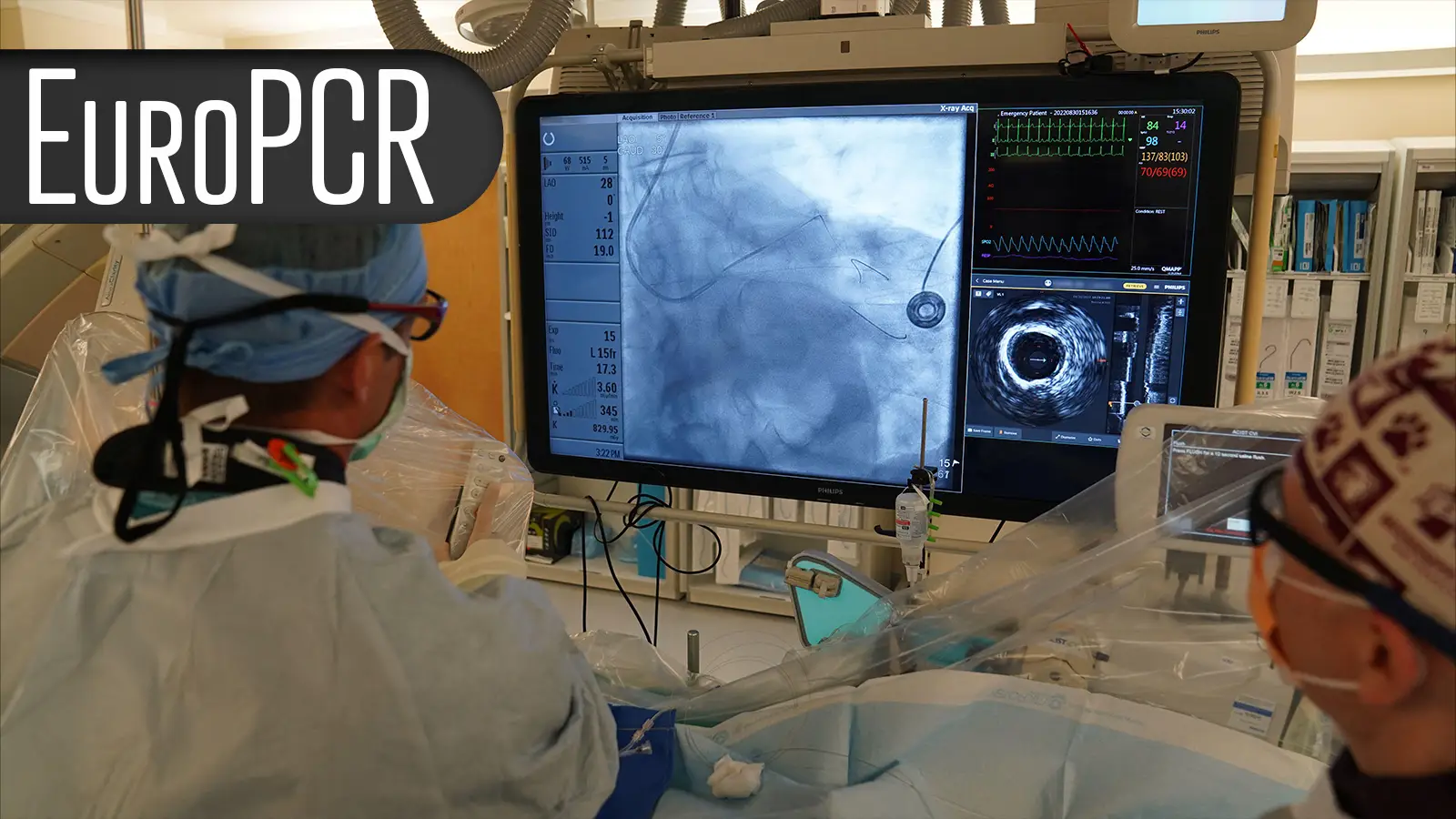
Honton presented the results of the ICARE OFDI study at the EuroPCR meeting held annually in Paris. The study was simultaneously published in EuroIntervention.
The evidence is growing for intravascular lithotripsy, which is considered an emerging alternative to gold-standard rotational atherectomy as a plaque preparation strategy.
“If you have the choice in suitable lesions, you can do both [intravascular lithotripsy and/or rotational atherectomy] with the same efficacy,” Honton said during a press conference. “We know that the adjunction of the two techniques in clinical practice is rare, only 10% of the procedures, so if you don’t have the choice of the technique, you can be confident in your results.”
Nevertheless, there was a signal that the intravascular lithotripsy group had a lower occurrence of major malapposition after PCI (58% vs 80%, P=0.002).
“Importantly, the present study was not designed nor powered to detect differences in clinical outcomes. Therefore, the analysis of clinical events should be considered descriptive and exploratory only, and no definitive comparative conclusions can be drawn between treatment groups,” Honton and co-authors wrote.
No safety signal emerged over time in the trial, with low rates of target lesion failure and target vessel failure and no excess of adverse events in either group, they noted. “These findings are reassuring given the high anatomical and clinical complexity of the enrolled patients, including a large proportion of heavily calcified lesions and calcified nodules.”
The ICARE OFDI trial was conducted from 2022 to 2024 across 14 French centers. Participants had moderate to severe calcified de novo lesions, >70% stenosis (or less stenosis but fractional flow reserve <0.80 or stress test ischemia), a maximum lesion length of 40 mm, and a 2.5- to 4-mm reference vessel diameter.
Eligible patients had to have their lesion crossed with a 2-mm balloon before undergoing OFDI and being randomized 1:1 to the intravascular lithotripsy Shockwave C2 or C2+ catheter (minimum 30 pulses) or Rotapro rotational atherectomy device. From there, operators proceeded with drug-eluting stent placement during PCI. Each patient underwent a post-PCI final OFDI run.
Of the 169 patients in the study, median age was 71.8, and 81.1% were men. Median lesion length on OFDI was 26.4 mm; the degree of calcium usually extended beyond 270º (~70%) and commonly reached a full 360º (~47%). A calcified nodule was observed in just under half of cases.
A noninferiority margin of 0.75 mm² had been prospectively defined for the minimal stent area endpoint.
There was no difference between groups in terms of periprocedural complications.
Intravascular lithotripsy was associated with a shorter fluoroscopic time (15.9 vs 18.9 minutes, P=0.003) and lower contrast medium use (160 vs 190 mL, P=0.02).
No stent thrombosis was observed in either group at 12 months.
The small, selected study population was a major limitation of the study. In addition, the depth of maximal calcium location within the arterial wall was not included in imaging results, Honton acknowledged.
Even so, the promising results of the study may be attributed to intracoronary imaging regardless of the plaque preparation technique, he said.
Source link : https://www.medpagetoday.com/meetingcoverage/europcr/121363
Author :
Publish date : 2026-05-20 15:04:00
Copyright for syndicated content belongs to the linked Source.