Feedback is New Scientist’s popular sideways look at the latest science and technology news. You can submit items you believe may amuse readers to Feedback by emailing [email protected]
Shooting for the moon
It’s been a while since humans walked on the moon: 54 years in fact. A lot of robots have visited our satellite since, some of them even landing successfully instead of ploughing into the lunar surface like a bullet hitting a pile of talcum powder. But no people.
NASA’s Artemis project plans to send people to land on the moon in early 2028, two years from now. If that mission is followed by more, maybe the permanent population of the moon will inch up from zero.
So, Feedback was taken aback to learn that accounting firm PwC had published, in January, its lunar market assessment. “The Moon,” it tells us sagely, “is rapidly emerging as a potential focal point for future global economic activity in space.”
Finally, someone is saying it: whenever Feedback looks up at our planet’s natural satellite, we speculate about how to monetise it. PwC says people now have “ambitions centered on sustained human and commercial presence”, and it has tried to work out how big this new market might become.
“The study adopts a scenario-driven approach, forecasting market opportunities for lunar surface activities from 2026 to 2050,” we are told. “The focus is on five foundational pillars: mobility, communication, habitation, energy, and water. Each domain is analyzed in terms of investment needs, technological inflection points, and potential revenue streams.”
It seems lunar entrepreneurs can expect to make a fair bit of money. “The total cumulative revenues expected from lunar surface activities between 2026 and 2050 are projected to be in the order of $93.9 [billion] to $127.3 [billion],” PwC concludes. That is more than the GDP of most countries.
This is all dependent on one main factor, it seems. “The lunar economy’s revenue outlook is shaped first and foremost by the intensity of exploration missions, both crewed and uncrewed,” PwC informs us. When it’s right, it’s right.
Still, the numbers struck Feedback as a little optimistic given that the Artemis missions to the lunar surface haven’t launched yet. Then we noticed that this is the second edition of PwC’s lunar market assessment, and we wondered what the first edition said. It was published in 2021 and projected revenues of “a cumulated $170 billion over up to 2040” – meaning that five years ago, PwC was expecting significantly more moon money, 10 years earlier.
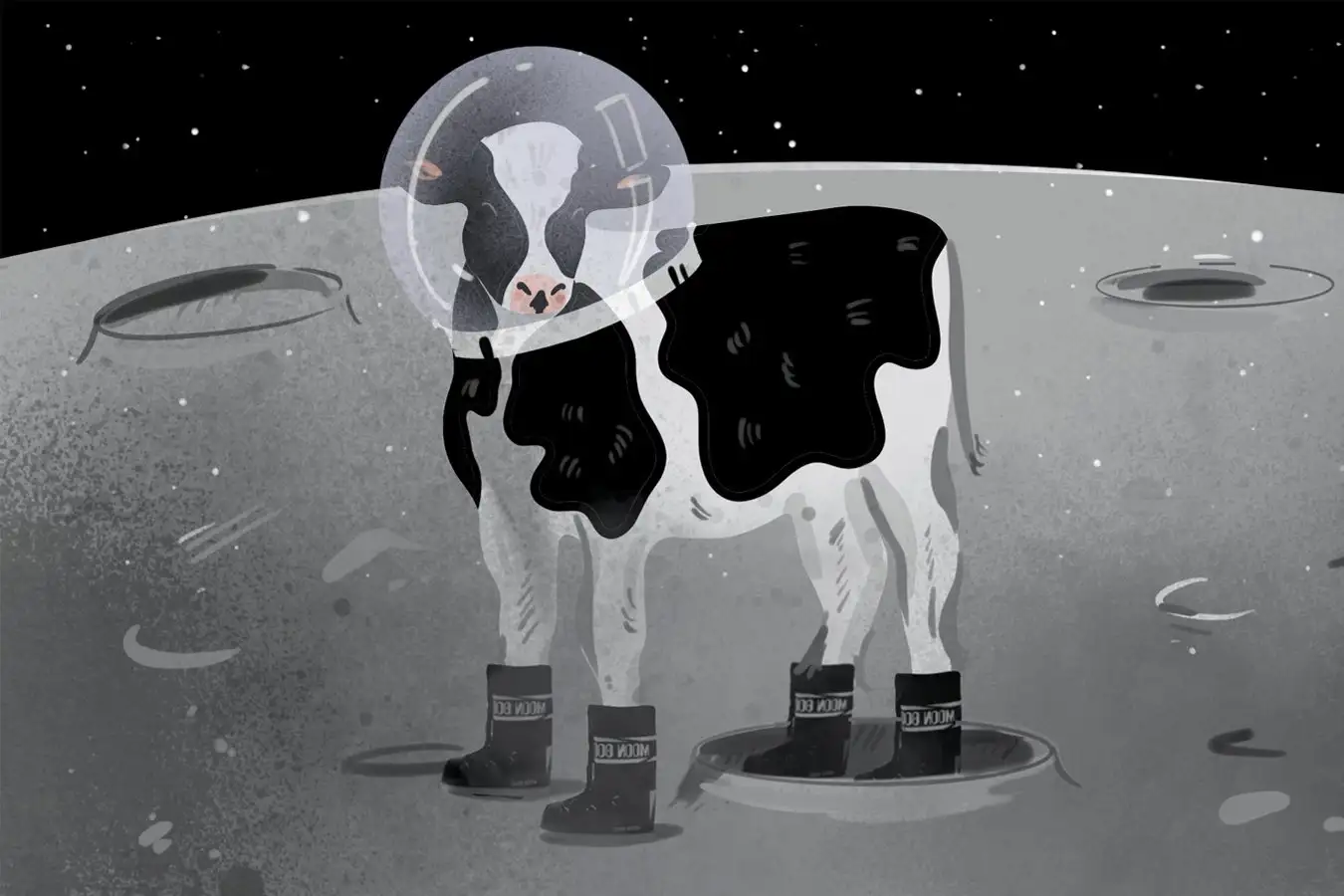
Feedback is not sure what changed in the past five years to dampen the prospects for the lunar economy, but we are disappointed. We were hoping to clear our mortgage by investing in moon-grown beef futures.
Stranger than fiction
In February, the journal Paediatrics & Child Health published two corrections. Nothing unusual about that: journals correct mistakes in scientific papers all the time.
Except that these were no ordinary corrections. One listed 15 papers that it was correcting; the other listed 123. The headlines explained that the purpose was “to add disclaimer”.
If readers scroll, as Feedback did, down past the dizzying list of papers that required these new disclaimers, they will find the following text: “Every clinical vignette presented within the journal’s CPSP Highlights section describes a fictional case, created as a teaching tool and related to a Canadian Paediatric Surveillance Program (CPSP) study or survey.”
This is worded in such an anodyne way that its significance might not be immediately clear. However, the nice journalists at Retraction Watch put it much more explicitly: “A medical journal says the case reports it has published for 25 years are, in fact, fiction.”
It turns out that the journal has, since 2000, published a regular series of case studies that appeared to describe real patients. Some of them were included in clinical guidance; others prompted physicians to launch research programmes following up on the observations. Except the case studies were made up and the journal never previously labelled them as such.
Feedback is going to go out on a limb here and suggest that perhaps the disclaimer that the case studies were fictional should have been there from the start. But maybe we are looking at this the wrong way. Science often struggles to get coverage in mainstream news, but if it were freed from the shackles of objective truth, it could really pack the readers in. “Dark matter is actually the farts of space whales”: admit it, you’d click on that.
Time for a drink
Feedback has an occasionally recurring thread on the topic of “Well, they would say that, wouldn’t they?” It persists because press officers keep sending us press releases that seemingly convey objective scientific information, only to stealthily drop additional details that reveal their real motives.
Another one came through to our overcrowded inbox, announcing that “Ahead of World Sleep Day (13 March 2026), we’re sharing expert insight on a simple but often overlooked factor that could be impacting sleep quality: hydration.” It goes on to explain that “even mild dehydration may contribute to night-time discomfort and next-day fatigue”, by causing “common discomforts such as headaches, dry mouth, muscle cramps and general restlessness”.
The press release was sent on behalf of a company that makes soluble electrolyte tablets.
Got a story for Feedback?
You can send stories to Feedback by email at [email protected]. Please include your home address. This week’s and past Feedbacks can be seen on our website.
Source link : https://www.newscientist.com/article/mg26935873-700-its-time-to-monetise-the-moon-definitely-maybe/?utm_campaign=RSS%7CNSNS&utm_source=NSNS&utm_medium=RSS&utm_content=home
Author :
Publish date : 2026-03-18 18:00:00
Copyright for syndicated content belongs to the linked Source.