
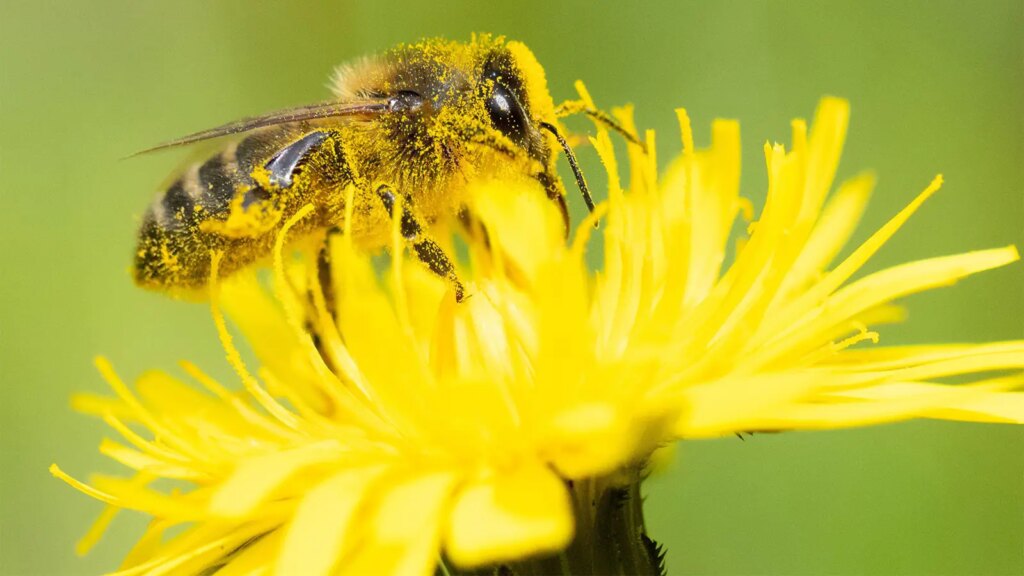
Many websites and smartphone apps offer “allergy forecasts” to guide allergy sufferers in daily activities, but just how reliable are they?
A pollen count reflects an actual measurement of the number of grains of pollen in a cubic meter of the air reported by the National Allergy Bureau (NAB) of the American Academy of Allergy, Asthma & Immunology (AAAAI).
While there’s a move toward greater automation of this process with image recognition methods, pollen counts still typically rely on visual examination under a microscope of the number of pollen grains clinging to the sticky rod of an air-sampling device exposed to the air for about 24 hours. The count is converted into units of grains per cubic meter of air, with “high” counts defined as 90 or above for tree pollen, 20 or above for grass pollen, and 50 or above for weed pollen.
However, “there is a difference between a pollen count and a pollen forecast,” the AAAAI cautions. “Predicted pollen forecasts are most often based on pollen data from previous years and general weather forecasts. Actual versus predicted counts can make a big difference for millions of people suffering from hay fever.”
People rely on these pollen counts and forecasts to take avoidance measures and anticipate potential worsening of symptoms.
Alana Jones, DO, an allergist at Nemours Children’s Hospital in Wilmington, Delaware, noted that this is true on a daily basis for many of the children she treats for seasonal allergies.
“I let families know these types of apps/counters are available to review if they want to see what pollen is present in their area in order to decide if their child should stay indoors that day during peak pollen counts or to take their as-needed medications such as allergy eyedrops [or] antihistamine nasal sprays,” she said.
Other preemptive steps might be to limit outdoor exercise when the pollen count is high or the air quality is poor and to keep windows in the home closed.
A 2024 analysis compared pollen counts from five U.S. cities’ monitoring stations that had been certified by the NAB against 1-day pollen forecasts from four different websites. For tree pollen, the match between the two was “highly variable between forecasting websites and of low overall accuracy, with ranges of 42-53% (Washington, D.C.), 30-42% (Atlanta), 11-34% (Scottsdale), 20-25% (Seattle) and 7-34% (Omaha).” Grass and weed pollen results also had a lot of variability between websites, with low overall accuracy.
Just looking at the prior day’s NAB pollen count beat the websites for accuracy on almost all categories, the researchers reported.
A 2025 analysis from one of the pollen monitoring stations compared its pollen count data for the top three tree species obtained with a Burkard sampler against the local pollen report and found no match on any of the three species in 40% of cases, while another 40% were partially correct, with a match for one or two species but not all three.
“That means that the predicted top three daily tree pollen species was correct (3/3) only 20% of the time,” the group concluded.
There is concern that the forecasts could become less accurate as climate change supercharges allergy seasons, according to a report on the impact of climate change on allergies from a work group at AAAAI.
“Timely pollen and fungal measurements are essential for informing allergists and their patients of their risk of allergen exposure; climate change is anticipated to make this even more important,” the report noted.
The AAAAI group called for expansion of NAB activities in providing local pollen and spore counts at regular intervals. “This will likely necessitate a coordinated, collaborative effort between professional organizations, and academic and governmental institutions,” they wrote. “In addition, diagnostic testing panels will need to be routinely adjusted to accommodate local findings.”
The National Oceanic and Atmospheric Administration has been working on an experimental pollen forecast to better predict levels using real-time data rather than relying on prior year data. Its supercomputing center can handle the challenge of real-time pollen data processing for forecast verification and the heavy computational requirements for the models. The agency has been releasing “beta” version data initially based on weather air pollution, with plans in the future to integrate more detailed smoke and dust systems.
“These implementations include forecasts for coarse and fine pollen species for tree, grass, and weed,” the agency explained. “Because pollen generation and the transport of pollen in the air are highly weather-dependent, this is a natural addition to the next-generation forecast model suite.”
One concern has been the sustainability of pollen monitoring. A 2024 survey of pollen monitoring coordinators in 37 countries showed that most of this work was done at universities (42%) and by hospitals or health services (29%). Students and volunteers accounted for 35% of the monitoring. Funding largely came from government agencies (33%) and government research grants (24%) — both less certain in the era of government downsizing.
“Aerobiological monitoring is currently sustained by complex, insecure, and insufficient resourcing, as well as reliance on volunteerism,” the survey authors concluded.
Please enable JavaScript to view the comments powered by Disqus.
Source link : https://www.medpagetoday.com/spotlight/season-allergies/120310
Author :
Publish date : 2026-03-16 14:35:00
Copyright for syndicated content belongs to the linked Source.