
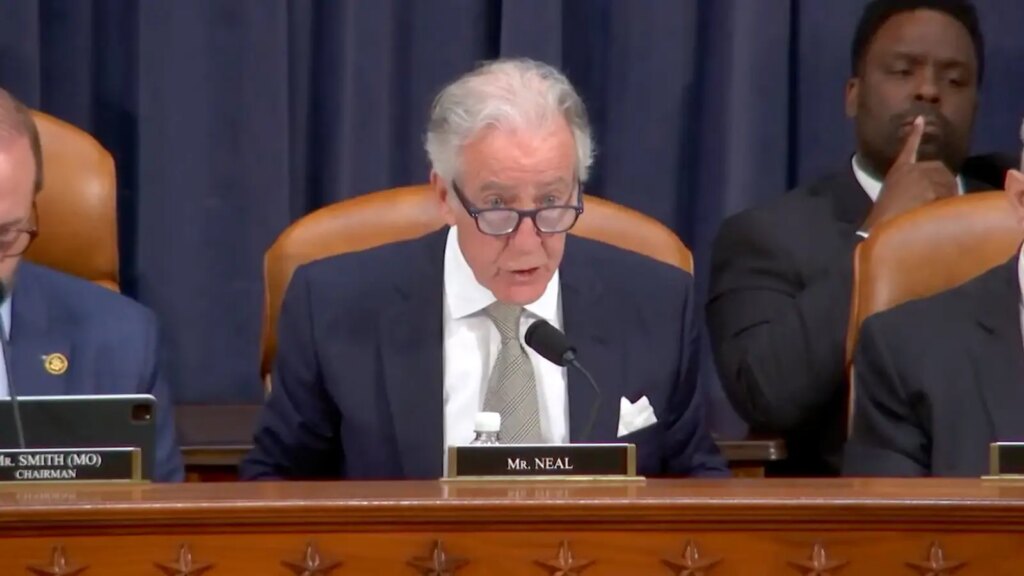
Are health system executives mostly worried about income and profits, or are they just struggling to serve patients amid increasing costs and inadequate insurance reimbursement? House Ways & Means Committee members appeared to be of two minds on the subject at a hearing Tuesday.
“Our communities are better off with hospitals in them, but large health systems have taken advantage of that reality,” Committee Chair Rep. Jason Smith (R-Mo.) said in his opening statement. “The corporatization of American hospitals means that our local hospitals and physicians have been replaced by mega corporations that put quarterly earnings over quality care and grow larger simply for the sake of growing larger. Hospitals with more than 100 beds have a higher profit margin than Delta Airlines, Target, or Disney.”
But Rep. Richard Neal (D-Mass), the committee’s ranking member, offered a different take. “Last year, we warned for months that [Republicans’] trillion-dollar tax cut bill was going to harm the American healthcare system,” he said in his opening remarks. “They refused to acknowledge the questions that we raised. They ripped coverage from 15 million people and pushed hundreds of hospitals to the brink, and then they complain about the problem after it’s their tax bill that’s going to lead to these massive cuts.”
The health system executives on the panel cited a number of factors contributing to their economic woes.
“Today, healthcare affordability is being strained by four powerful forces: labor, rising supply and technology costs, payer behavior, and regulatory burden,” said Wright Lassiter III, president and CEO of CommonSpirit Health in Chicago. “Labor alone has risen more than 20% in the last 5 years, and now represents more than 54% of our operating expenses. Prices of pharmaceuticals, medical supplies, and advanced technologies each grew by more than 10% last year.”
Caring for the uninsured also plays a part, said Sam Hazen, CEO of HCA Healthcare in Nashville, Tennessee. “Last year alone, we provided approximately $4.5 billion in uncompensated care, including charity care and financial assistance for uninsured patients,” he said. “The reality of our system today is clear — healthcare in this country has never been better nor more advanced, but it is also too expensive for too many people. Whether it is the price of a prescription, insurance premiums, or an unanticipated emergency room visit, the financial pressures associated with healthcare affect every American household.”
Hazen had three recommendations for the lawmakers:
- Ensure stable and affordable health insurance coverage. “When patients have reliable coverage, they have greater access and can seek care earlier, manage chronic conditions more effectively, and avoid costly emergency interventions,” he said. “Providers must also deliver care more efficiently with higher quality and greater consistency.”
- Engender fair competition. “When providers compete on quality service and access, it drives better patient care and lowers costs,” noted Hazen. “Certificate of need laws originally intended to control costs now do the opposite, limiting competition, constraining supply, and increasing prices. Revisiting these laws would encourage innovation and improve access, especially in underserved areas.”
- Simplify claims payment and prior authorization. “We see firsthand the toll of administrative complexity,” he concluded. “Insured patients and providers routinely face barriers, including prior authorization and payment disputes [over] care denials and underpayments. These frictions translate directly into delayed diagnosis, reduced access, and higher costs.”
For their part, lawmakers on each side of the aisle seemed very far apart on solutions.
“Is there anyone that disagrees that Medicare for All should be something that every single American has so that they have the access to the very healthcare facilities conducive to make a better life?” said Rep. John Larson (D-Conn.), referring to a single-payer, government- financed health insurance system that would cover all Americans. “Why [are we not] agreeing that this is what we have to do?”
That did not sit well with Rep. Greg Murphy, MD (R-NC). “Medicare for All is a ridiculous initiative,” he countered. “You want less government in the situation, because that’s [what is causing] some of the worst problems that we have today.”
Rep. Vern Buchanan (R-Fla.) focused on how a better diet could help prevent many chronic conditions. “Prevention and eating real food is the key to making healthcare more affordable,” he said. “We must prioritize prevention — in other words, don’t get sick in the first place — to the extent we can … as the key to reversing trends in heart disease, obesity, and diabetes. Hospitals can and should take the time to make sure what we’re doing is the right thing in the long term.”
Buchanan praised HHS for its redesign of the food pyramid and asked the four health system witnesses whether their health systems would “take the pledge” to provide more nutritious food in their hospitals. Several responded that they were already working on the issue.
Site-neutral payment — the idea that Medicare should reimburse the same amount for a given procedure no matter which facility it is performed in — came up several times during the hearing.
Rep. David Kustoff (R-Tenn.) held up a chart showing that a colonoscopy costs $656 if it is performed at a physician-owned surgery center, but the same procedure costs $1,222 if it is performed at the hospital as an outpatient procedure. “I’ll concede that there are some services that you provide [at the hospital] that the surgery center doesn’t provide outside of the colonoscopy, but does 100% increase in the fee that you charge versus the surgical center seem reasonable to you?” he asked Brian Donley, MD, president and CEO of NewYork-Presbyterian health system in New York City.
Donley agreed that there were opportunities to consider the use of site neutrality for some procedures. “I do think it’s important, though, that we recognize … that hospitals … take care of sicker patients” compared with physician-owned outpatient facilities, he noted. “That’s more risk and that’s costlier. Hospitals also will take care of all patients that show up, regardless of what their payer is, and that’s different than physician-owned places. The other thing is there’s a higher regulatory burden for a hospital as opposed to a physician-owned place.”
Please enable JavaScript to view the comments powered by Disqus.
Source link : https://www.medpagetoday.com/hospitalbasedmedicine/generalhospitalpractice/121008
Author :
Publish date : 2026-04-28 21:26:00
Copyright for syndicated content belongs to the linked Source.