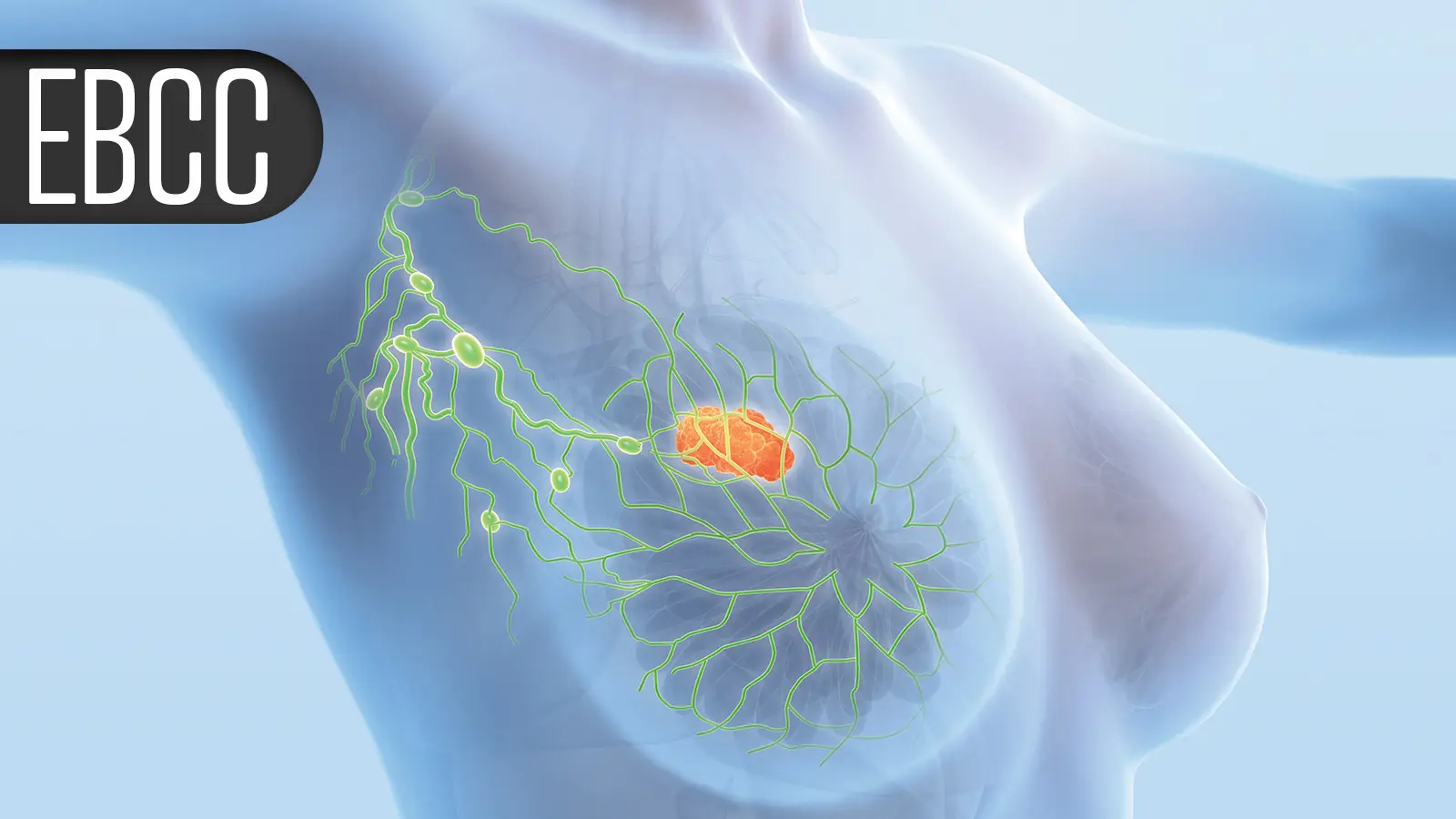
Ten years after tailored radiotherapy (RT) for breast cancer, fewer than 3% of patients had locoregional recurrences (LRR), most during the first 5 years, a Dutch registry study showed.
The overall LRR of 2.9% did not differ significantly across subgroups of patients with low-, intermediate-, or high-risk disease or between the risk groups. Both the 10-year relapse-free interval (RFI) and overall survival (OS) declined as the risk level increased, indicating the risk-stratification criteria based on response to neoadjuvant chemotherapy accurately distinguished the groups.
The results align with the 5-year data from the NSABP-B51 trial, which showed that more than 90% of patients remained recurrence free after 5 years, said Fleur Mauritz, MD, of the Maastricht Radiation Oncology Institute in the Netherlands, at the European Breast Cancer Conference.
“The results of our study show that tailoring the extent of radiotherapy according to how well the chemotherapy has worked to treat cancer in the lymph nodes leads to very low and reassuring recurrence rates in the breast and surrounding area,” said Mauritz. “In a selected group of patients, we see very low recurrence rates even when we leave radiotherapy out completely.”
“Locoregional radiation was only tailored based on nodal status, so no other factors were taken into account,” she added. “This is something we want to do in the future, for example, look at tumor cell type.”
The Dutch RAPCHEM prospective cohort study asked whether response to neoadjuvant chemotherapy can act as a prognostic biomarker for absolute benefit to enable tailored RT, according to invited discussant Charlotte Coles, MD, of Addenbrooke’s Hospital and the University of Cambridge in England. The study had a “threshold-crossing design” and “was many years ahead of its time.”
The 10-year results did show that “response to neoadjuvant chemotherapy can act as a prognostic biomarker, enabling tailoring of radiotherapy following axillary lymph node dissection,” said Coles. “The focus now is very much on de-escalation of surgery to reduce toxicity and we really, as a community, need to get behind and support the ongoing randomized trials and well-designed prospective cohort studies. It’s going to be really important to understand the possible interplay of biology better.”
Multiple ongoing studies are evaluating issues that could further define the role of RT in breast cancer, including searches for additional prognostic biomarkers, honing indications for axial radiation, and studying ways to prevent or limit lymphedema, Coles added.
As background for the RAPCHEM study, Mauritz noted that the approach to treating early breast cancer has evolved from primary surgery followed by locoregional RT and adjuvant systemic therapy to primary neoadjuvant systemic therapy followed by surgery and locoregional RT. The transition created uncertainty about how to manage patients with cT1-2N1M0 disease (≤ three suspicious nodes).
“Initially, we decided to be on the conservative side and use the same strategy: apply local radiation therapy, followed by nodal radiation to levels 1 to 4,” she said. “However, that raised the question, ‘Isn’t that overtreatment?'”
The question led to evaluation of a strategy to tailor RT indications to nodal response after primary systemic therapy. Investigators at 17 Dutch centers enrolled patients and assigned them to risk groups on the basis of axillary lymph nodal status after systemic therapy, corresponding to a study guideline for RT.
- Patients in the low-risk group (ypN0) group received whole-breast RT after lumpectomy, no RT after mastectomy, and no nodal RT.
- Intermediate-risk patients (ypN1) received whole breast RT after lumpectomy, chest wall RT after mastectomy, no RT after axillary lymph node dissection (ALND), and RT to levels 1-2 after sentinel lymph node biopsy (SLNB).
- The high-risk group (≥ypN2) received whole-breast RT after lumpectomy, chest wall RT after mastectomy, RT to levels 3-4 after ALND, and RT to levels 1-4 after SLNB.
The study’s primary endpoint was LRR after 10 years, and secondary endpoints were 10-year RFI and OS. An interim report showed an LRR rate of 2.2% after 5 years.
Data analysis included 838 patients, consisting of 291 in the low-risk group, 370 in the intermediate-risk group, and 177 in the high-risk group. Almost two-thirds of the patients had hormone receptor-positive/HER2-negative disease, followed by triple-negative breast cancer (15%), HR-positive/HER2-positive (13%), and HR-negative/HER2-positive (7%). More than 80% of the patients had ALND, far more than current standard of care, Mauritz noted.
After 10 years 24 patients had LRR, 18 during the first 5 years. The 10-year LRR rate of 2.9% consisted of 2.4% for low-risk patients, 3.2% for the intermediate-risk group, and 2.8% for high-risk patients. The 10-year RFI was 79.2% and 10-year OS 83.0%. As predicted, both values declined with increasing risk:
- RFI: 88.2%, 78.9%, 64.9%
- OS: 90.7%, 83.0%, 70.5%
Mauritz noted that RT was tailored by ypN status only. No other risk factors were considered. Future studies should include the influence of tumor subtype.
Source link : https://www.medpagetoday.com/meetingcoverage/ebcc/120555
Author :
Publish date : 2026-03-30 17:14:00
Copyright for syndicated content belongs to the linked Source.