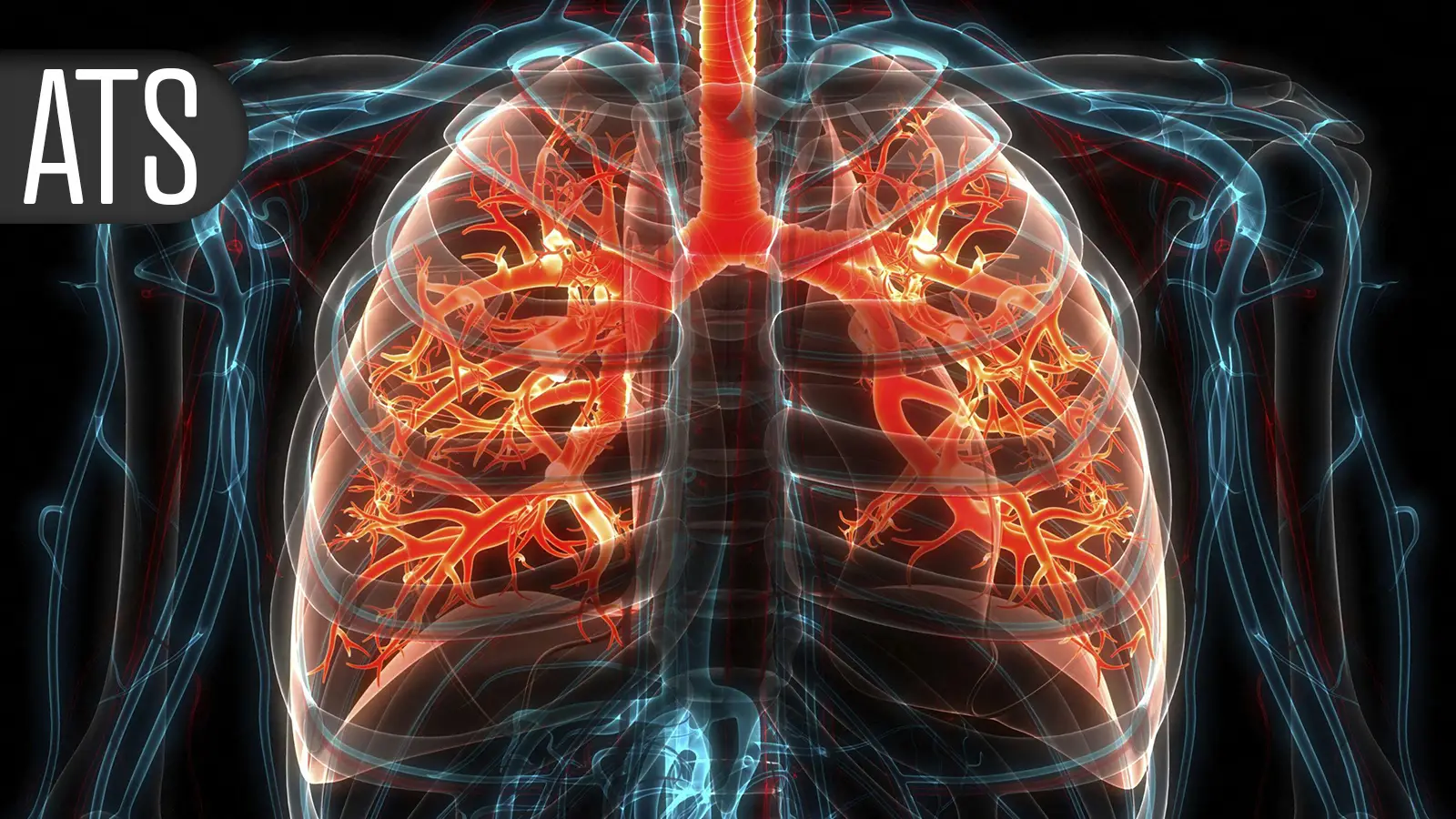
A transbronchial lung biopsy cryoprobe 1.1 mm in diameter outperformed standard 2.0-mm forceps for diagnostic yield, the FROSTBITE-2 randomized trial showed.
Diagnostic yield came in nearly 10 percentage points higher with transbronchial biopsy done using the Erbe Elektromedizin cryoprobe than with forceps (88.6% vs 78.8%, P=0.003), reported Jeffrey Thiboutot, MD, MHS, of Johns Hopkins University School of Medicine in Baltimore, at the American Thoracic Society (ATS) annual meeting in Orlando.
The difference was particularly great among patients with pulmonary nodules or masses (83.2% vs 70.1%, P=0.04) in the findings, which were published simultaneously in JAMA.
With no difference seen in safety endpoints, “all of that together shows that this is really ready for prime time,” Thiboutot said. “This is ready for routine use in your bronchoscopy suites.”
“This is actually a reasonably high impact procedure that pulmonologists across the world are doing with some risk to patients,” said ATS session study commentator George T. O’Connor, MD, of Boston University and a JAMA editor. “And if it in fact is a better way to do it, this may be a very important message that is going to have a big impact.”
Indeed, lung biopsy is “far from perfect. In fact, when we’re going into sample lesions in the periphery of the lung, we’re really only getting an answer maybe 70% of the time,” Thiboutot said at the late-breaking clinical trial session. And that hasn’t changed despite electromagnetic navigation, cone beam CT, and all the other ancillary technological advances, he added. “We haven’t budged in 10 years. Maybe we need to start looking at the tool.”
Previous studies showed higher yield of cryobiopsy, as it offers larger tissue specimens at higher quality without crushing the sample, but at the cost of more bleeding and pneumothorax events.
So Thiboutot’s group modified the cryoprobe probe down from 1.9 to 1.1 mm to be small enough to enter through the working channel and obtain the specimen without having to remove the scope. Following the FROSTBITE-1 trial’s demonstration of similar complication rates to standard forceps, the group aimed to demonstrate a clinical advantage in diagnostic yield.
The investigator-initiated trial involved nine U.S. medical centers that performed at least 100 transbronchial biopsies per year and had affiliated institutional centers for lung cancer, lung transplant, and interstitial lung disease. Patients were age 18 years or older and scheduled to undergo transbronchial biopsy for lung nodules or masses, lung transplant, or diffuse parenchymal lung disease. Consecutive patients were approached until 500 could be enrolled and randomly assigned open label to either the 1.1-mm cryoprobe or the 2.0-mm forceps for the biopsy. Randomization was stratified by indication; assessment was blinded.
For the key secondary analyses, cryoprobe diagnostic yield was significantly higher among patients biopsied for lung transplant (96.0% vs 88.7%, P=0.03) and directionally higher in diffuse parenchymal lung disease (72.0% vs 62.5%, P=0.55), although not reaching statistical significance likely due to small numbers (24-25 in each group), Thiboutot suggested.
For histologic size and quality, “across the board the cryoprobe outperformed forceps: larger biopsy sizes, more alveolated tissue, less crush artifact, higher quality indices,” Thiboutot said. “All of these things are what was reflected in that difference in diagnostic yield.”
In terms of safety, four pneumothoraces requiring chest tube placement occurred in the forceps group (1.6%) but none in the cryoprobe group. No patients experienced significant, grade 3 or 4 bleeding or respiratory failure events. Certain lots of the cryoprobe went under a class I recall in March due to reports of rupturing or bursting during activation, but none of these events were reported in the trial.
Cryoprobe biopsies were done under deep sedation or general anesthesia with an endotracheal tube, laryngeal mask airway, or tracheostomy in place.
“So this is now taking the procedure out of the hands of interventional pulmonologists, who have the training in rigid [bronchoscopes] and balloons and is now putting this instrument into the hands of the general pulmonologists, emergency room doctors, [intensive care unit] doctors, anesthesiologists that could be using this as well,” Thiboutot said.
He noted that it is for peripheral lung biopsy only, not for endobronchial lesions or suspected usual interstitial pneumonia.
“The cryoprobe is significantly more expensive than the forceps,” he acknowledged in response to a question from the audience, “but I’ll say you’re talking about on the order of magnitude of a couple hundred dollars difference. The price of a repeat bronchoscopy or benign surgery can buy you a whole lot of cryoprobes.”
A formal cost-efficacy analysis is planned, he said.
Source link : https://www.medpagetoday.com/meetingcoverage/ats/121371
Author :
Publish date : 2026-05-20 17:05:00
Copyright for syndicated content belongs to the linked Source.