


Developed in partnership with the Our Partner
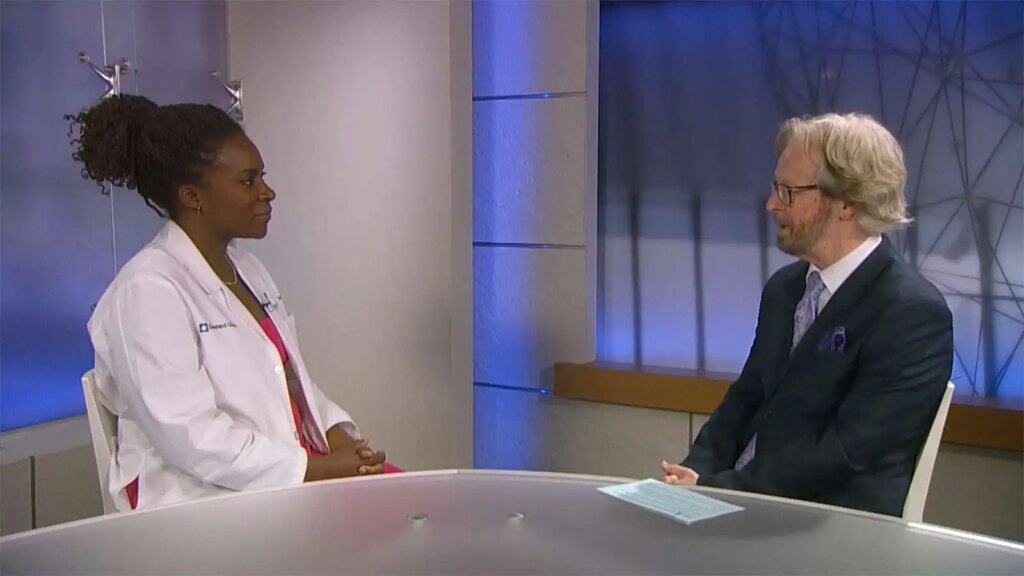
In “Beyond Diagnosis: Breast Cancer,” Cleveland Clinic oncologist Tiffany Onger, MD, and host John Mangels discuss the dynamics of communicating effectively and empathetically with patients facing the challenges of this life-altering disease.
Each monthly installment has examined an individual aspect of these crucial conversations, including establishing trust, reviewing treatment options, and navigating difficult questions.
In this final episode, Onger reflects on how clinicians can maintain perspective, manage the emotional demands of care, and build meaningful, human connections with patients over time.
The following is a transcript of their remarks:
Mangels: Welcome to “Beyond Diagnosis.” I’m your host, John Mangels. Newly diagnosed breast cancer patients need information and support. As a physician, how should you prepare for that conversation? For expert advice, I’m joined by Cleveland Clinic oncologist and breast cancer specialist, Dr. Tiffany Onger. Dr. Onger, thanks so much for your time today.
Onger: Thank you for having me.
Mangels: We’re talking today about maintaining perspective and balance as a physician. How do you care for yourself while you’re caring for your patients?
Onger: This is an important question. We know that one of the things that can lead to burnout is when we overextend ourselves. Certainly, our patients need our full attention and it can sometimes take a lot of time. Not only time in the office, but also emotional time and emotional energy.
One of the things that helps me is by talking about what I’m experiencing with my other medical oncology colleagues. They can appreciate if we get a bad scan and it not only feels bad for the patient, but also feels bad to us. And so having a sounding board where I can have others who listen and can just appreciate if it’s been a tough day, I’ve had some patients that were sick, just having a safe space to talk about that.
Mangels: So talking to each other, supporting each other, being there for each other, just listening to each other, it sounds like.
Onger: Absolutely.
Mangels: You have a demanding practice. You have a schedule to keep. How do you do that and still relate to your patients in a way that they need to feel seen and heard?
Onger: Well, I do do my best to stay on time. I’m not always successful, but some of the things that do help me are to set an agenda with the patient so that we know what’s most important to cover today and what we might have to visit at a future time.
The things that I do outside of the clinic visit to help me stay on time is to allow my team — and that can include my nurse practitioner as well as my RN — to operate at the top of their licenses. I don’t have to answer every question myself while the patient just wants to know that I have contributed to the recommendation that my nurse or nurse practitioner are providing.
Mangels: What’s the most important advice you’d pass along to your peers?
Onger: One of the most important pieces of advice is, I have gone through my training and through my experience of seeing breast cancer patients is to really approach each patient as an individual and to get to know them. Find out who’s their daughter, who is their friend, who is their companion who’s in the room with them today. If I see that they’ve got a picture of a dog on their phone, for example, I ask about them.
And we just get to know each other a little bit more personally. And I’ll even share from my personal experience as well. A lot of my patients this week know that I got a new puppy and they are all asking me questions about him.
Mangels: I’d love to see pictures.
Onger: I will show you.
Mangels: So treat patients as people, not just patients.
Onger: Exactly.
Mangels: Thank you so much for your advice.
Onger: Certainly. Thank you for having me.
Mangels: And thank you for watching. Please join us again for another episode of “Beyond Diagnosis.”
Please enable JavaScript to view the comments powered by Disqus.
Source link : https://www.medpagetoday.com/beyond-diagnosis/breast-cancer/120834
Author :
Publish date : 2026-04-17 14:25:00
Copyright for syndicated content belongs to the linked Source.