
[ad_1]
Welcome to “Medical Mavericks,” a series from MedPage Today featuring interviews with healthcare professionals working in unconventional fields of health and medicine.
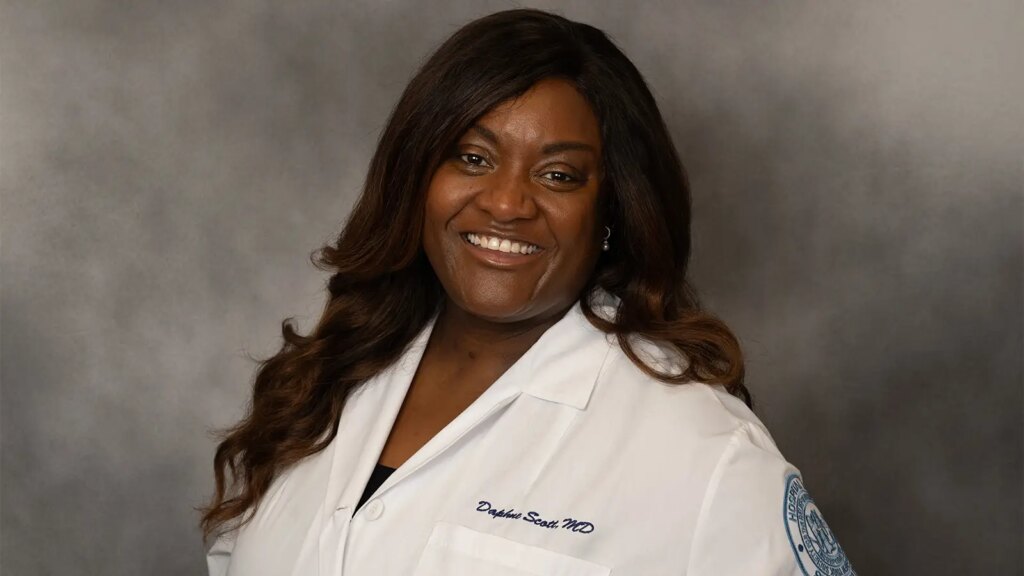
In the wake of the New York Knicks winning the National Basketball Association (NBA) championship for the first time in 53 years, we spoke with Daphne Scott, MD, chief of the Primary Sports Medicine Service, associate chief medical diversity officer, and an attending physician at Hospital for Special Surgery (HSS) in New York City, about her role caring for a professional basketball team.
During our conversation, Scott told us that since the championship win she’s been getting several emails a day from people who want to do what she does. So, what did it actually take to get there? Read on to hear from Scott about her pathway to the Knicks and her work on and off the court.
How did you get involved with the New York Liberty of the Women’s National Basketball Association (WNBA), and ultimately, the Knicks?
Scott: When I was in Seattle, I had the opportunity to work with the Seattle Storm [WNBA team] in my last year of residency. I went to the University of Washington because they have a strong family medicine residency, but they also have a very strong sports medicine faculty. So I had the opportunity to work with great sports medicine mentors. Then, we go to fellowship where again I was like, hey, I love collegiate athletics, this is amazing.
Ultimately, I left to come to HSS, and when I got here, every team already was covered. So I kind of served as the backup for a year. I was like, if anyone’s going out of town, if anyone needs any help, I’m here. I was covering everywhere I could whenever people needed some extra coverage.
Then there was one game where I covered with the Liberty and the rest was history. They invited me on as an assistant. And when the team was sold, I was able to work with them for one additional season and then decided to stay on with Madison Square Garden, and ultimately took over as the head team physician for the Westchester Knicks in 2018, and later joined the New York Knicks.
As the lead physician for the Knicks, what does your role entail?
Scott: This is a year-round position for me. Everyone thinks, well, the season’s over, so it’s kind of slowed down for you — but it ends up being quite involved. Since the season ended, we went straight into the draft, which is where myself and my surgical colleagues — Dr. Allen and Dr. Drakos — and I have to review charts of all potential draftees and be ready to answer questions. And then we have a team leaving for summer league.
So, there’s a lot going on, in addition to still taking care of the guys and helping other staff get much-needed appointments set up. During the season things get pushed to the wayside, so the primary care physician part of me comes out in the off-season. I’m like, hey everyone, you need to follow up with this doctor or that doctor.
Once you get into the season, a lot of it is working closely with our team. We have an amazing team of providers. Without every single person, I don’t think we would be where we were, to be able to support these guys from a medical standpoint.
We have our leader, Quentin Dolan, who has been wonderful to work with. And I work very closely with Casey Smith who came to us from the Dallas Mavericks. Between him and myself, we kind of oversee the day-to-day. We also have our longtime head athletic trainer and a slew of other athletic trainers, chiropractors, physical therapists, dietitians, a massage therapist, and strength conditioning coaches.
It’s a large team that works very closely together. If the communication was not there, I don’t think we would have been able to do what we were able to do.
What does your role look like on the court during a game?
Scott: A game day for me, with regards to communication, is: What’s going on with the team? Is there anything we need to potentially get there early to look at? Do I need to arrange for a consultant to be there? That sort of thing. I have to be there 90 minutes ahead of a tip-off — that’s a league rule.
Usually when I get in, I check in with everyone, making the rounds, making sure everyone’s good. Everyone thinks, hey, you’re just taking care of the athletes – that’s actually not [the case]. You’re taking care of coaches, you might have a quick check-in with front office. And I’m not necessarily providing direct care to everyone, but sometimes it’s helping with coordination of care. Because you want to make sure that everyone within the family is well taken care of. So, there’s a lot of walking around, checking in with people in that first bit of time.
At 35 minutes prior to tip-off, I go with one of our athletic trainers to meet with the visiting team. Typically, the visiting teams aren’t traveling with their doctors, so we’re meeting with an athletic trainer, potentially their security, and all the emergency personnel at Madison Square Garden. And I will lead what we call the 35-minute medical emergency meeting where we talk through both teams, if there’s anything going on that we should know about with any players; what the protocol is if something were to happen on court or off court, where we’d be going, in terms of which hospitals; and then answering any questions should there be a medical emergency.
Do you travel with the team or only at home games?
Scott: I do travel, but not to every game. Typically, what happens when the schedule comes out, we’ll look ahead and I’ll look at times when I think, hey, that could be problematic for us. So, a long road trip with a back-to-back [games] — that’s when fatigue can set in and potential injuries or illness can happen. It’s important to be around for that. Then during the playoffs, during the post-season, I travel to every game, or a lot.
If you see an injury mid-game, how do you approach that?
Scott: This goes back to our amazing team model. You should never see us on the court. I always say if you see myself or an orthopedic surgery colleague on the court, that means something really bad happened. If there’s any injured athlete, then per protocol for the NBA, the head athletic trainer would be the first one to go out once they’re cleared by the referees. They’ll go out and assess.
In the case of a significant medical emergency, throughout the entire league there’s a common signal that if they needed everyone out on the court, there’s a raised-fist-overhead signal. But typically, if there’s an injury, our head athletic trainer would assess that, and make a decision with the athlete on whether they can deal with it on the bench or if they need to go back to the locker [room] for further evaluation.
Depending on what we think is going on, if it’s more in my lane, then I’ll go back. But a lot of the time it is musculoskeletal injuries. And so, one of our orthopedic surgeons goes back. If there’s a break in between quarters or it’s halftime, then I’ll go back and assist.
At any given time we always want to make sure we have eyes on the court. So, it would be absolutely rare that both of us would be out of our seats and not watching the court.
I imagine you watch the games very differently than the spectators.
Scott: It’s actually really interesting how I was taught to watch basketball games. I joke around and say, you have to be able to have eyes on both sides of the court at the same time. Let’s say there’s a play that’s a fast break going one way, but someone went down over there. With one eye I’m kind of watching that fast play and watching what’s going on down there, but I’m also looking at the other side of the court to make sure that athlete got up.
We’re also responsible for the ref — every once in a while something happens to a referee. So, you want to make sure you’re able to see everyone who’s out there and are they moving OK? Or does it look like someone’s laboring, like what’s going on?
So, I watch the games a lot differently. Then at the end of the night, I go home and I kind of rewatch the game. Then I can watch as a fan and catch up on all the fun things I may have missed.
What are your favorite parts of the job?
Scott: It’s gotta be the people. We work with some of the most amazing people. To be able to talk with them or hear about their past experiences or get mentorship has been wonderful.
And then the guys [players], right? These are young men who work hard, day in and day out, to come together for a common goal. And this year, they came out on top. And then talking with Coach Brown and his staff, I mean those guys came together so quickly and were able to pull off almost what you would consider to be the impossible. Just a large group of coaches and their support staff coming together to put together this championship team was amazing.
Is there anything I haven’t asked that you’d like to add?
Scott: Since this [the Knicks win] happened, every day I’m getting three to four emails from people who want to do what I do. I had someone say the other day, “right place, right time.” Here’s what I want to let people know: It’s actually not right place, right time. There was a lot of hard work, there were a lot of late nights and not glamorous places that went into this. And not just for myself, for many of us who were able to get here.
It’s putting in the time, it’s putting the work. It’s those early years of saying yes. It’s checking your ego at the door. You’re there to work with everyone for the greater good, for the greater goal.
But once you get here, it’s fun and I enjoy every day. I’m lucky to do what I do. I’m lucky to be able to take care of the amazing patients I have at HSS and the team and the amazing colleagues I work with.
Please enable JavaScript to view the comments powered by Disqus.
[ad_2]
Source link : https://www.medpagetoday.com/popmedicine/popmedicine/122122
Author :
Publish date : 2026-07-09 18:44:00
Copyright for syndicated content belongs to the linked Source.