


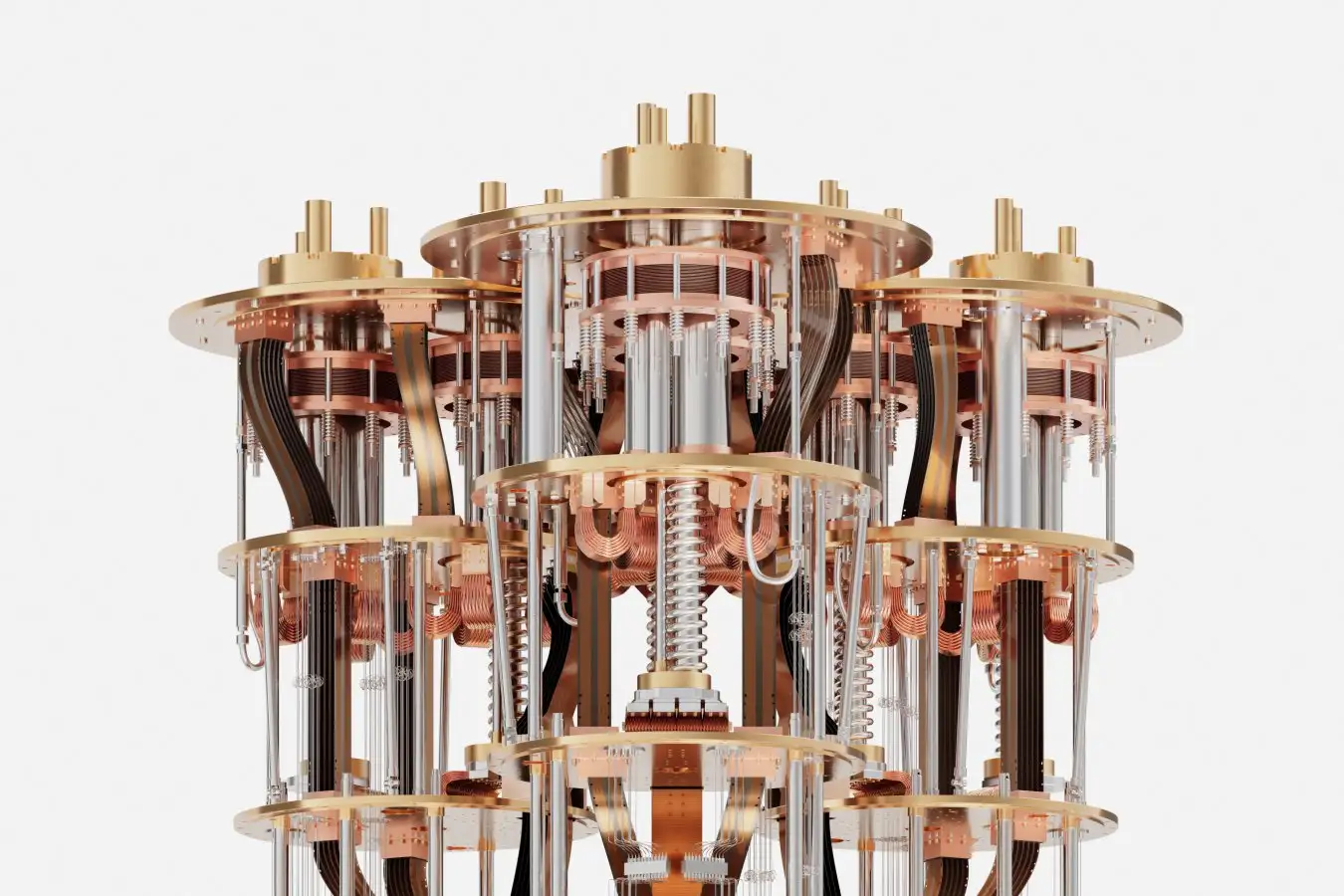
The IBM Quantum System Two, which is similar to the machine used to make the new time crystal
IBM Research
A time crystal more complex than any made before has been created in a quantum computer. Exploring the properties of this unusual quantum setup strengthens the case for quantum computers as machines well-suited for scientific discovery.
Typical crystals have atoms arranged in a specific repeating pattern in space, but time crystals are defined by a pattern that repeats in time instead. A time crystal repeatedly cycles through the same set of configurations and, barring deleterious influences from its environment, should continue cycling indefinitely.
This indefinite motion initially made time crystals seem like a threat to the fundamental laws of physics, but throughout the past decade researchers have made several of them in the lab. Now, Nicolás Lorente at Donostia International Physics Center in Spain and his colleagues have used an IBM superconducting quantum computer to make an unprecedentedly complex time crystal.
While most past studies focused on one-dimensional time crystals, which can be compared to a neat line of atoms, the researchers set out to create a two-dimensional version. To that end, they used 144 superconducting qubits arranged in an interlocking pattern roughly like a honeycomb. Each qubit played the role of a particle with quantum mechanical spin, which is a key component of quantum materials such as magnets, and the team could control how nearby qubits interacted with each other.
Varying these interactions over time is what gave rise to the time crystal, but the researchers could also program the interactions to have a particularly pattern of strengths.
Being able to reach this new level of complexity allowed the team not only to create a time crystal more complex than any produced with a quantum computer before now, but also to start mapping out the features of the whole qubit system to obtain its “phase diagram” – a map that shows all the possible states the system can take. Completing a phase diagram is an important step for understanding the properties of a material – a phase diagram of water, for instance, reveals whether the water is liquid, solid or gas at a given temperature and pressure.
Jamie Garcia at IBM, who wasn’t involved in the research, says this experiment may be the first in many steps that could eventually lead to quantum computers helping to design new materials based on a fuller picture of all the possible properties a quantum system can have, including those as odd as time crystals.
The equations that the researchers used as a blueprint for making the time crystal and to begin constructing its phase diagram were already complicated enough that conventional computers can’t use them for simulations without having to make approximations. At the same time, all existing quantum computers suffer from errors, so the researchers had to use those conventional methods to estimate where the quantum computer’s work, such as the phase diagram, may become unreliable. This back-and-forth between approximate conventional methods and exact but error-prone quantum approaches could sharpen our understanding of many complex quantum models for materials going forward, says Garcia.
“Two-dimensional systems are practically very challenging to simulate numerically, so the large-scale quantum simulation with more than 100 qubits should provide an anchor point for future research,” says Biao Huang at the University of Chinese Academy of Sciences. He says that the new study represents exciting experimental progress for several areas of study into quantum matter. Specifically, it could help connect time crystals, which can be simulated on quantum computers, to similar states that can be created in some types of quantum sensors, says Huang.
Topics:
- quantum computing/
- quantum physics
Source link : https://www.newscientist.com/article/2513426-most-complex-time-crystal-yet-has-been-made-inside-a-quantum-computer/?utm_campaign=RSS%7CNSNS&utm_source=NSNS&utm_medium=RSS&utm_content=home
Author :
Publish date : 2026-01-28 10:00:00
Copyright for syndicated content belongs to the linked Source.