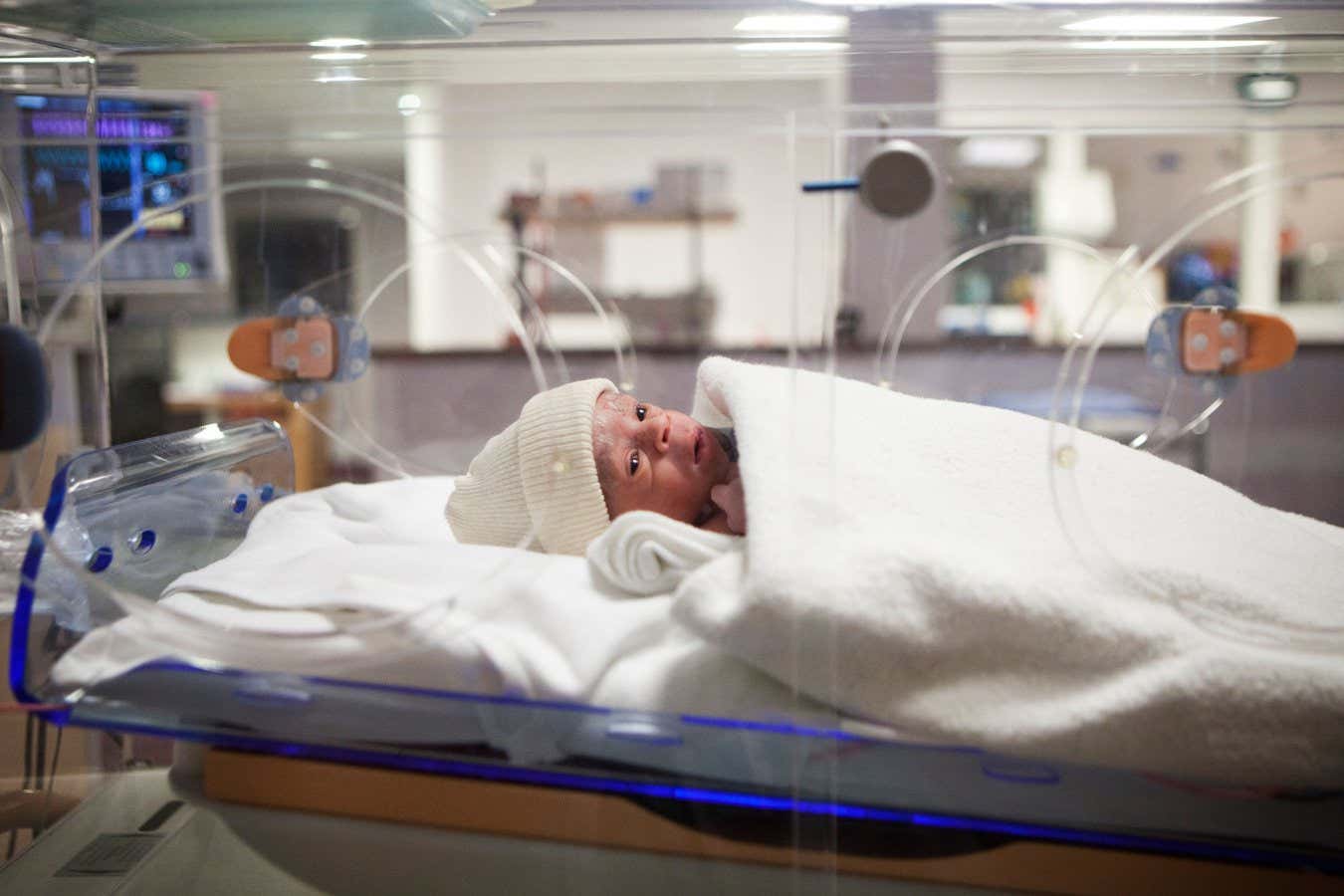
Babies born prematurely can have language difficulties later in life, but a simple intervention could help
BSIP SA/Alamy
Playing recordings of a mother’s voice to premature babies may help their brains mature faster, according to the first randomised-controlled trial of this simple intervention. This approach could ultimately improve language outcomes for babies born too early.
Being born prematurely is associated with altered brain structures, which is linked with language difficulties, sometimes compromising later communication and academic achievement. The sound of a mother’s voice and her heartbeat can encourage the growth of pathways associated with hearing and language skills. But it isn’t always possible for a parent to be with or hold their baby in a neonatal ward.
To find out if their presence could be mimicked by a recording, Katherine Travis at Weill Cornell Medicine in New York and her colleagues enrolled 46 premature babies, born between 24 weeks and 31 weeks of gestation, while they were in neonatal intensive care.
The mothers recorded themselves reading extracts from the children’s book A Bear Called Paddington. A 10-minute audio clip was then played to half the babies twice every hour between 10pm and 6am, increasing that child’s exposure to their mother’s voice by an average of 2.7 hours each day, until around their original due date. The rest of the babies received the same care, but without the recordings.
Once the babies had reached term, they were given two types of MRI scan, which showed how organised and connected their brain networks were. The scans revealed that those who heard their mother’s voice at night had stronger and more organised connections in and around the left arcuate fasciculus, one of the major areas supporting language processing. It was more mature, says Travis. “Its structure looks more like what we would expect to see in an older or more developmentally advanced infant.”
The scans also suggest that this maturation may be driven by increased myelination – the formation of fatty sheaths that insulate nerve fibres and help signals travel faster and more efficiently around the brain. “Myelination is a key aspect of healthy brain development, especially in pathways that support communication and learning,” says Travis.
Prior studies have linked delays in development in these areas of the brain to later language and learning difficulties. The new results hint that targeted speech exposure could help improve those outcomes.
But was there anything uniquely important about the babies hearing their mother, rather than anyone else’s voice? This study hasn’t answered that, but previous research has shown how babies begin to hear from about 24 weeks of gestation, and continuous exposure to their mother’s voice in the womb is thought to explain why they prefer it over other voices after they are born. “It’s the most familiar and biological meaningful voice for an infant,” says Travis. “Because this voice is so well-established even before birth, it may be especially engaging for the developing brain.”
That said, variability in speech is also important for language development, she says, so it is possible that speech from other caregivers could provide similar benefits. The team intends to explore this idea in future studies.
The intervention is simple and could be easily added into the care system. However, David Edwards at Evelina London Children’s Hospital warns that the results shouldn’t be overinterpreted. “It’s a very small sample size and I think some more control groups are needed – other sources of speech, other forms of auditory stimulation, other forms of increased stimulation,” he says.
Travis and her team are now hoping to confirm the results in larger trials and in babies who are more medically fragile. They will also follow the current participants to see if the brain differences observed translate into meaningful benefits in language and communication skills as they grow.
Topics:
Source link : https://www.newscientist.com/article/2499734-mothers-voice-seems-to-boost-language-development-in-premature-babies/?utm_campaign=RSS%7CNSNS&utm_source=NSNS&utm_medium=RSS&utm_content=home
Author :
Publish date : 2025-10-14 05:00:00
Copyright for syndicated content belongs to the linked Source.