


- A study has found promising results with the breast cancer prevention drug (Z)-endoxifen.
- The drug reduced breast density safely and with fewer side effects than tamoxifen.
- It also had fewer troublesome side effects than this standard preventive treatment.
- Experts say that if further research confirms these findings, the endoxifen could help increase compliance and improve outcomes.
The protocol involves low doses of (Z)-endoxifen, a metabolite of the well-known drug tamoxifen.
The study, known as the KARISMA Endoxifen trial, tested the effects of two daily doses of (Z)-endoxifen on mammographic breast density, a known marker of breast cancer risk and treatment response.
Researchers examined whether (Z)-endoxifen could reduce breast density safely and with fewer side effects than tamoxifen, potentially offering a new option for breast cancer prevention. Here’s what they found.
The KARISMA Endoxifen trial was a double-blind, randomized, placebo-controlled phase II study that enrolled premenopausal women ages 40 to 55.
Researchers recruited 240 healthy participants from Sweden’s national breast cancer screening program between December 2021 and November 2023.
To be eligible, participants needed to have regular menstrual cycles or confirm premenopausal status via blood tests, and to have a baseline mammogram showing measurable breast density. Women taking medications that could interfere with endoxifen metabolism were excluded.
Participants were randomly assigned to one of three groups receiving daily oral capsules for six months: a placebo, 1 milligram (mg) of (Z)-endoxifen, or 2 mg of (Z)-endoxifen.
The study was “double-blinded,” meaning neither the participants nor the researchers knew who was receiving which treatment until the trial was completed, ensuring unbiased results.
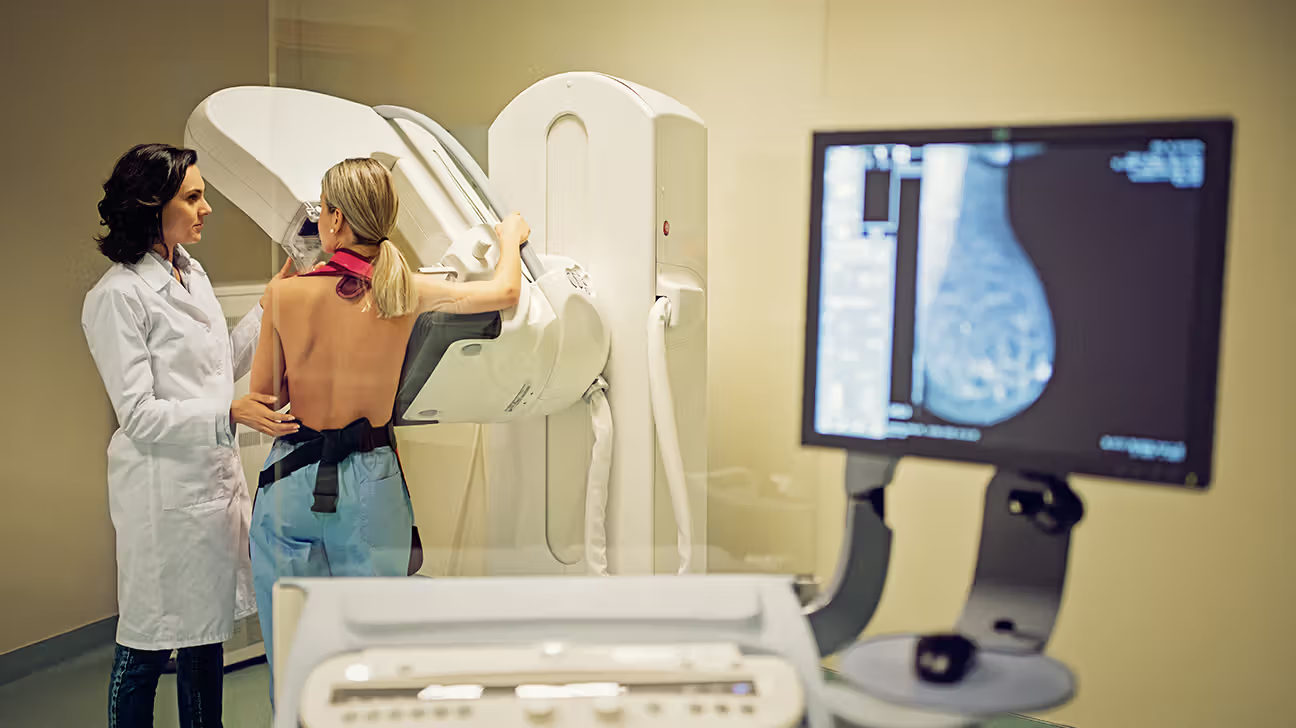
Mammographic breast density was measured from full-field digital mammograms obtained at the start, 3 months, 6 months, or upon early discontinuation. A specialized automated method, STRATUS, assessed breast density area in square centimeters, and images were aligned to reduce measurement errors.
Safety and tolerability were evaluated throughout the study by monitoring vital signs and blood chemistry, and by assessing participant-reported side effects via a digital application and questionnaires.
Tolerability was assessed using the Breast Cancer Prevention Trial Eight Symptom Scale (BESS Plus), a validated symptom questionnaire, supplemented with questions specific to tamoxifen-related symptoms based on previous research.
The trial’s main goal was to determine whether either dose of (Z)-endoxifen was better than placebo at reducing mammographic breast density, a proxy for breast cancer risk reduction.
Statistical analysis focused on relative changes in breast density adjusted for baseline values and compared the results between placebo and active treatment groups.
Of the over 126,000 females invited to participate, 240 were enrolled and randomly assigned to the three treatment groups, with 75 females in each group completing baseline and end-of-treatment mammograms for analysis.
The groups were balanced in terms of age, body mass index (BMI), smoking status, and family history of breast cancer.
The key finding was that both doses of (Z)-endoxifen significantly reduced mammographic breast density compared to placebo.
Females receiving 1 mg of (Z)-endoxifen showed a 19.3% reduction in breast density, while those on 2 mg experienced a 26.5% reduction. In contrast, the placebo group showed virtually no change. These reductions are comparable to those previously seen with the standard 20 mg dose of tamoxifen used for breast cancer prevention and treatment.
Blood tests confirmed that (Z)-endoxifen levels in the blood corresponded with the doses given, with average plasma concentrations of 4.75 ng/mL in the 1 mg group and 9.69 ng/mL in the 2 mg group.
However, breast density reduction plateaued at concentrations of 3-4 ng/mL, suggesting that higher doses may not provide additional benefit.
Regarding safety, the overall number of adverse events (AEs) reported was similar across all groups; however, more women in the (Z)-endoxifen groups reported side effects related to the study drug.
The most frequently reported side effects in the treatment groups included:
Additionally, the 1 mg dose had fewer participants discontinue treatment due to side effects than the 2 mg group, indicating better tolerability at the lower dose.
No clinically significant changes were noted in blood chemistry, hematology, or vital signs, and serious adverse events were rare and unrelated to the study drug.
According to the authors, the findings suggest that a low dose of (Z)-endoxifen can effectively reduce breast density with a manageable side-effect profile, especially at 1 mg.
Blen Tesfu, MD, a physician and Medical Advisor at Welzo, wasn’t involved in the clinical trial but said the findings are important.
The trial shows that a significantly lower dose of (Z)-endoxifen is as effective as the standard tamoxifen dose in reducing mammographic breast density, which is most commonly used for prevention, Tesfu noted.
“Since there are established associations between breast density and breast cancer risk, even modest reductions could have implications for preventive approaches,” she told Healthline.
Tesfu further pointed out the benefits of improved tolerance.
“[T]his could help to address what has been identified as one of the primary impediments to patient compliance with long-term use of hormone-based drugs,” she said.
Brian Clark, BSN, MSNA, a certified registered nurse anesthetist and founder and CEO of United Medical Education, agreed. He said that many people who can’t tolerate the side effects of tamoxifen simply don’t receive adequate hormonal prevention. Clark wasn’t involved in the trial.
“This opening of the population to a drug that offers similar effects at 1 mg opens the door to populations previously not afforded this quality of care,” he told Healthline, adding that it could change the way breast cancer risk reduction is approached at the population level.
It should be noted, however, that this is a proof-of-concept trial, meaning that larger, longer trials will be needed to determine whether (Z)-endoxifen actually reduces breast cancer risk.
Still, if these findings hold up, a lower-dose option like (Z)-endoxifen could make preventive treatment more manageable for many people.
By reducing side effects without sacrificing effectiveness, it may help more patients stay on therapy long enough to see meaningful benefits, a challenge with current options.
Source link : https://www.healthline.com/health-news/new-breast-density-treatment-fewer-side-effects-cancer-prevention
Author :
Publish date : 2026-05-09 08:38:00
Copyright for syndicated content belongs to the linked Source.