
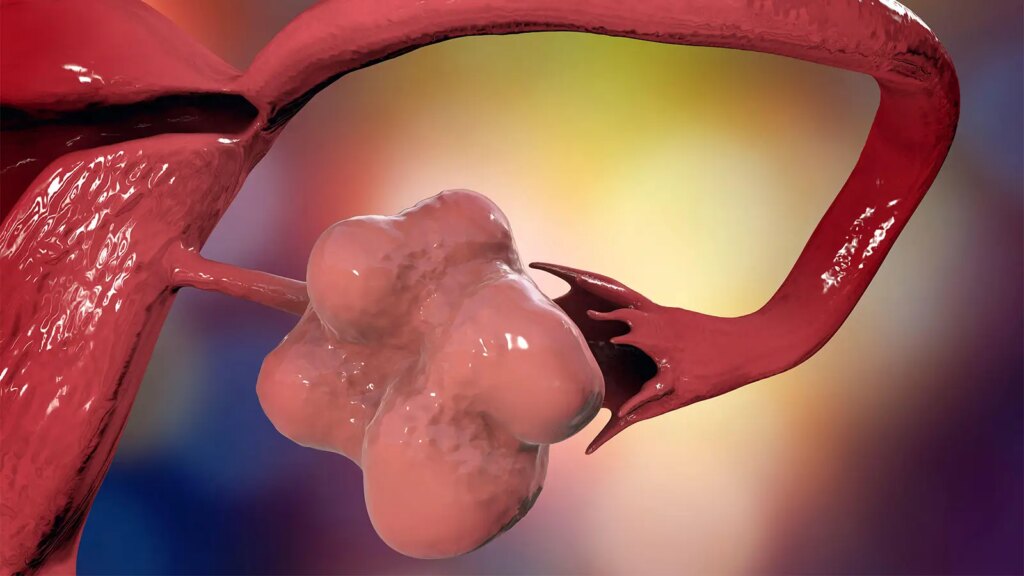
- Experts say the term polycystic ovary syndrome (PCOS) does not accurately reflect the condition and has long led to patient confusion.
- A global consensus process involving patients and clinicians landed on what they say is a more accurate term: polyendocrine metabolic ovarian syndrome (PMOS).
- The name change will be rolled out over the next 3 years.
Polycystic ovary syndrome (PCOS) now has a new name that experts say more accurately reflects the condition: polyendocrine metabolic ovarian syndrome (PMOS).
The change comes after an extensive global consensus process involving patients with the condition and multidisciplinary healthcare providers around the world, reported Helena Teede, MD, PhD, of the Centre for Health Research and Implementation at Monash University in Melbourne, Australia, and colleagues.
By avoiding misleading references to ovarian cysts and accurately reflecting the condition’s diverse and multisystem features, the goal is that the new name will increase awareness, enhance diagnosis, and improve care quality and patient satisfaction, the authors said in a health policy initiative in The Lancet.
“This change was driven with and for those affected by the condition and we are proud to have arrived at a new name that finally accurately reflects the complexity of the condition,” Teede said in a press release.
What has historically been known as PCOS affects one in eight women — about 170 million women globally. Despite being so prevalent, the name PCOS itself has long been recognized as inaccurate and has led to patient confusion for decades. Previous efforts to change the term had stalled.
“[T]he broad clinical features of the condition are not captured in its current name, as although arrested follicular development is common, pathological ovarian cysts are not increased,” Teede and team wrote, noting that the misleading name may contribute to delayed diagnosis, with up to 70% of cases going undiagnosed.
While primarily thought of as a gynecological or ovarian disorder, the condition is more complex, involving endocrine, metabolic, reproductive, psychological, and dermatological factors. Under international guidelines, adults at least 20 years old are diagnosed with PCOS if they meet two of the following criteria following the exclusion of other disorders: oligoanovulation, clinical or biochemical hyperandrogenism, or polycystic ovaries on ultrasound or elevated anti-Müllerian hormone. Adolescents must meet the first two criteria.
Rachel Weinerman, MD, a reproductive endocrinologist at Case Western Reserve University and University Hospitals in Cleveland, told MedPage Today that PCOS’s name change is long overdue and that the new term accurately represents that PMOS is “a metabolic condition that affects multiple parts of a woman’s health, including her reproductive function.”
She said the term “polycystic” had led to unnecessary confusion for patients who may think that having a cyst — a common gynecologic occurrence — meant that they had PCOS. While it will take time for patients and physicians to adjust to new terminology, Weinerman says she thinks the name PMOS will ultimately benefit patients and lead to less confusion over irrelevant cysts.
Anuja Dokras, MD, MHCI, PhD, a physician and researcher specializing in women’s health who directs a multidisciplinary PCOS center in Philadelphia, told MedPage Today that hopefully the term PMOS will bring greater awareness of the condition to clinicians of different specialties and “allow for early diagnosis and more comprehensive counseling regarding risks associated with this syndrome.”
The global consensus process was spearheaded by Monash University’s Centre for Research Excellence in Women’s Health in Reproductive Life, the Androgen Excess and PCOS Society, and the U.K.-based charity and advocacy organization Verity, and ultimately involved 56 leading academic, clinical, and patient organizations.
The team conducted iterative global surveys with responses from 10,411 patients and 3,949 health professionals around the world, as well as workshops to finesse the name and marketing and communication analyses.
The priorities for the new name included scientific accuracy, clarity, stigma avoidance, cultural appropriateness across multiple contexts, and the feasibility of implementation. The new name needed to reflect the condition’s multisystem pathophysiology and make sense in a global context while not replicating common acronyms for other conditions.
The preliminary top-ranked name was polyendocrine metabolic ovulatory syndrome, which was revised to the ultimately selected term polyendocrine metabolic ovarian syndrome.
Now, an eight-stage co-designed implementation strategy to launch the new name is underway. This involves publication and academic dissemination, integration into health systems across a 3-year transition period, and eventual integration into international guidelines, already used by 195 countries, when they are next updated in 2028.
Teede and team noted some limitations, including the disproportionate representation of some higher-income world regions and the possibility of selection bias.
Please enable JavaScript to view the comments powered by Disqus.
Source link : https://www.medpagetoday.com/obgyn/generalobgyn/121254
Author :
Publish date : 2026-05-13 20:51:00
Copyright for syndicated content belongs to the linked Source.