[ad_1]
Improved understanding of the tumor microenvironment and genomics has fueled a new generation of therapies that could lead to better outcomes for esophageal cancer.
Some of those therapies have already made the leap from research to clinical practice, such as zolbetuximab (Vyloy), the Claudin (CLDN) 18.2-directed cytolytic antibody, recently approved for HER2-negative gastric and gastroesophageal cancer. Two phase III trials showed that adding the agent to FOLFOX or capecitabine and oxaliplatin (CAPOX) chemotherapy significantly improved progression-free survival (PFS) and overall survival in newly diagnosed CLDN 18.2-positive unresectable or metastatic gastroesophageal adenocarcinoma.
The emergence of zolbetuximab has solidified CLDN 18.2 as a target for future therapeutic development but also emphasize the need to continue searching for promising therapeutic platforms, said Elizabeth Smyth, MD, of Oxford University in England, during an education session at the American Society of Clinical Oncology (ASCO) meeting in June.
“We need to consider why this is important,” she said. “Absolute rates of gastroesophageal cancer will continue to rise because of demographic changes, despite a reduction in incidence. Our best licensed therapies only lead to a median survival of about 2 years, which far underperforms molecularly targeted therapies in other diseases. There is no room for us to be complacent.”
Many other therapeutic candidates are in various stages of the clinical journey. As an example, the EP4 antagonist ONO-4578 modestly but significantly improved progression-free survival (PFS) in untreated advanced gastroesophageal cancer when added to immunotherapy and chemotherapy (9 vs 6.9 months). In results reported at the ASCO meeting, the PFS benefit was driven by the subgroup with a PD-L1 combined positive score (CPS) ≥1. The safety profile of the EP4 regimen was deemed manageable, including use of medication for gastric ulcerations, said Sung Hee Lim, MD, of Samsung Medical Center in Seoul.
The results are promising and warrant further investigation of ONO-4578 and other EP4 antagonists as first-line therapy for esophagogastric adenocarcinoma, said ASCO discussant Sunnie Kim, MD, of the University of Colorado Comprehensive Cancer Center in Aurora. However, the results also highlight the need for better options for patients with PD-L1 low or negative tumors, a limitation of currently available therapies.
At the ASCO meeting, Smyth reviewed three broad platforms for therapeutic development in gastroesophageal cancer: proximity-based platforms, antibody-drug conjugates (ADCs), and CAR T-cell therapy.
Proximity-Based Platforms
Proximity-based platforms encompass checkpoint bispecific agents, such as a PD-(L)1 inhibitor and a CTLA-4 inhibitor; T-cell engagers, such as one that binds to CLDN 18.2 and CD3; and conditional co-stimulators, such as CLDN 18.2 and 4-BB1 antibodies.
“The trick of these treatments is based on geometry,” said Smyth. “They bring together cells or receptors to create a new or amplified signal.”
Rilvegostomig offers an example of an investigational checkpoint bispecific, combining PD-1 and TIGIT inhibition in a single agent. The STAR-221 trial showed that separate agents inhibiting PD-1 and TIGIT individually did not improve overall survival when given together in advanced gastroesophageal cancer, compared with nivolumab (Opdivo) and chemotherapy.
“Rilvegostomig putatively increases PD-1 binding in the presence of TIGIT co-expression, so it will be very interesting to see whether the bispecific binding will overcome the failure of the individual antibodies,” said Smyth. “In preclinical studies, the bispecific is clearly superior to the individual antibodies.”
A small phase II study of rilvegostomig plus chemotherapy showed confirmed objective responses in 52.9% of patients with untreated advanced gastroesophageal cancer, including almost two-thirds of patients with a PD-L1 combined positive score (CPS) ≥5.
With T-cell engagers, oncologists hope to translate “hugely successful” results in hematology to solid tumors, said Smyth.
“One arm binds a tumor antigen, the other a T-cell marker, usually CD3,” she said. “This forces an artificial immune synapse and leads to T-cell activation without the need for neoantigen presentation. Putatively, this could work in immunologically cold tumors, although clearly you need a sufficient number of T cells for efficacy.”
Targeting CLDN 18.2 with the help of CD3 cells, ASP2138 is furthest along in development, said Smyth. Early clinical studies showed the drug had minimal activity by itself; but when combined with pembrolizumab (Keytruda) and chemotherapy, the response rate increased to almost 70%. Additionally, subcutaneous administration eliminated grade ≥3 cytokine release syndrome.
The novel bispecific conditional co-stimulator givastomig, which binds CLDN 18.2 and 4-1BB, is similar to a T-cell engager but amplifies an existing response as opposed to creating a new immune synapse, said Smyth. Similar to the experience with ASP2138, givastomig had minimal activity by itself in early trials, but the response rate exceeded 70% in combination with nivolumab and chemotherapy (83% with higher doses). The agent has demonstrated a favorable safety profile.
Antibody-Drug Conjugates
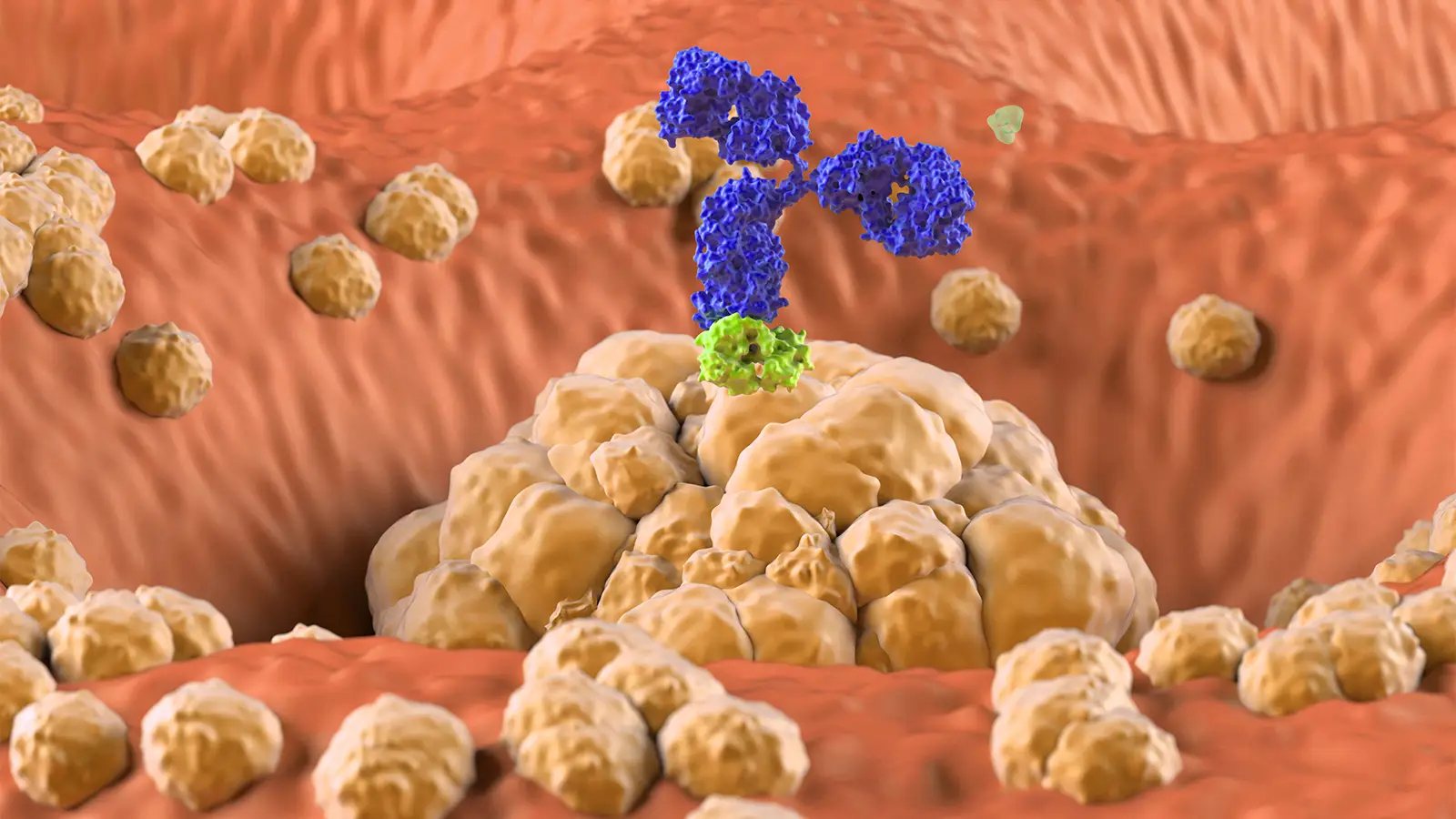
Antibody-drug conjugates (ADCs) require a target that alone is not sufficient for action. To be effective, these drugs also require sufficient combined binding affinity and internalization, said Smyth. With respect to gastroesophageal cancer, trastuzumab deruxtecan (Enhertu) is the prototype ADC, establishing single-agent efficacy in trastuzumab-resistant disease. The agent also has shown preliminary efficacy in HER2-low tumors. ADCs are currently limited by having only two proven cytotoxic payloads, topoisomerase inhibitors and monomethyl auristatin E.
Multiple ADCs targeting CLDN 18.2 have reached late-stage clinical development.
“When you look at the data, the response rates and progression-free survival are fairly consistent across these molecules,” said Smyth. “Sonesitatug vedotin has completed recruitment to the phase III randomized CLARITY trial. If it shows the efficacy demonstrated in phase I/II, that will likely establish it as the first CLDN 18.2 ADC to move into clinic.”
Combination therapy with a CLDN 18.2 ADC is an obvious next step in clinical investigation. Early experience with JS107 plus CAPOX chemotherapy and toripalimab (Loqtorzi) in a phase I study of untreated advanced gastroesophageal cancer showed an 87% overall response rate and median PFS of 11.1 months. However, the results came with a heavy treatment burden, leading to dose interruption in 78% of patients and dose reduction in 29%.
“We should not get overexcited about the response rate,” said Smyth. “Yes, 88% is high. But in my opinion, this treatment is too much for patients. This is triplet chemotherapy plus PD-1. We know triple chemotherapy is not tolerated in esophagogastric cancer. Global registration trials for any ADC in the future will more sensibly look at doublet chemotherapy plus PD-1.”
CAR T-Cell Therapy
CAR-T therapy has had a transformative impact on blood cancers, but solid tumors have proven to be far more challenging.
“CAR-T can cure hematological cancers, but solid tumors are different,” said Smyth. “CAR-T is a process as much as a medicine, with apheresis and manufacture requiring time and bridging chemotherapy and lymphodepletion, which requires fitness that many gastric cancer patients do not have. Unlike CD19 [a common target in hematologic cancers], solid tumor antigens are heterogenous, difficult to reach, and are found in an immunosuppressive tumor microenvironment.”
The first randomized trial of a CAR T-cell therapy for gastroesophageal cancer, conducted in China, met the primary endpoint, achieving an objective response rate of 26% and a median PFS of 3.25 months versus 1.77 months for the control arm.
“There is no doubt this is exciting for a solid tumor,” said Smyth. “However, the comparator, which included some tyrosine kinase inhibitors and other ineffective third-line treatments, was weak; and the long-term survival is unimpressive compared to what we see in hematological cancers.”
“When you take this in context of the onerous requirements for patients, including bridging therapy and lymphodepletion, and the financial resources required, we need better outcomes before this could be justified as a mainstream treatment,” she added.
[ad_2]
Source link : https://www.medpagetoday.com/spotlight/asco-esophageal-cancer/121895
Author :
Publish date : 2026-06-23 21:31:00
Copyright for syndicated content belongs to the linked Source.