
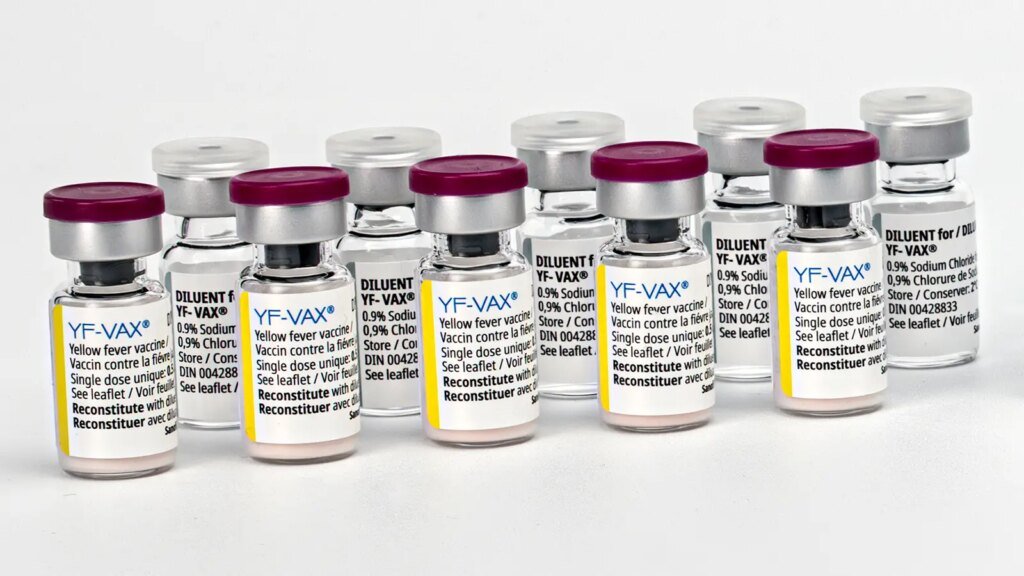
- Yellow fever outbreaks in recent years and subsequent vaccine shortages have highlighted a need for updated shots that can be produced more rapidly.
- To help speed production, an investigational live-attenuated yellow fever vaccine is being developed that is produced in Vero cells instead of eggs.
- In this randomized phase II trial, the novel yellow fever vaccine proved noninferior to the FDA-approved shot for seroconversion at day 29.
An investigational yellow fever vaccine (vYF) that could help avoid shortages matched the immunogenicity and safety profile of the FDA-approved shot (YF-VAX), according to a phase II trial.
In healthy adults with no history of yellow fever infection, seroconversion at day 29 with either of the two live-attenuated vaccines met statistical criteria for noninferiority, at 99.7% and 99.4%, respectively, researchers led by Emmanuel Feroldi, MD, of Sanofi in Lyon, France, reported in the New England Journal of Medicine.
Irrespective of baseline yellow fever serostatus, an identical proportion of vaccine recipients at 1 year had neutralizing antibody titers of at least 1:10 (97.5% in both groups), which is considered likely to be seroprotective.
Unlike YF-VAX and similar versions of the yellow fever vaccine, the vYF shot isn’t grown in eggs.
“The investigational vYF vaccine is a next-generation, live-attenuated yellow fever vaccine grown in serum-free Vero cells and is being developed, in part, to ensure a more sustainable global supply,” Feroldi and colleagues explained, noting that it is derived from YF-VAX’s YF-17D 204 substrain.
With outbreaks of the acute viral hemorrhagic disease expanding in the western hemisphere and beyond, a more scalable, reliable, and faster vaccine production process would be an advantage, Peter Hotez, MD, PhD, dean of Baylor College of Medicine’s National School of Tropical Medicine in Houston, told MedPage Today.
The U.S. has no stockpiles of yellow fever vaccine, Hotez said. If yellow fever were to find its way back into the immunologically naive U.S. population, the results could be “devastating” and reminiscent of deadly 19th-century yellow fever epidemics in Gulf Coast cities such as New Orleans and Galveston, Texas.
Severe outbreaks, such as the one in 2015-2016 in central Africa, can exhaust global emergency vaccine stockpiles, creating shortages and forcing fractional dosing in some countries.
“Yellow fever is the disease that really worries me, and I’ve been sounding the alarm about it for a couple of years,” Hotez said.
Yellow fever’s spread from the Amazon region into more urbanized areas in 2025 highlights the risk. Driven by climate change and urbanization, arboviruses are spreading in countries like Brazil and driving up rates of diseases such as dengue and Zika in the U.S., Hotez noted.
Yellow fever is caused by a flavivirus and spread by infected mosquitoes. The World Health Organization estimates yellow fever causes 67,000-173,000 severe infections and 31,000-82,000 deaths annually, primarily in Africa, but also in Central and South America. In 2025, there were 346 confirmed cases and 143 deaths reported in seven South American countries.
The CDC recommends yellow fever vaccination for those 9 months or older who will be traveling to or living in at-risk areas of Africa or South America.
For the vYF phase II trial, researchers enrolled healthy adults ages 18 to 60 years at 11 U.S. centers from July 2021 to May 2022. A total of 568 participants were randomized to a single injection of either subcutaneous vYF (n=382) or subcutaneous YF-VAX (n=186).
Mean age was 39.7 years, 61.6% were women, and 65.1% were white. At baseline, most study participants didn’t have a history of yellow fever infection or vaccination.
Baseline neutralizing antibody geometric mean titer (GMT) values were the same in the two vaccine groups among participants without a history of yellow fever infection or vaccination, at 1:5. Through day 29 after vaccination, GMTs reached 1:2654 in vYF participants and 1:3147 in YF-VAX participants. At 1 year, vYF GMTs were 1:401, and YF-VAX GMTs were 1:548.
Safety outcomes were similar between vYF and YF-VAX. Solicited post-injection adverse reaction rates were 56.7% in vYF participants and 61.1% in the YF-VAX group, while rates of unsolicited adverse events within 28 days were 26.1% and 21%, respectively. At 6 months, the rates of serious adverse events were 1.6% in the vYF group and 1.1% in the YF-VAX group.
The phase II trial wasn’t powered to detect rare adverse events such as yellow fever vaccine-associated viscerotropic disease, however, according to Feroldi’s group.
Other study limitations included the trial’s location in a country where yellow fever isn’t endemic. The researchers also excluded vulnerable populations such as children, pregnant women, and immunocompromised people.
Please enable JavaScript to view the comments powered by Disqus.
Source link : https://www.medpagetoday.com/infectiousdisease/vaccines/120708
Author :
Publish date : 2026-04-08 22:15:00
Copyright for syndicated content belongs to the linked Source.