
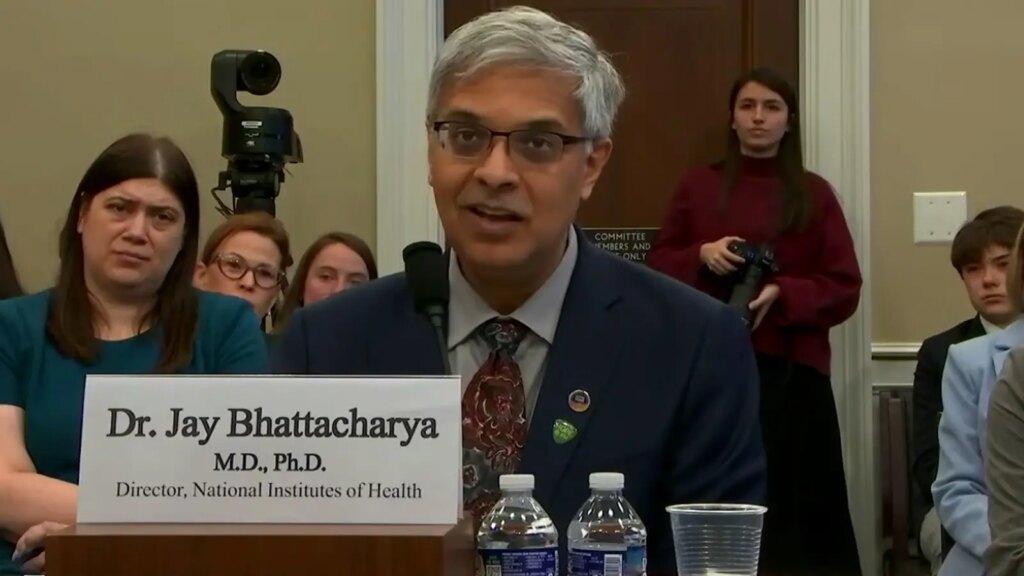
NIH Director — and CDC Acting Director — Jay Bhattacharya, MD, PhD, had little trouble Tuesday responding to questions from House members during an oversight hearing.
“While the promise of the NIH is strong, we must reflect upon policies and evolve with changing technology,” Bhattacharya told members of the House Appropriations Subcommittee on Labor, Health and Human Services, Education, and Related Agencies. “And reform is already underway. A new office within the [Office of the Director] will support rigorous analysis of the NIH portfolio to strengthen performance management, accountability, and promote reproducibility of our research, because … it’s vital that the research that we do is reproducible, that an independent team looking at the same result find the same answer.”
Committee members on both sides of the aisle seemed generally pleased with the way Bhattacharya was running things. “It is encouraging that NIH has been exploring ways to encourage the scientific community to validate or replicate scientific findings,” said subcommittee chair Rep. Robert Aderholt (R-Ala.). “In line with the administration’s goal of making America healthy again, NIH has also renewed its focus on addressing chronic illnesses that affect Americans.”
“I thank you for what you do — your work now, and your past as a scientist and researcher,” said Rep. Rosa DeLauro (D-Conn.), the subcommittee’s ranking member. “I know where you are on grantmaking at NIH.” She asked Bhattacharya to “reassure this committee that NIH grants will be awarded on scientific commitment and not political ideology.”
The Trump administration’s stance on diversity, equity, and inclusion (DEI) was one issue that did raise some tension during the hearing — but only a little. “Federal law requires that NIH, to increase diversity in biomedical workforce, [should increase] recruitment of women and other members of disadvantaged communities, underserved communities, for NIH training grants,” said Rep. Bonnie Watson Coleman (D-N.J.). “Do you have any concrete steps that you’re employing now that would help to recruit more diverse scientists?”
“I think the key thing is empowering early career scientists with greater access to NIH funds so that they can do their work,” said Bhattacharya, adding that “I don’t think there’s anybody that disagrees with me that research that is not rigorous, that is overly politicized, that doesn’t actually have a chance of improving minority health, I don’t want to fund it.”
“I don’t think that that’s the issue,” Watson Coleman said. “We who are concerned about diversity, equity, and inclusion … We don’t understand why it’s summarily dismissed in when we decide what we’re going to award grants to, and how do you reconcile that in your field, in particular with the recognition that diversity is essential?”
Bhattacharya did not answer directly. “You want a line between DEI and not DEI — my line is research that has no chance of actually improving human health, I don’t want to fund that.”
Rep. Michael Simpson (R-Idaho), who formerly worked as a dentist, asked about the value of fluoride. “The National Institute of Dental and Craniofacial Research [demonstrated] that cavities are an epidemic disease and community water fluoridation is a safe, effective, equitable, and economical way to prevent and reduce tooth decay,” he said. “In your recent comments on a podcast episode … you highlighted balancing fluoride’s proven caries-prevention benefits with emerging data on exposure variability and potential risks. What specific research agenda has NIH established on those exposures?”
“Fluoride is essential for oral health, but too-high-level exposure can have neurological impacts and developmental impacts,” said Bhattacharya. “So the key thing is making sure the right dose is delivered in the right way. The key public health [issue] … is identifying what those too-high doses are,” especially for areas that have naturally fluoridated water.
Bhattacharya also was asked some questions about his temporary role at CDC; DeLauro wanted to know what he was planning to do to retain staff so that CDC “does not become just a grantmaking agency.”
Bhattacharya responded that although he was critical of the agency during the COVID-19 pandemic, since he has become acting director he has seen that “There are a tremendous amount of professionals at the CDC that care deeply about public health … There is a real openness to discuss things where there are disagreements within public health.”
He said that although he was initially “in despair” about taking on this second job, “I’ve come out of it with an increasing sense of hope … I’m committed to making sure that whoever the next director is has a CDC that’s working well.”
Rep. Madeleine Dean (D-Pa.) noted that she has a friend with Parkinson’s disease and asked about the CDC’s efforts related to it. “In 2024, Congress passed a law establishing the National Parkinson’s Project; one element of this initiative is the [CDC’s] Parkinson’s Advisory Council,” she said. “Its report to Congress was due Jan. 1, but we’ve not received it. I’m particularly troubled by the fact that the Advisory Council hasn’t even been announced yet. So, Dr. Bhattacharya, when can Congress expect the report? And when will you announce members of the council?”
“I know the report’s delayed,” Bhattacharya said. “We’re working on it. It should be sometime in the next couple of months. I can’t give you an exact timeline, but it’s a priority.” As for naming members of the advisory council, “this is one of those things where I just arrived at CDC 3 weeks ago. I’m trying to figure out what the backlog is, so that’s something I’m focused on.”
Please enable JavaScript to view the comments powered by Disqus.
Source link : https://www.medpagetoday.com/publichealthpolicy/healthpolicy/120352
Author :
Publish date : 2026-03-17 21:44:00
Copyright for syndicated content belongs to the linked Source.