


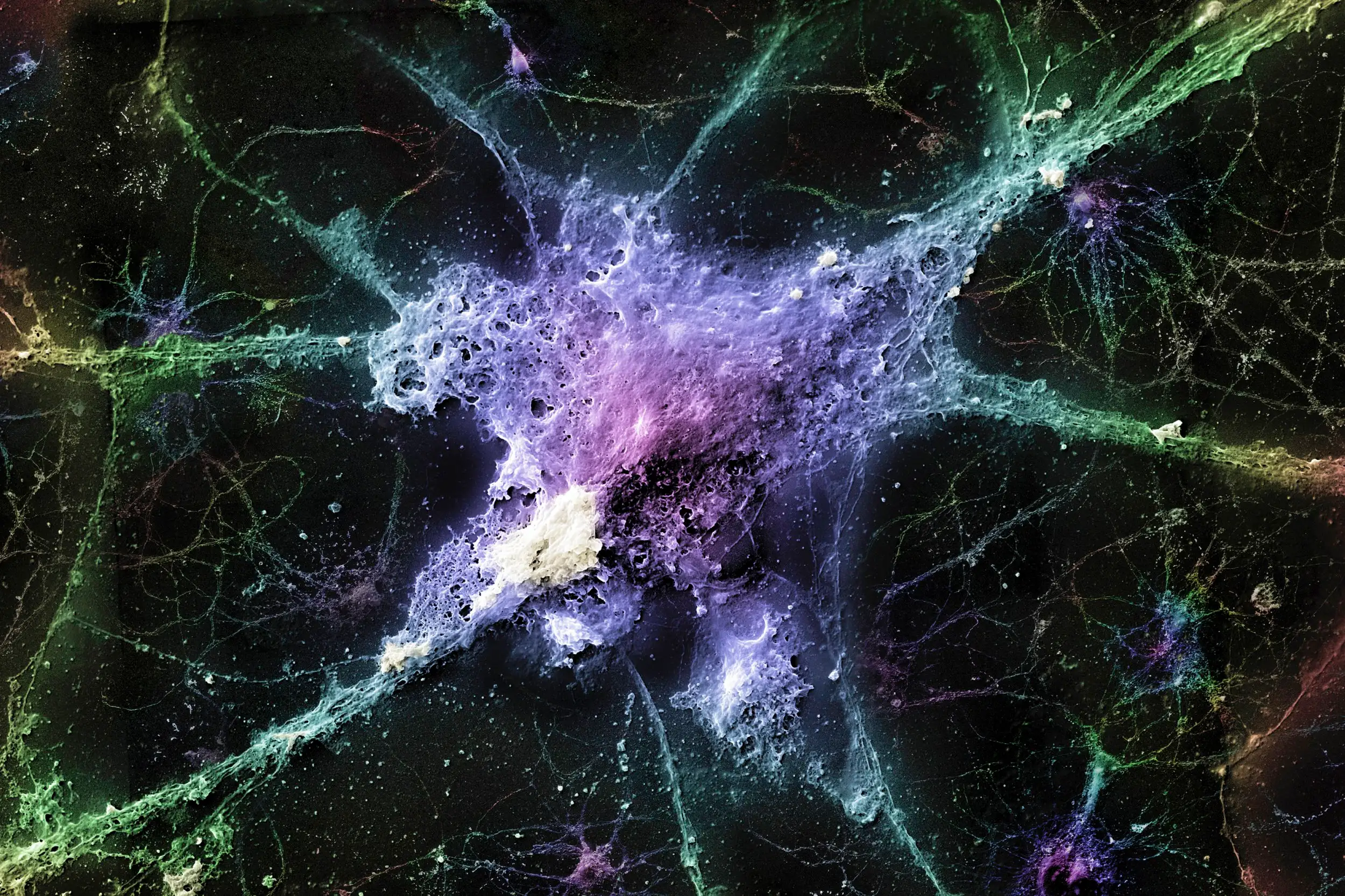
A scanning electron micrograph of a mouse nerve cell that is affected by misfolded versions of the proteins amyloid and beta, which are thought to drive Alzheimer’s disease
LINNEA RUNDGREN/LINEAR IMAGING/SCIENCE PHOTO LIBRARY
Interest is growing in using the brain’s waste-disposal system to delay or ease Alzheimer’s disease. Now, a new technique that helps clear toxic clumps of Alzheimer’s-associated proteins from the brains of mice has been found to boost their performance on memory and learning tests.
This is done by targeting a receptor, called DDR2, that is more commonly being investigated for lung health. “If you’re blocking the DDR2 pathway, theoretically there will be less amyloid-beta protein produced and, at the same time, it will boost the waste clearance for the protein,” says Jia Li at Guangzhou Medical University in China. “So, we’re hoping it can finally reverse Alzheimer’s.”
The build-up of misfolded proteins known as amyloid plaques and tau tangles in the brain is widely thought to trigger Alzheimer’s disease. Drugs can remove amyloid clumps, but this hasn’t translated into a large improvement in Alzheimer’s symptoms. Efforts are now increasingly pivoting towards other approaches, such as boosting the glymphatic system, which clears waste from our brain.
Li and his colleagues are building on this, by zooming in on a receptor embedded in the membrane of cells that seems to enhance glymphatic action as one of its many functions. DDR2 (discoidin domain receptor 2) is being investigated by Jin Su – a member of Li’s team who is also at Guangzhou Medical University – for pulmonary fibrosis. This lung condition occurs when the network of proteins surrounding cells – known as the extracellular matrix – becomes dysfunctional, resulting in too much of the structural protein collagen being deposited, which restricts cells’ oxygen supply.
There have been signs that dysfunction of the extracellular matrix is linked to amyloid and tau proteins being deposited in Alzheimer’s, with similar effects. “This blocking of oxygen could be what causes problems with thinking or remembering,” says Li.
To investigate DDR2’s involvement, the researchers started off by looking for it in databases of human tissue, finding that it is hardly ever seen. But when they looked in samples from the brains of people with Alzheimer’s, they found lots of it. “We are the first to confirm that DDR2 is found in high abundance in Alzheimer’s brain tissue,” says Su.
Through a series of experiments in human and non-human primate cells, and mouse models of Alzheimer’s, the researchers believe DDR2 regulates the cellular dysfunction that causes the disease’s symptoms.
This is based on the fact that three cell types seem to increase the amount of DDR2 in their membranes during Alzheimer’s disease. The first are reactive astrocytes, which surround amyloid-beta clumps; the second are perivascular fibroblasts, which alter their activity before the onset of Alzheimer’s; and the third are choroid plexus epithelial cells, which are important for cerebrospinal fluid production – crucial to the glymphatic system.
These results suggest that targeting DDR2 could influence multiple aspects of Alzheimer’s disease at once, says Shiju Gu at Harvard University. But given how complex the condition is, “I will put a big question mark here in terms of reversing Alzheimer’s”, he says.
Next, the researchers developed a monoclonal antibody to target and eliminate DDR2 receptors. In a mouse model of Alzheimer’s, this improved both spatial learning and memory, with brain scans showing a reduction in DDR2, fewer amyloid plaques and a stronger glymphatic system.
“The mouse results are overall encouraging and, within the limits of a mouse model, fairly impressive,” says Gu. “It reiterates the significance of glymphatic function and brain fluid dynamics in brain health. This suggests DDR2 is a legit target for potential Alzheimer’s treatment.”
César Cunha at the Novo Nordisk Foundation Center for Basic Metabolic Research in Denmark likes that the researchers are going beyond just targeting amyloid plaques, but he says the mice modelled a relatively rare type of Alzheimer’s disease that is inherited and appears earlier than is typical. It’s unclear if the antibody would function as well in the more common late-onset Alzheimer’s, he says.
Yet Su argues that DDR2 upregulation is seen in people with both familial and late-onset Alzheimer’s, suggesting that the treatment would have broad efficacy. DDR2 expression also seems to be increased by ageing and hypoxia, she says, which are both risk factors in late-onset Alzheimer’s.
The researchers are now doing a clinical trial that uses a tracer to monitor DDR2 levels in the brains of people with Alzheimer’s to determine where to direct the antibody, says Li. They are also developing a smaller antibody to more efficiently cross the blood-brain barrier.
Topics:
Source link : https://www.newscientist.com/article/2522065-novel-approach-to-clearing-brain-waste-shows-promise-for-alzheimers/?utm_campaign=RSS%7CNSNS&utm_source=NSNS&utm_medium=RSS&utm_content=home
Author :
Publish date : 2026-04-06 12:00:00
Copyright for syndicated content belongs to the linked Source.