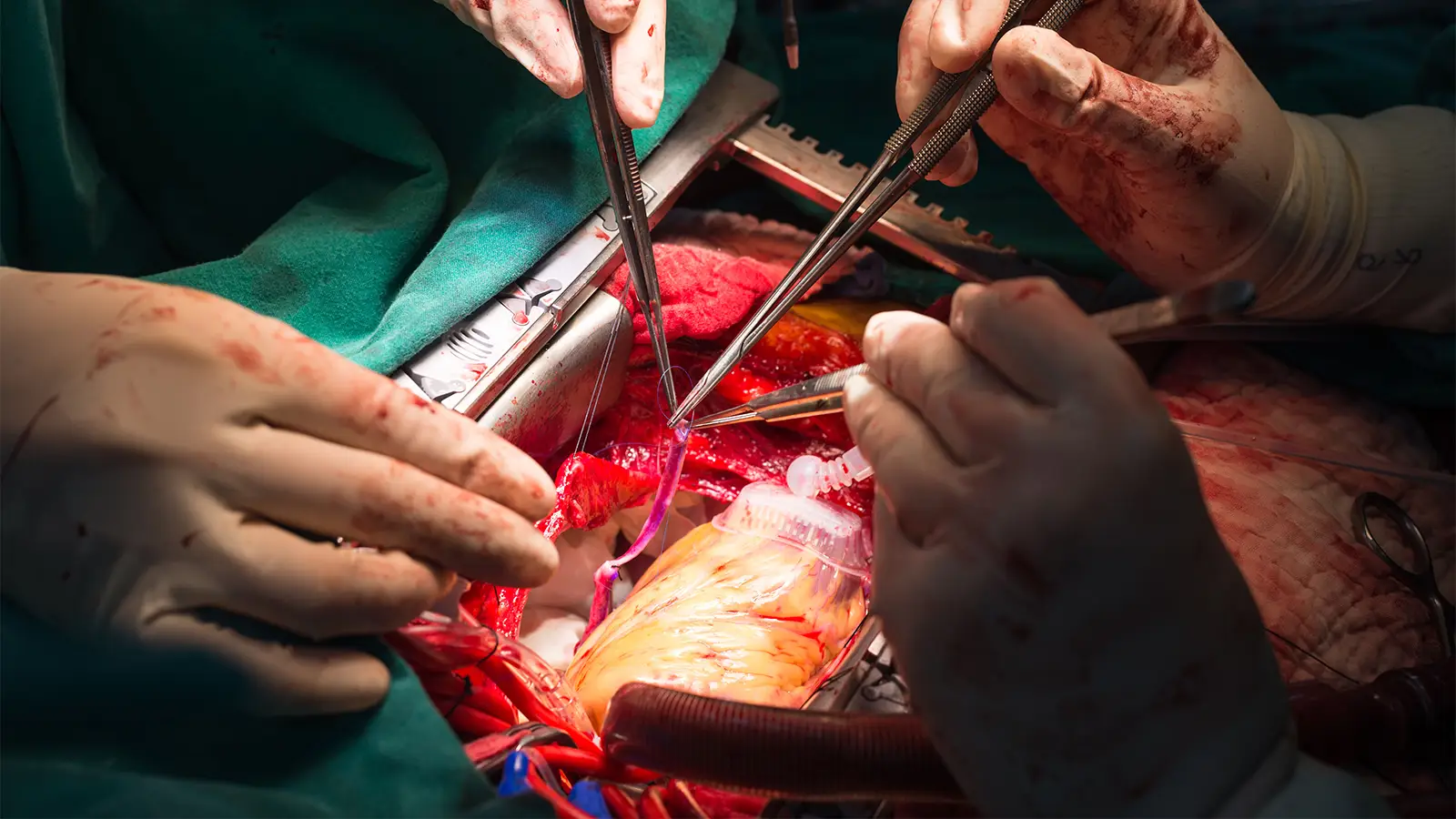
- A surge of cardiac troponins appeared to be the norm even after uneventful coronary artery bypass graft (CABG) surgery, a prospective study confirmed, and how high these biomarkers go depended on the exact assay used.
- Investigators directly compared the postoperative concentrations of cTnT and cTnI using the same blood samples and found consistently higher cTnI concentrations.
- The cTnI results alone more frequently crossed several proposed thresholds defining perioperative MI, leaving researchers doubtful of what a biomarker release actually means in cardiac surgery.
A diagnosis of perioperative myocardial infarction (MI) from coronary artery bypass grafting (CABG) surgery was hardly set in stone, a prospective study found, with different cardiac troponin (cTn) assays and thresholds producing strikingly discordant results.
After isolated uneventful CABG, median postoperative peak values were 349 ng/L for cTnT and 1,517 ng/L for cTnI (corresponding to 25×99th percentile upper reference limit [URL] and 58×99th percentile URL, respectively), with peak values of these biomarkers most frequently observed on the first postoperative day, according to a group led by Luca Koechlin, MD, of University Hospital Basel in Switzerland.
Whether a troponin release during cardiac surgery actually reached the level of perioperative MI varied according to the threshold used. However, cTnI values more often put patients into the category of perioperative MI compared with cTnT, even as the bar went higher and higher:
- Fourth Universal Definition of Myocardial Infarction (>10x99th percentile URL alone or with 20% increase if elevated at baseline): 72.4% of patients exceeding threshold based on cTnI vs 60.0% based on cTnT (P<0.001)
- Academic Research Consortium-2 (>35×99th percentile URL): 69.2% vs 30.0% (P<0.001)
- VISION trial (218×99th percentile URL): 8.8% vs 2.4% (P<0.001)
- European Association of Cardio-Thoracic Surgery suggestion of 500xURL: 2.8% vs 0% (P=0.016)
“In conclusion, cTnT and cTnI differ in their postoperative concentrations following uneventful CABG surgery,” Koechlin and colleagues wrote in the Journal of the American Heart Association. “This has major clinical and academic implications, as the choice of assay can influence the incidence of PMI [perioperative MI] by up to 300%. Such variability results in considerable uncertainty and misinformation for both patients and physicians.”
Guidelines and consensus statements currently “equalize” cTnT and I on assumptions that they reflect the same pathophysiological processes and are equally effective in their diagnostic and prognostic performance, they noted.
Hence the larger question of what any of these biomarker releases actually mean in cardiac surgery. Perioperative MI has long been a key source of contention in trials comparing CABG against percutaneous coronary intervention (PCI) for coronary artery disease, with surgeons arguing that this imperfect metric puts CABG in a worse light than deserved in reality.
“If the currently possible conclusion of significant myocardial injury induced by cardiac surgery using cardiopulmonary bypass were true, it would be difficult to explain the repeatedly observed survival advantage found for coronary artery bypass grafting compared with both medical and interventional treatment of chronic coronary artery disease,” noted Tulio Caldonazo, MD, MSc, and two colleagues from the University of Jena in Germany in an accompanying editorial.
Indeed, cTn can be released where there is no cell death at all, they explained.
“Endurance athletes, animal models exposed to brief inotropic stimulation, and in vitro systems subjected to transient flow changes all demonstrate substantial biomarker elevations without true myocardial necrosis,” Caldonazo’s group wrote. “In cardiac surgery, additional procedural factors such as atrial manipulation during cannulation or concomitant valve interventions contribute further to biomarker release that does not reflect ventricular ischemia.”
“These non-cell-death mechanisms may explain the poor correlation between postoperative enzyme levels and long-term outcomes seen across recent clinical trials,” the editorialists wrote.
Koechlin and colleagues also pointed to prior work showing that the majority of CABG patients exceed the current guideline-recommended cTn thresholds — “arbitrarily chosen,” in their words — and that only a very high bar for troponin release would have a prognostic impact.
“These findings challenge the proposed cutoffs, as a substantial proportion of patients with an uneventful postoperative course — characterized by no significant decrease in left ventricular ejection fraction and confirmed patent bypass grafts — fulfill these criteria, potentially leading to overdiagnosis and uncertainty among treating clinicians,” they reported.
Their study had been presented in the fall at the European Association for Cardio-Thoracic Surgery annual meeting. It is part of an ongoing single-center study evaluating the diagnostic accuracy of biomarkers for early bypass graft occlusion detected in routine postoperative CT after isolated CABG surgery.
Study authors included adults who underwent isolated CABG and came out with patent bypass grafts on postoperative CT, without a ≥10% decrease in left ventricular ejection fraction, and no unplanned PCI during the hospital stay.
cTnT and cTnI were evaluated in the same patients from the same blood samples, the assays performed in a core laboratory using hs-cTnT-Elecsys Generation 5 and hs-cTnI-Alinity. All measurements were taken immediately after sample collection from fresh blood.
The study cohort came out to 258 CABG patients (median age 69 years, 16% women) who had a baseline median ejection fraction of 55%. The CABG was elective in 72% of cases and done on-pump in 75%. Median cardiopulmonary bypass time was 99 minutes. After surgery, patients were in the intensive care unit for about 1 day and in the hospital for 7.
When echocardiogram and ECG criteria were considered in the definition of perioperative MI, the gap between cTnT and I shrank somewhat but remained evident, Koechlin’s group reported.
Study authors acknowledged that the study could have been underpowered for some comparisons and may have missed some factors influencing the release dynamics of cTnT and cTnI, among other limitations.
Caldonazo and colleagues said they were also looking to study the meaning of biomarker release in cardiac surgery. Their ongoing prospective observational study in Germany (RORSCHACH) will see if troponins and creatine kinase-myocardial band can be correlated to the amount of myocardial cell death evident on cardiac MRI.
Preliminary results of RORSCHACH are expected by the end of 2026, they said.
Source link : https://www.medpagetoday.com/surgery/thoracicsurgery/120870
Author :
Publish date : 2026-04-20 21:29:00
Copyright for syndicated content belongs to the linked Source.