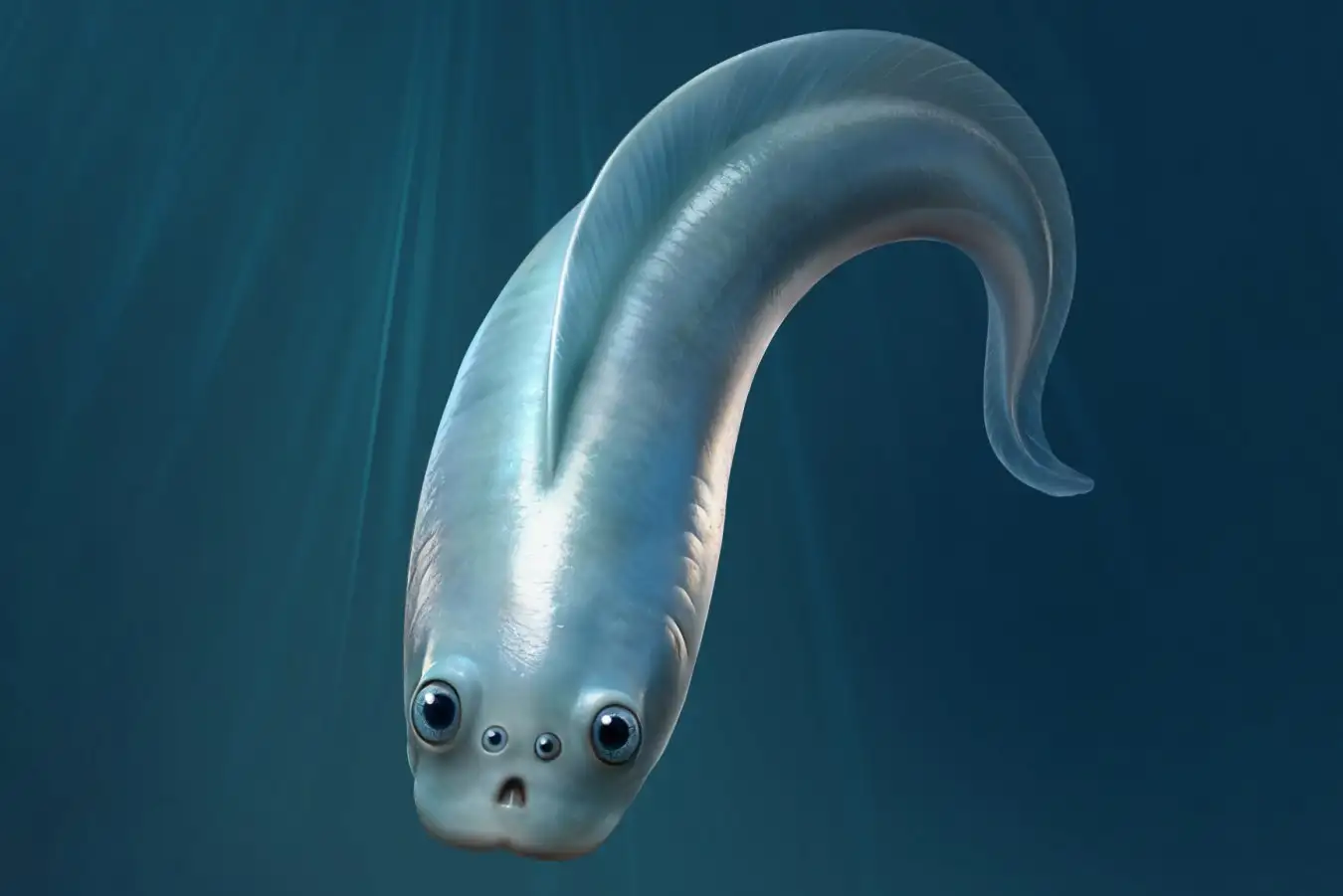
Illustration of Haikouichthys, a fish from the Cambrian period, with a second pair of eyes suggested by fossil evidence
Xiangtong Lei, Sihang Zhang
Over half a billion years ago, the world’s oldest known vertebrates seem to have sported an extra set of eyes – and humans may still carry a remnant of this ancient evolutionary innovation.
Extraordinary fossils of two species of jawless fish called myllokunmingids were found by Peiyun Cong at Yunnan University in China and his colleagues between 2019 and 2024, on the banks of Dianchi Lake in south-west China.
The ancient life forms found in this area, known as the Chengjiang biota, are preserved in exquisite detail. They date from around 518 million years ago, during a period known as the Cambrian, when life exploded in diversity, creating most of the major animal groups alive today.
Importantly, the vertebrate fossils found by Cong’s team included preserved soft body parts and the creatures’ eyes.
Complex eyes evolved independently in several groups of animals. Some invertebrates, such as insects, have compound eyes made up of hundreds or thousands of separate units, each with its own lens, cone and light receptors, together creating a mosaic image.
Vertebrates, such as humans and reptiles, have what scientists describe as camera-type eyes. Our eyes consist of a spherical lens, a retina, an iris and muscles that control their movement. They also contain pigmented structures called melanosomes, which among other things determine our eye colour.
Light is focused on the retina, creating signals that are transmitted to the brain through the optic nerve.
When Cong and his colleagues studied the fossils under an electron microscope, they could see a pair of eyes on the side of the head with preserved melanin-containing melanosomes, as well as two mysterious, much smaller, black smudges in between.
“More strikingly, there is also an impression of a lens in each of the lateral eyes and centrally-positioned eyes,” says team member Jakob Vinther at the University of Bristol in the UK.
Vinther says this evidence suggests that these animals had two pairs of camera-type eyes. “This would have enabled these 518-million-year-old vertebrates to form an image of their world much like we do,” he says. “But a key difference is that they used four eyes and not just two.”
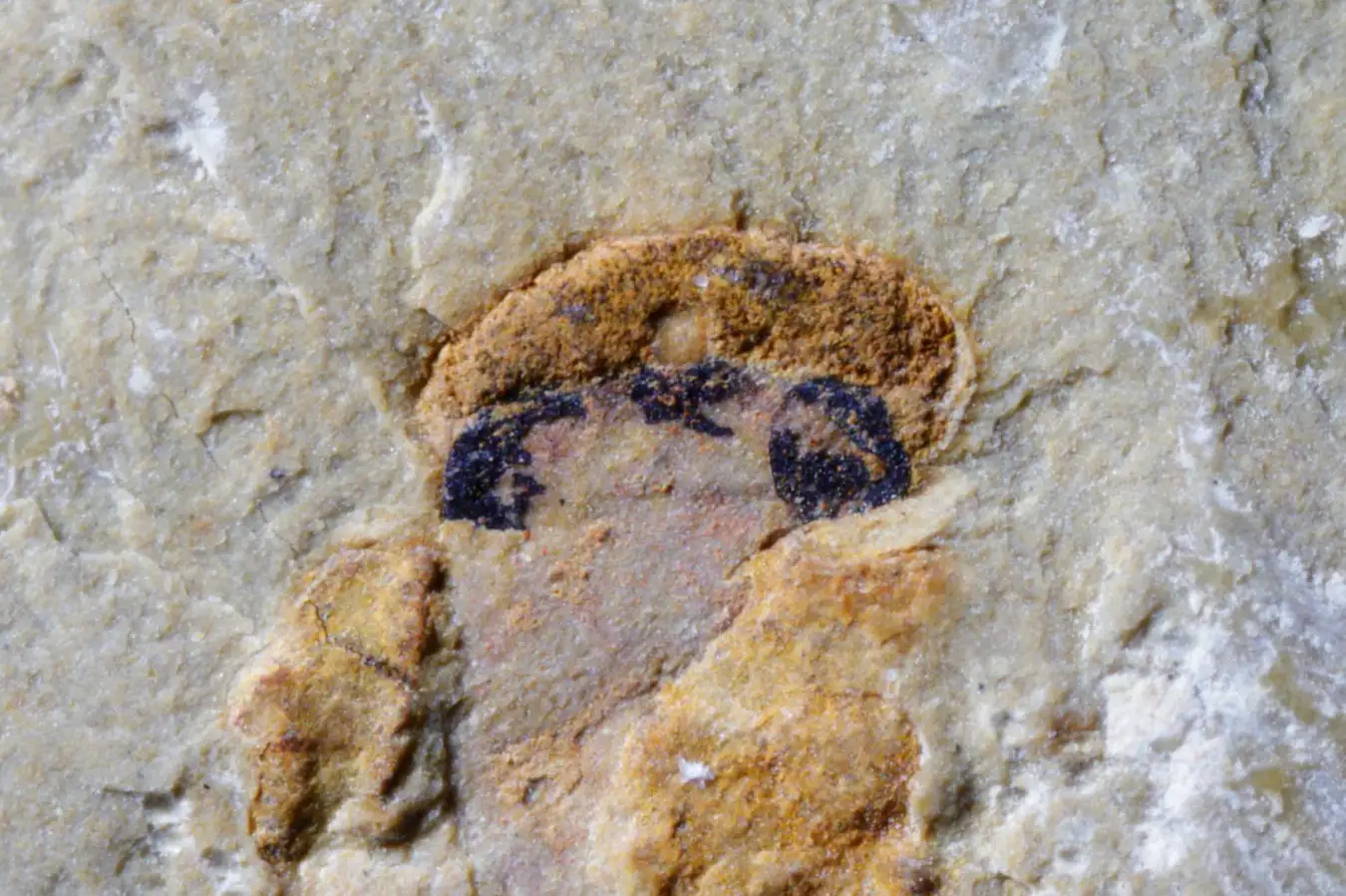
A fossil of Haikouichthys showing the preserved melanosomes
Xiangtong Lei, Sihang Zhang
The team believes that this ancient, extra pair of eyes went on to evolve into a set of organs known as the pineal complex. Some vertebrates such as reptiles still have a light-sensitive organ at the top of the head called the parietal eye, but in mammals, the complex consists of only the pineal gland, which regulates our sleep cycle by secreting melatonin.
“We show [the pineal organs] had a more important function as eyes in the early vertebrates and could create somewhat of a decent image before they evolved into organs regulating our sleep cycle,” says Vinther.
The big eyes were probably better for seeing things in high resolution, he says, while the smaller eyes would have helped the animal to spot objects approaching it. This would have provided a slightly different field of view, important in Cambrian seas where these jawless fish would have been a desirable meal.
“They likely could see objects quite well, telling their shape and some degree of three-dimensionality,” says Vinther. “They likely also had a broad view of their surroundings, sort of IMAX-style, thanks to their four eyes.”
Tetsuto Miyashita at the Canadian Museum of Nature in Ottawa says he is “half believing and half recoiling from this new, fascinatingly original interpretation” of these fossils.
The structures visible between the lateral eyes of these fossils have long puzzled researchers and it is a “light bulb” moment to realise they may be another set of camera eyes, he says.
But if they are eyes, that would raise the question: where is the nose? “So much about early fish evolution revolves around the nose, so not having one preserved is unlikely from a developmental standpoint,” he says.
Miyashita predicts there will be substantial debate until experts can see “eye to eye”. “Does it really make so much sense to have so many prominent eyes on the head?” he says.
John Paterson at the University of New England in Armidale, Australia, says it makes sense that these prey species “developed that type of vision, just to avoid scary predators coming after them”.
“The Cambrian is a bit of a weird time when you see animals doing strange things for the first time in an evolutionary sense, where it’s not just always a pair of eyes looking to the side or looking forward – but you can actually have eyes on other parts of the head.”
Karma Nanglu at the University of California Riverside says he would like to see detailed mapping of the entire body of the fossils to see whether there are any other similar markings elsewhere, which may indicate that the second set of eyes is in fact just an artefact of the chemistry of fossilisation.
Dinosaur hunting in the Gobi desert, Mongolia
Embark on an exhilarating and one-of-a-kind expedition to uncover dinosaur remains in the vast wilderness of the Gobi desert, one of the world’s most famous palaeontological hotspots.
Topics:
Source link : https://www.newscientist.com/article/2512668-our-earliest-vertebrate-ancestors-may-have-had-four-eyes/?utm_campaign=RSS%7CNSNS&utm_source=NSNS&utm_medium=RSS&utm_content=home
Author :
Publish date : 2026-01-21 16:00:00
Copyright for syndicated content belongs to the linked Source.